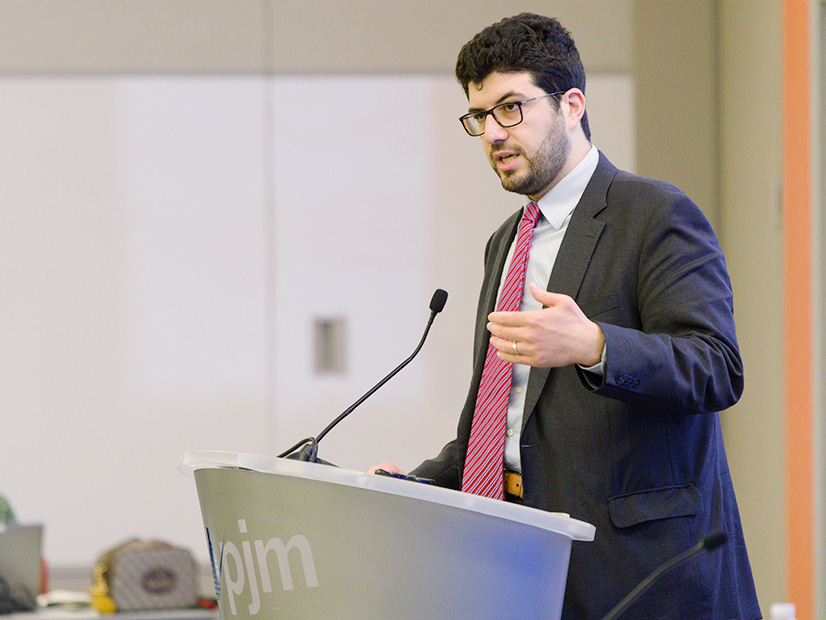
PJM member states are seeking the ability to nominate two candidates to the RTO’s Board of Managers as they grow increasingly vocal about their dissatisfaction with the affordability and reliability of the grid.
During the Members Committee meeting July 23, Virginia Energy Director Glenn Davis read a statement from nine state governors calling the status quo unsustainable and arguing PJM must take concerted, rapid action, including a new vision for how the RTO interacts with the states.
To that end, the governors called for a permanent process for the states to nominate candidates to fill two of the seats on the nine-member board. Candidates are selected by the Nominating Committee (NC), which is composed of representatives from each of PJM’s five membership sectors and three from the Board of Managers. Nominees are approved by the MC.
The statement was signed by the governors of Delaware, Illinois, Kentucky, Maryland, Michigan, New Jersey, Pennsylvania, Tennessee and Virginia. They argued there should be a formal role recognizing the shared responsibility of PJM and its member states to ensure affordable and reliable electric service.
That could take the form of a new organization where representatives of governors’ offices publicly meet with RTO leadership and stakeholders, they wrote. Such an association would allow the states to better understand the political and economic ramifications of data center load, and it would provide PJM with more intimate knowledge about the policymaking and discussions occurring in statehouses, they argued.
The governors had requested a meeting with the NC to recommend two candidates to fill open seats on the board and speak to their merits in a letter to the board July 16. They argued there is a crisis of confidence in the grid operator’s leadership that requires the appointment of “distinguished, widely respected individuals.” The governors said they have several candidates in mind.
“At a time of rapidly rising load growth, PJM’s multiyear inability to efficiently connect new resources to its grid and to engage in effective long-term transmission planning has deprived our states of thousands of jobs and billions of dollars in investment that may flow to other regions,” the governors wrote. “Now these deficiencies threaten the bedrock reliability and affordability our consumers expect and deserve. We are deeply concerned that PJM’s response has been typified by halting, inconsistent steps and rising internal conflicts within the stakeholder community that have recently culminated in the abrupt termination of two longstanding members of the Board of Managers and the imminent departure of the CEO.”
The NC responded with its own letter declining to meet with the states, stating that it felt that a wider conversation open to all the RTO’s stakeholders would be more beneficial. The committee also said PJM’s Code of Conduct prohibits it from considering candidates who had not submitted applications to the independent consultant retained for the candidate search, Korn Ferry.
The board also responded, inviting the states to attend the July 23 MC meeting and outlining PJM’s efforts to operate markets capable of delivering reliability at least cost while navigating an “explosion of demand growth” and generation deactivations, some of which have been prompted by state policies.
The nine governors (along with those of the other four states in PJM: Indiana, North Carolina, Ohio and West Virginia) are also planning to hold a technical conference to publicly discuss “organizational and market reforms at PJM, and to establish an active participatory role for member states and jurisdictions.” The conference is scheduled for Sept. 23 at the National Constitution Center in Philadelphia. Ohio Gov. Mike DeWine supported the nomination proposal in his own letter.
PJM and Stakeholder Responses
PJM Senior Vice President of Governmental and Member Services Asim Haque said staff have been very engaged with state executives and legislators. He said one of the most controversial decisions PJM has recently made was entering into a settlement with Pennsylvania Gov. Josh Shapiro to lower the maximum capacity clearing price and establish a price floor. (See FERC Approves PJM-Pa. Agreement on Capacity Price Cap, Floor.)
“Expect for that engagement to continue, and should you form a formal organization, we would support that as well,” he said.
He added that PJM already spends a great deal of time working with the Organization of PJM States Inc. (OPSI), though he said that does not mean the RTO could not engage with another organization representing state interests.
CEO Manu Asthana said the states have a major role in PJM, and their priorities deserve careful attention.
“I think we should build upon the excellent participation and voices of the states we already have at OPSI,” he said.
Jacob Finkel, Shapiro’s deputy secretary of policy, said the governors have a desire to play a more active role in PJM decision-making than the more responsive position OPSI has often been forced to take.
Paul Sotkiewicz, president of E-Cubed Policy Associates and former PJM chief economist, said he believes the notion that states should have a role in selecting board membership comes dangerously close to violating PJM’s independence, adding that RTOs are not a creature of the states, but rather of the federal government.
Sotkiewicz questioned whether states seeking greater engagement with PJM are prepared to take ownership and responsibility for RTO decisions and their consequences.
Finkel said the final decision over board appointments would remain with the PJM Members Committee, and the governors are not seeking anything that would run afoul of FERC Order 2000. Rather, they want to avoid PJM coming to state capitols and explaining that its markets are not functioning properly or interfacing well with state policies by having the states play a role in getting the market design right in the first place.
Board Chair David Mills said he doesn’t believe PJM has come to the states to say it has bungled market design, but out of a desire to collaborate. Those efforts can be undermined, however, when state officials discredit the RTO or make threats to withdraw, which can harm investor confidence, he said.