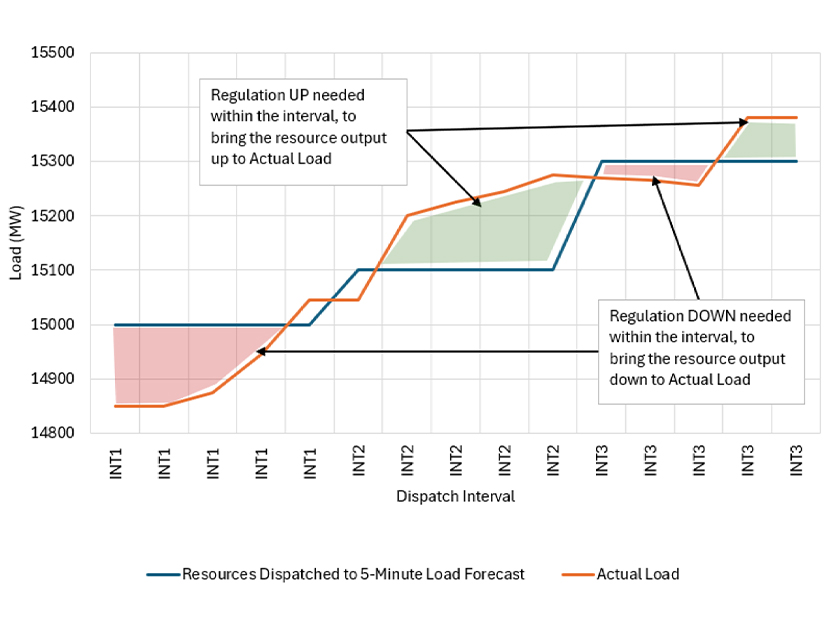
IESO will seek to fill its growing need for regulation services through competitive bids but will resort to bilateral procurements if there is insufficient interest, officials told stakeholders July 24.
IESO’s most recent Annual Planning Outlook found the ISO will need 30 MW of additional regulation as soon as next year — with needs growing to 100 MW by 2029 — as a result of expected increases in industrial loads such as electric arc furnaces.
Regulation is one of several capabilities IESO uses to keep its supply and demand in balance, including inertial response, the stored kinetic energy of rotating equipment tapped immediately following a system event; primary frequency response, the automatic adjustment of energy output by generators within seconds of an event; and operating reserves, which the ISO calls on within 10 minutes or 30 minutes of an event.
Regulation resources respond to IESO instructions within five minutes of an event, after primary frequency response and before operating reserves.
Requirements
Generators providing regulation must be dispatchable, able to follow automatic generation control signals every two seconds or less and have an energy ramp rate of at least 50% of the offered regulation capacity per minute. A resource offering 20 MW of regulation, for example, would be required to move at least 10 MW/minute to reach its setpoint. IESO proposes a minimum regulation capacity of ±10 MW.
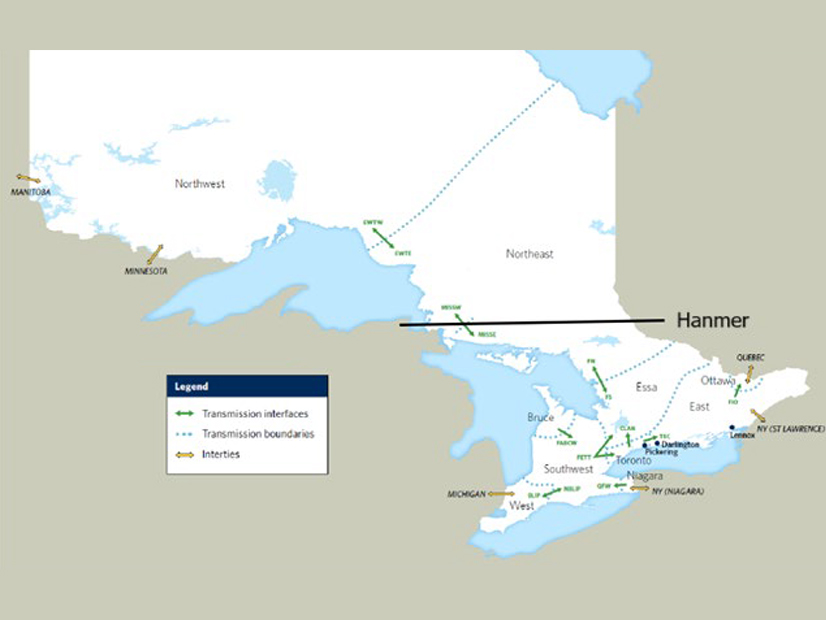
The ISO is seeking regulation only from facilities located south of Hanmer because severe weather in the Northwest zone and transmission congestion in the Northeast can restrict generation.
Storage currently is not eligible to provide regulation, but the capability will be added in future market rules under IESO’s Enabling Resources Program, the ISO said. (See IESO Seeks Feedback on Revised Storage Model.)
In addition, IESO’s dispatch scheduling software is unable to simultaneously schedule operating reserve (OR) from a resource providing regulation. As a result, resources providing regulation will receive real-time OR lost opportunity costs to make them whole for the OR revenue they would have received.
Because regulation is a reliability service, IESO does not need a government directive to procure it. The ISO could enter bilateral negotiations with facilities meeting technical requirements, or seek competitive bids, said Natalia Perdomo, an adviser in IESO’s market and system adequacy team.
“The ISO’s preference is a competitive procurement, as we believe it can provide better value for the ratepayer,” she said. “However, if there isn’t enough interest, the ISO can engage in bilateral negotiations.”
Next Steps
The ISO asked for written feedback by Aug. 8 via engagement@ieso.ca. It expects to decide on its procurement mechanism in the fourth quarter.
“If we do an RFP, the hope is that it would commence in 2026,” IESO’s Dina Shoukri said in response to a question about the timing and duration of the procurement.
“[The] duration of the contract, that is something we would have to determine,” she added. “A lot of the answers to those questions are going to be informed by the feedback we get. So, once we understand availability, readiness to deliver, how much is out there, it will help to inform the answers to those questions.”