The federal government’s rollback of incentives for renewable energy has thrown a wrench into MISO’s work to develop four new transmission planning scenarios.
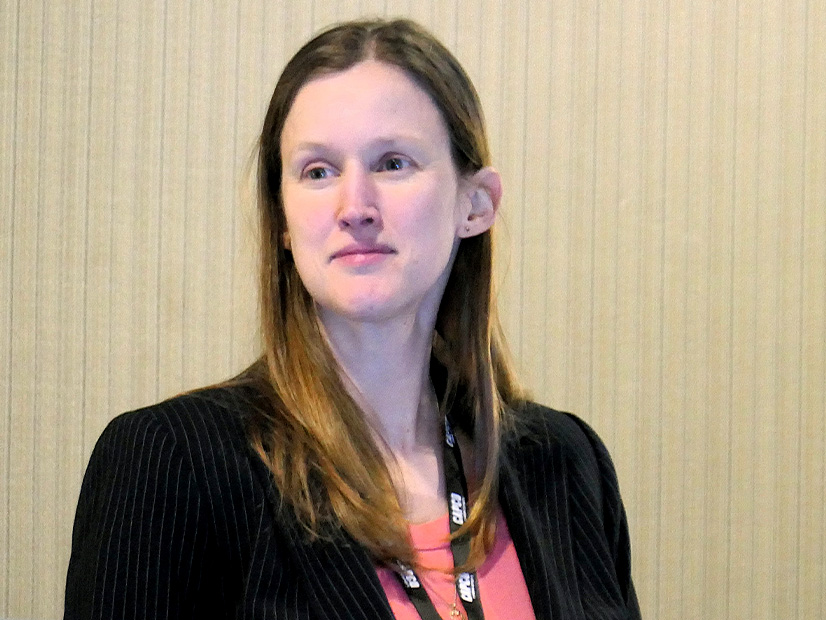
Laura Rauch, MISO executive director of transmission planning, said that because of the One Big Beautiful Bill Act, signed into law July 4, the RTO will extend its timeline for establishing its four 20-year transmission planning futures.
Rauch said MISO will remove all investment and production tax credits for wind and solar generation in its equation for the future scenarios to match the sweeping federal law. She said the deletion is set to affect the futures’ generation expansion assumptions, though MISO does not yet know to what degree.
“We plan on having that answer at the end of the year,” Rauch said during a July 29 meeting of the Entergy Regional State Committee. She added that state and member goals would now become the major driver of renewable energy expansion in the RTO’s territory.
“My expectation is that it will affect renewable expansion, but you still will have demand driven by the member goals and relative economics,” Rauch told MISO South regulatory staffs.
Rauch said MISO’s work on its futures until now can be considered “informational” and provide insight into how renewable expansion might have played out had the federal incentives survived.
Despite the pause to rework its futures, Rauch said MISO’s billions of dollars’ worth of past long-range transmission planning still holds up as beneficial and useful because it was based primarily on member plans and comparatively low load increases. (See MISO Board Endorses $21.8B Long-range Transmission Plan.) Rauch said she is not “seeing any risk” that generation construction would slow given rising demand and the fact that members’ carbon-reduction goals remain unchanged.
“We have not seen a big change in our members’ goals with the One Big Beautiful Bill Act,” Rauch said.
MISO’s futures include “Lower Load Growth,” “Stated Policy” and “Higher Load Growth” scenarios. The next iteration also will feature a “Supply Shift” future in which the RTO predicts the capacity landscape if the supply chain situation does not improve and continues to weigh down construction.
The RTO originally planned to finalize its futures sometime in late fall. (See MISO Aims for 4 New Tx Planning Futures in 9 Months.)
MISO’s fourth future had contemplated a throttled build rate, which it already warned may cause “tension” with members’ resource planning and carbon-cutting goals. Christina Drake, MISO director of economic, interregional and policy planning, previously said stakeholders could think of the fourth future as the “in-law suite” on a house, with the core three futures being the house itself. (See MISO Forming 4th Tx Planning Scenario Based on Supply Chain Barriers.)
MISO will host upcoming futures workshops with stakeholders Aug. 29, Sept. 24 and Oct. 29.