MISO issued a slew of warning notices and operating instructions — especially in its South region — to help deal with oppressive July heat, forced generation outages and strained transmission.
But the grid operator managed to avoid calling a maximum generation emergency on July 29, although it circulated a maximum generation warning that was in effect from 3 p.m. to 10 p.m. ET.
MISO declared two maximum generation alerts for July 28 and 29 for its entire footprint and a transmission advisory for the South region on July 29 because of limited transfer capability. MISO debuted transmission advisory notifications following load shed in greater New Orleans on May 25 that could be traced to transmission insufficiency, not a lack of capacity. (See MISO Debates What-ifs, Vows Improvements in Front of La. PSC After Load Shed.)
“Today is probably the fifth day or so of a streak of hot weather across most of the Eastern Interconnect,” MISO Senior Director of Reliability Coordination John Harmon said during a July 29 meeting of the Entergy Regional State Committee (ERSC), held a few hours after MISO issued the maximum generation warning. Harmon said MISO and other grid operators were conducting a flurry of analyses and collaborative actions to cope with the heat.
He said an Arkansas transmission line was forced offline late on July 28, impacting MISO’s ability to move power in the South, which prompted the transmission advisory. He also noted MISO’s July 29 demand forecast was higher than originally anticipated.
At the time, Harmon said MISO would act as it saw fit to combat risk.
Public Utility Commission of Texas economist Werner Roth said he appreciated the addition of MISO’s transmission position warnings, noting he’d rather have more notices from the RTO than too few.
MISO prepped for a possible 126-GW peak demand on July 28 but ultimately served nearly 121 GW. In the moment, the RTO said it was contending with forced generation outages and a loss of its import interchange schedules in addition to heat-driven demand.
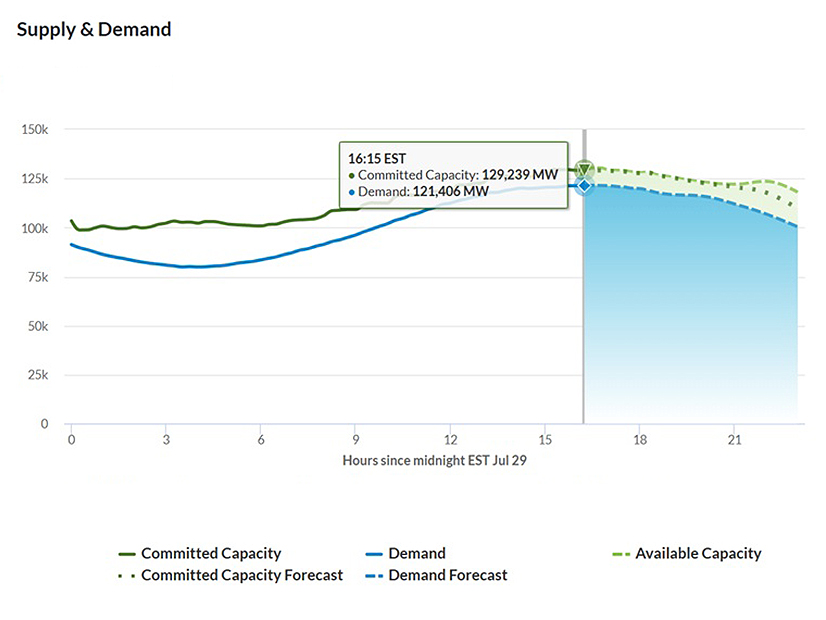
At one point on July 29, MISO forecast a nearly 124-GW peak and said it had about 130 GW in committed capacity on peak. It reported more than 9 GW in imports near its 121.5-GW peak.
MISO spokesperson Brandon Morris said neighboring grid operators dialed back exports on July 29 because of the widespread heat.
“However, the MISO grid remains stable at this time, and we will continue to work with our member utilities to navigate this prolonged heat wave impacting almost half of the country,” Morris said in an email to RTO Insider at about 4 p.m. ET, when real-time demand passed 120 GW.
‘Very Resilient’
The RTO enacted conservative operations instructions four days in advance for July 28-29, when the extreme heat was expected to pose the most risk.
Additionally, MISO declared a severe weather alert for those days in its Midwest region as it prepared for thunderstorms with winds up to 75 mph and possible tornadoes.
The grid operator has called a string of capacity advisories and conservative operations throughout July, making 17 separate capacity advisories and three conservative operations calls. All told, MISO published 47 notifications to caution members, update them or cancel instructions and alerts.
MISO initiated a series of capacity advisories for MISO South on July 10, 14-17 and 21-24 due to significant forced generation outages. By July 23, the advisory extended to the entire footprint as the grid operator contended with more widespread hot weather and offline generation.
The RTO also instituted conservative operations July 21-25 for the entire footprint due to soaring temperatures.
Meanwhile, MISO rounded out June with a 120-GW peak on June 23 during its sole maximum generation emergency declaration of the summer. (See MISO Declares Max Gen Emergency in Heat Wave.)
MISO Independent Market Monitor Carrie Milton said MISO “successfully managed the situation” without resorting to relying on operating reserves despite the emergency declaration. She added that other grid operators were forced to dispatch and nearly exhaust their operating reserves.
Milton said MISO’s handling of the challenges borne by the heat is further evidence that it doesn’t deserve the high-risk status it was assigned in NERC’s revised Long-Term Reliability Assessment. (See IMM: NERC Reliability Assessment Still Overstating MISO Risk.)
“MISO showed itself to be very resilient,” Milton said at the ERSC meeting.
Beyond the maximum generation event, load averaged 83.7 GW over June, the highest in the past four years. The day before the emergency, solar output peaked for the month at 13.1 GW.
Real-time prices in June rose to an average of $42/MWh, compared with the $28/MWh average in the two previous Junes. Daily generation outages also were up in June, averaging 51 GW — far from June 2024’s 35-GW average.