The Public Service Enterprise Group is waiting for New Jersey to address the region’s predicted energy shortage as the utility sees a dramatic rise in potential demand from data centers, said CEO Ralph LaRossa.
Developer inquiries for large load projects seeking new service connections jumped by 47% between March and June to 9,400 MW, LaRossa said Aug. 5 during the company’s second-quarter earnings conference call.
There’s growing concern in New Jersey and in other states that the PJM region is facing a chronic future energy shortage. Rapid demand growth is happening while aging fossil fuel plants are closing faster than new generators, mostly renewable energy, can open.
“The resource adequacy challenges in New Jersey and across the entire 13-state PJM region are becoming more acute,” LaRossa said. “Recent reports reflect an increasing amount of new large load applications that are quickly eroding existing reserve margins. Within the confines of PJM, it’s hard to see the path to new generation through existing market signals, which may require the consideration of a new approach to procuring capacity and resource planning.”
Underscoring the seriousness of the situation, LaRossa said the utility hit a peak load of 10,229 MW during the three-day heat wave in June, the highest level since 2013. New Jersey, a net importer of power, imported about half its energy during the heat wave, LaRossa said. But while the state in the past could rely on energy imports from other PJM members that generate excess power, such as Pennsylvania, that “convenient option is quickly being absorbed by rapid growth of native load in those states,” he said.
Much of the new demand is for large-load projects, mainly data centers used for artificial intelligence and other projects. LaRossa said about 90% of the 9,400 MW in large load projects — which include mature applications, feasibility studies and initial leads — comes from planned data centers. He said he expects 10 to 20% of the total to be completed eventually.
One of the projects included in the large load figure is a data center that AI cloud computing company CoreWeave plans to build on a 107-acre campus in Kenilworth, N.J., LaRossa said. CoreWeave announced on Aug. 4 it has completed the land purchase.
Capacity Auction Concerns
The earnings call was PSEG’s first since PJM completed its capacity auction and announced on July 22 the outcome price of $329.17/MW-day (UCAP) RTO-wide for delivery year 2026/27. The price would have been $388.57/MW-day without a price cap put in place by PJM in agreement with Pennsylvania Gov. Josh Shapiro (D). He filed suit seeking changes in the system after the auction in 2024 raised prices about tenfold to $269.92/MW-day, the result of load growth, generation deactivations and changes to risk modeling that shrank reserve margins. (See PJM Capacity Prices Hit $329/MW-day Price Cap.)
The dramatic hike in the last capacity auction triggered widespread concern among officials in New Jersey and other states for its impact on ratepayers. The average electricity bill in New Jersey increased by 20% on June 1.
LaRossa said the company anticipates “a near flat impact on customer electric bills” from the recent auction when it is factored into the state’s Basic Generation Service rates that will take effect June 1, 2026.
In the longer term, one measure that would help the state increase its generating capacity is a bill, A5439, that would allow electric public utilities to own and operate electric generation facilities, LaRossa said.
“In New Jersey, policymakers have begun to actively weigh the priorities of economic growth with system reliability and affordability and the state’s environmental policies,” he said.
PSEG is pushing the state to address some key issues, he said: “What are the forecasts they’re looking for? What are the reliability outcomes they’re targeting? What are the affordability targets they have? And then finally, the environmental policy goals. When you put those four pieces together, we think we’ll be able to find the right answer and solution for the state.”
However, he said PJM’s capacity process, especially its governance, needs reform, echoing concerns expressed by other critics of the RTO.
“We’ve been very vocal about that for many years,” he said. “We don’t think that it is attracting additional generation. … The facts are that there has not been any new base load generation built in New Jersey for quite some time.”
“The governance at PJM doesn’t allow for a lot of the things that people are talking about to just be unilaterally implemented,” he said, citing the example that for state governors to get involved in the process, PJM members must give a vote of approval. “This governance process is the core problem.”
Nuclear Advances
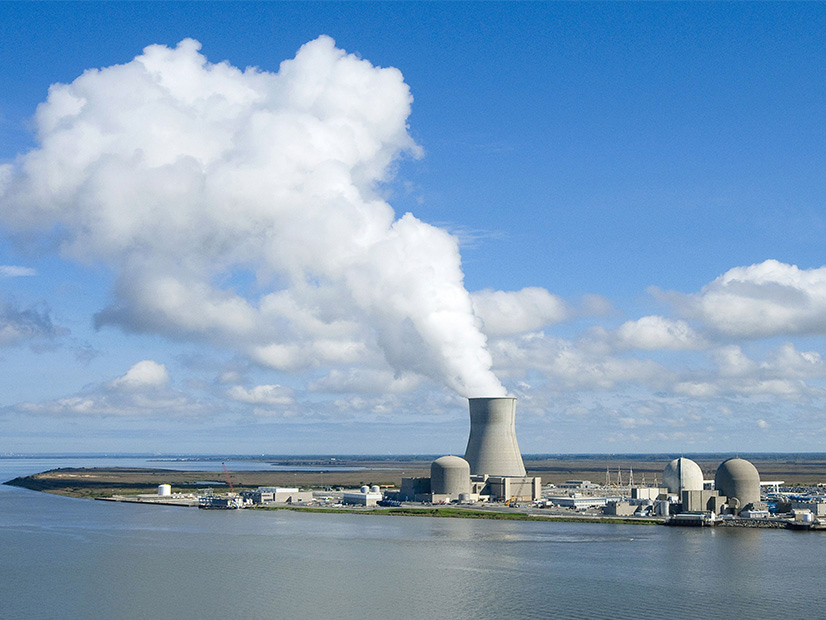
LaRossa said PSEG is taking steps to enhance its nuclear power generation, noting that an enhancement project at the Hope Creek Generating Station nuclear facility operated by the company in Salem, N.J., will add 200 MW. He characterized the enhancement, which is expected to go online between 2027 and 2029, as “the size of a small modular creator of incremental, carbon-free, dispatchable power.”
He said the company also will benefit from the recent federal funding bill, which continued the production tax credits for nuclear facilities and extended depreciation rules that will help PSEG’s nuclear fleet.
PSEG’s second-quarter results for 2025 grew from $434 million ($0.87/share) in 2024 to $585 million ($1.17/share). Non-GAAP operating earnings for the quarter were $384 million ($0.77/share) in Q2 2025, compared with $313 million ($0.63/share) in the same period last year.