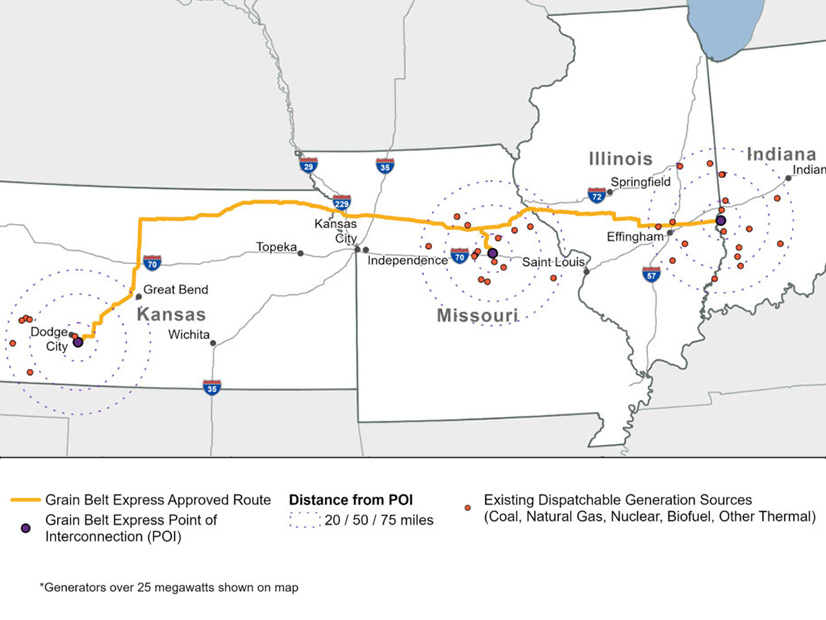
Drafted during a different presidential administration, the Grain Belt Express’ final environmental impact statement downplays the potential environmental benefits of the line.
The Trump administration’s U.S. Department of Energy Loan Program Office released the final review days after withdrawing a $4.9-billion conditional loan commitment for the 800-mile HVDC line. (See DOE Pulls $4.9B in Funding for Grain Belt Express.) Line owner Invenergy has vowed to move ahead with the project.
While the final impact statement finds the same adverse impacts to soil, vegetation, land, recreation and water and points to mitigation on Invenergy’s part, the completed document also diminishes the emissions that Grain Belt could avoid or reduce from 2.8 to 3.1 million tons to just 175,000 metric tons annually. The 175,000-ton figure is based solely on a 3% percent transmission efficiency improvement that the line, at a capacity of 2,500 MW, would foster through decreased line losses.
The DOE erased a draft finding that an alternative scenario where Grain Belt is not built “would not support” the Biden administration’s circa-2021 target to cut greenhouse gas emissions anywhere from 50-52% from 2005 levels by 2030. The department also excised sections of the more than 440-page report that assumed the line would help new renewable energy projects access the grid, potentially avoiding up to a cumulative 5.15 million tons of greenhouse gases annually while supporting 3 GW of new renewable generation capacity.
Instead, the DOE emphasized that Grain Belt cannot discriminate between coal, natural gas or renewable resources when deciding whose power to transmit. It said it expected the line to carry “diverse power mixes,” including existing baseload and dispatchable energy facilities.
“Following publication of the draft [environmental impact statement] in January 2025, a number of policies were enacted that facilitate the development of baseload and dispatchable energy. It is too soon to foresee the impact that these policies may have on market conditions and demands for certain types of energy in the vicinity of the project,” the DOE said.
The agency deleted a previous finding that there would be a “significant cost barrier for any new or existing coal generation projects to tie into the project” and struck a note that no new natural gas generation projects are planned to be built near the point of injection. It also nixed an explanation that HVDC technology doesn’t “easily allow” for new connections along the line without building intermediate converter stations, “which requires significant modifications to the overall design as well as notable increased costs.”
The DOE edited out a scenario in the draft report where the agency assumed the line wasn’t built because it refused to provide federal financial support to Invenergy.
The department also deleted more than 20 pages on environmental justice considerations, since environmental justice factors now are outside the scope of the environmental review under the National Environmental Policy Act, pursuant to President Donald Trump’s executive orders. It scrapped all mentions of the DOE’s discontinued Climate and Economic Justice Screening Tool that helped track effects on disadvantaged communities.
Grain Belt’s draft environmental impact statement paid special attention as to whether minority and low-income communities would experience about the same construction disruption as wealthier counterparts. The DOE in early 2025 concluded in the draft document that the line wouldn’t disproportionally burden low-income populations.
The DOE eliminated instances of “climate change” from the final report and deleted sentences pondering the potential for more intense weather to affect Grain Belt facilities once built. It also removed references to EPA’s 2022 finding that human-driven greenhouse gas emissions are the “leading cause of the Earth’s rapidly changing climate.”