After receiving positive feedback from stakeholders, ISO-NE plans to proceed with its proposal for a quantitative threshold to determine an acceptable level of energy shortfall risk for the region.
The regional energy shortfall threshold (REST) project is one of the RTO’s key initiatives for 2025 and is intended to establish a threshold reflecting “the region’s level of risk tolerance with respect to energy shortfall during extreme conditions.”
The REST, which incorporates both shortfall magnitude and duration, would be used for seasonal assessments forecasting energy shortfall risks heading into each summer and winter period, along with long-term assessments looking at risks five and 10 years into the future.
When calculating the threshold, ISO-NE would consider the tail 0.25% of 21-day model cases with the most shortfall risk. The REST would be triggered if the average shortfall magnitude of these tail cases exceeds 3% and the shortfall duration exceeds 18 hours. (See “Regional Energy Shortfall Threshold,” NEPOOL Reliability/Transmission Committee Briefs: July 15-16, 2025.)
Jinye Zhao of ISO-NE said at the NEPOOL Reliability Committee (RC) meeting Aug. 19 that, on average, one of the extreme 21-day cases would occur “approximately once every 90 three-month periods.” Accepting this threshold means that “about once every 90 three-month periods, the region can tolerate up to 3% of unserved load on average across the 72 most severe hours.”
“Stakeholders have generally expressed support for the ISO’s proposed tail α% of 0.25%, proposed shortfall magnitude threshold of 3%, and proposed shortfall duration threshold of 18 hours,” Zhao said. “As a result, the ISO has retained its REST proposal as introduced at the June RC.”
Zhao clarified that the duration metric will evaluate the cumulative shortfall hours within a 21-day period instead of the longest period of consecutive shortfall hours. She said focusing on consecutive shortfall hours would introduce significant noise to the data, as small gaps between shortfall periods could mask the length of shortfall events.
She noted that ISO-NE never has experienced load shed due to a lack of generation, so it is not possible to back-test these thresholds for accuracy. However, she stressed that the lack of energy shortfall events in the past does not guarantee a risk-free future, and the increasing uncertainties stemming from climate change and a shifting resource mix and load profile could increase risks.
ISO-NE has said the REST will be a key tool to help identify when solutions are needed, but it is “premature to calculate the value of lost load (VOLL)” associated with extreme shortfall periods, Zhao said.
“While there are methodologies available to calculate metrics like VOLL, applying them may be more appropriate if a specific system risk has been identified through the long-term or seasonal assessment process,” she said. “A cost/benefit analysis could be helpful at that time to evaluate whether potential risk mitigation options are economically justified once the nature and scale of tail risk are identified and better understood.”
Some stakeholders urged the RTO to start thinking about how to identify and pursue solutions if the REST is violated, noting that, if the region identifies significant risks in one of the initial REST analyses, it likely would take years to establish a process for selecting a solution, work through the process and ultimately develop the selected project.
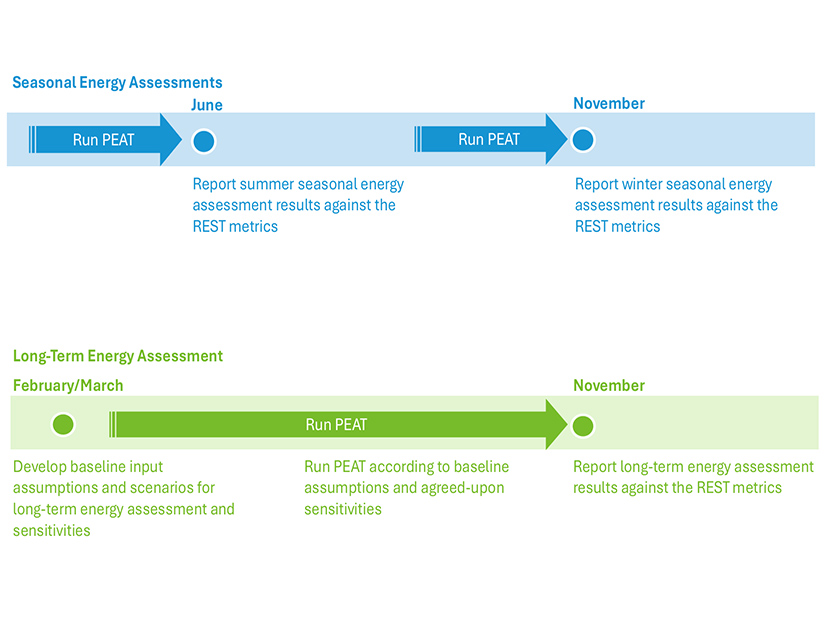
ISO-NE plans to run the REST analysis in conjunction with its seasonal assessments and will report the summer results in June and the winter results in November. For annual long-term assessments, the RTO plans to begin work in February or March and produce a report in November, beginning in 2026.
Mike Knowland of ISO-NE said the RTO will allow stakeholders to suggest modeling sensitivities to include in REST analyses and that ISO-NE plans to include three to five stakeholder-requested sensitivities in each long-term REST assessment. The RC is scheduled to vote on the REST proposal in September.