Yeah, that one. The Wall Street Journal’s op-ed broadside on Gov. Phil Murphy, New Jersey and PJM.
We’ll get to the punchline later, but let’s start with some reality checks.
Reality Checks
Energy independence in the past? Here’s the op-ed claim: “By 2016, New Jersey achieved energy independence … partially fueled by Pennsylvania gas.” That is a plain contradiction in terms. Not to mention that New Jersey’s gas power plants are totally fueled by out-of-state gas.
And, come to think of it, I haven’t noticed any uranium mines in New Jersey that could fuel New Jersey’s nuclear plants.
And even if the op-ed claim was meant to refer to New Jersey power plants (not their fuels), it’s still wrong: In 2016, New Jersey had 16,797 MW of generation capacity and 19,012 MW of peak demand (Slides 7 and 25), so New Jersey wasn’t “energy independent” no matter how you look at it.

Coal plants shut down? How about the op-ed claim that New Jersey “shut down” all its coal plants? Coal plants in New Jersey shut down voluntarily because of poor economics, with the last of them, Logan and Chambers, shutting down in 2022.
Increased reliance on wind and solar? The op-ed claims that New Jersey has “increased its reliance on intermittent wind and solar power.” Actually, solar power has had a trivial increase from 117 MW to 181 MW, and wind power has changed, a la Mr. Blutarsky, from zero-point-zero MW to zero-point-zero MW. (See Slide 7 and Slide 8.) So much for facts.
Supply-side mismanagement? New Jersey is alleged to have had supply-side mismanagement leading to a 12% decrease in generating capacity. That is a smaller decrease than the regional decline of 20% that the op-ed claims later.
Blue-state PJM? Then there’s the claim that PJM has had the same bad policies as New Jersey because PJM’s “leadership” is driven by its “largely blue-state makeup.” This claim is baffling on multiple counts. PJM is not governed by states’ political leadership — instead by an independent board and “stakeholders” like retail customers, generators and utilities.
PJM is regulated by FERC. PJM states are not even “largely blue” — the legislatures are divided evenly, six red, six blue and two split, between its 13 states and the District of Columbia. With legislatures and governors considered it’s four red, five blue, and five split.
Facts are stubborn things.
What Actually Happened?
So what actually happened over the past 10 years? Low wholesale energy and capacity prices incented inefficient generators (mostly coal) to retire in New Jersey and across PJM. And they did. The PJM markets served consumers well, as summed up in a New Jersey BPU report: “The regional competitive market has performed well in offering secure, low-cost supply to New Jersey.” (See Page 9.)
The New Jersey average residential rate increased by 23.3% from 2016 to 2024 (less than 3% per year).
Data from the same Energy Information Administration chart shows that residential rates in the rest of PJM increased by an average of 27.9% over this same period. So the New Jersey rate increase was less than the rest of PJM. And the residential rate increase in the U.S. overall was 31.3% — so the New Jersey and PJM increases were both less. Please check out the numbers yourself.
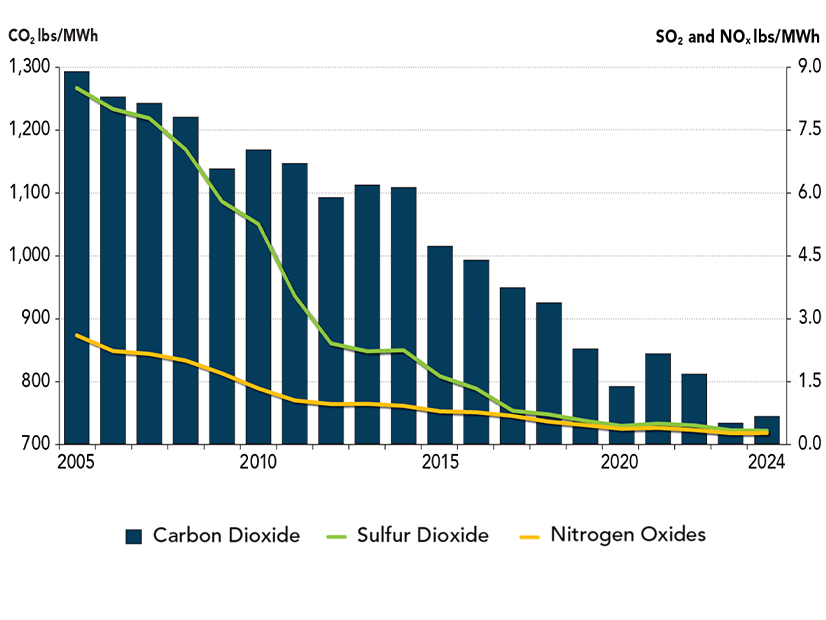
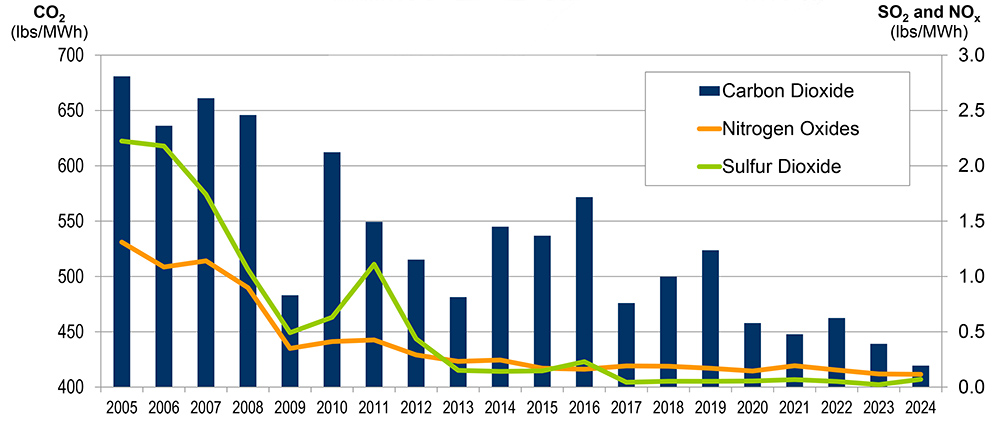
And, as a bonus, emissions in PJM have declined dramatically, as this chart shows. (See Slides 31 and 32.) Even if you don’t care about carbon emissions and global warming, you should at least welcome the amazing declines in nitrogen oxides and sulfur dioxide.
Now we’re in a new supply-demand situation from data centers driving big increases in forecasts of future demand. (See Slide 20.) This is increasing capacity prices. The higher prices are designed to attract new generation to meet that future demand. It’s that simple. And though tough challenges loom, including higher residential rates, thus far it’s working as designed.
By the way, something else you’d never guess from the op-ed: The capacity price increase for New Jersey is no less than that for the rest of PJM.
Leaving PJM
Now that we understand the fundamentals of where we were and are, let’s consider the op-ed’s punchline that New Jersey should leave PJM, and go it alone.
Hmm. New Jersey has 13,388 MW of generation capacity and 21,221 MW of peak demand. (See Slides 8 and 21.) So it’s short 7,883 MW.
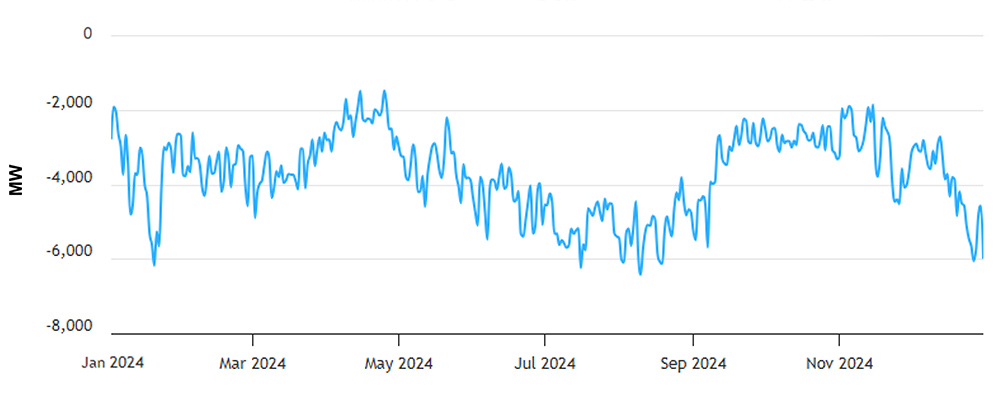
Here’s the chart of New Jersey’s electricity imports to meet customers’ needs. (See Slide 28.) You’ll notice that imports vary between 2,000 MW and 6,000 MW throughout the year. That means that if New Jersey left PJM to be on its own, there would be rolling blackouts around the clock, varying from 9% of New Jersey households to 28% of New Jersey households. Brilliant!
New Natural Gas and Nuclear to the Rescue?
The op-ed goes on to suggest that New Jersey could avoid shortages and blackouts with new natural gas and new nuclear generation. Sorry, no.
The op-ed says new natural gas plants could be delivered in New Jersey within three years — that’s not only wrong, but irrelevant. New natural gas supplies couldn’t be delivered to New Jersey for 10 years at best, as this timeline for the Northeast Supply Enhancement project illustrates. The last pipeline project proposed to serve New Jersey, the PennEast Pipeline, was proposed in 2014; targeted completion became 2023 before it was abandoned in 2021. So good luck with that.
New nuclear is even further off, not to mention prohibitively expensive (before cost overruns), as I’ve discussed before. As Brattle recently advised the New Jersey BPU: “If it chooses to embark on an ambitious new nuclear strategy, New Jersey may have a new, probably small, nuclear unit online by the late 2030s or 2040.” (See Page 6.) Oh boy, one small nuclear unit in 15 years or so. And good luck with the siting, especially in northern New Jersey, where the new generation would be needed.
The Upshot
New Jerseyites would suffer through many years of rolling blackouts, wondering why The Wall Street Journal promoted leaving PJM.
Columnist Steve Huntoon, a former president of the Energy Bar Association, practiced energy law for more than 30 years.