SPP stakeholders have approved a revised version of the grid operator’s fast-track study to integrate high-impact large loads (HILLs) during a special virtual meeting of the Markets and Operations Policy Committee.
MOPC members resoundingly shot down the proposal during their July quarterly meeting, giving it only 53.7% approval. They said the fast-track study policy was a rushed process outside of the normal stakeholder structure and didn’t give them enough time to review the revision request (RR696).
Since then, staff have stripped out conditional high-impact large load service (CHILLS) and the design associated with dispatch, study and charges for the service from its original proposal. It also removed one of three paths for high-impact large load generation assessment (HILLGA).
The changes met with success. MOPC members complimented staff on the revisions and then gave the measure 95.7% approval. The transmission owner and transmission user sectors each had one dissenting vote, with 15 total abstentions.
“We’re reviewing an improved product compared to what we discussed in July, so appreciate all the time and effort to get here today,” Southern Power’s Chase Smith said during the meeting.
“I know … there was a desire for members just to have a little bit more time to get more comfortable,” SPP COO Antoine Lucas said. “Today, we’ll do what we can to close out that effort and be able to move this forward to the next stage.”
SPP’s Board of Directors delayed consideration of RR696 during its August meeting to allow a follow-up session for MOPC to discuss the issue further. (See SPP Board Sets Aside 765-kV Costs, Large Load Policy.)
The board and the RTO’s state regulators now will take up the HILL proposal. SPP has scheduled an education session for the board, its Members Committee and the Regional State Committee for Sept. 3. The board then will hold a call Sept. 4 to consider HILLs and Southwestern Public Service’s out-of-bandwidth 765-kV project, which also was set aside by the directors.
MOPC approved a design focused on HILLs and HILLGA paths as revised by staff’s latest comments, filed Aug. 14. Approval is contingent upon SPP modifying the tariff to reinstate a 60-day study under Attachment AQ, which governs upgrades or other changes to delivery point facilities.
HILL studies will remain on a 90-day timeline. Changes include a revised HILL definition that clarifies its transmission service study process and its independence from non-conforming load.
A HILL is defined as a new commercial or industrial load or an increase to existing load at a single site, connected through one or more shared interconnection or delivery points. Load can be either 10 MW or more if connected to the system at a voltage level less than or equal to 69 kV, or 50 MW or more if connected at a voltage level greater than 69 kV.
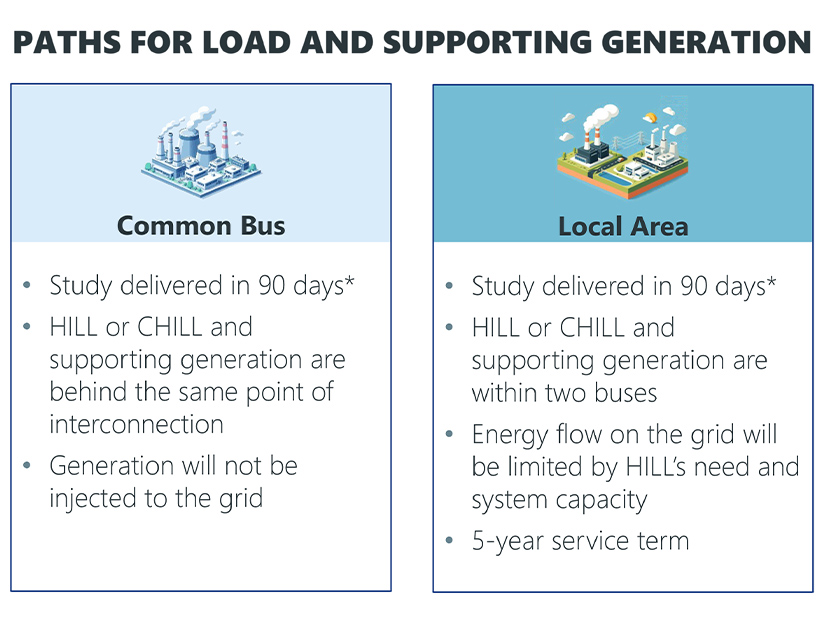
SPP says its HILL proposal will result in more robust study analysis, with large loads and their support generation studied together. It still includes load forecasts and ride-through requirements, with two HILLGA paths: a common bus or a local area.
Costs will be allocated to the cost-causers:
-
- HILLs using a delivery point assessment will have their upgrades base-plan funded.
- Upgrades from HILLs using a provisional load process will be directly assigned until the customer acquires firm service for new generation.
- Upgrades from HILLs bringing supporting generation to a local area will be directly assigned to the generation customer.
The CHILLS policy will be taken up during the MOPC, RSC and board meetings in October and November. Staff will hold education sessions before then with various working groups and the RSC.