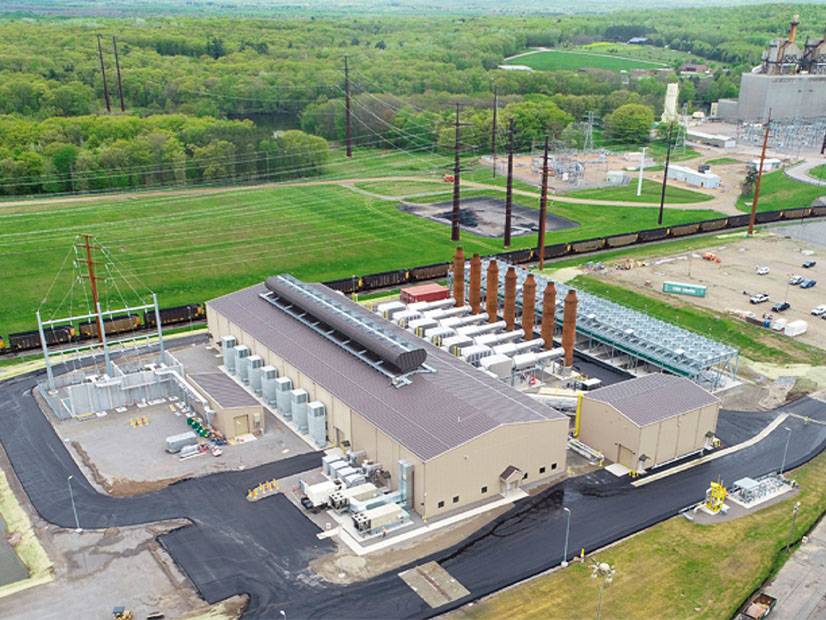
MISO announced that its first interconnection queue express lane application window turned up 47 projects at a little more than 26.5 GW of proposed new capacity, with natural gas generation accounting for about 20 GW.
The grid operator said projects are spread across 12 states and include 74% natural gas, 15% battery storage, 4% wind, 4% solar and 3% nuclear power. MISO’s interconnection fast lane is meant to maintain resource adequacy and was approved by FERC in July. (See FERC Approves MISO Interconnection Queue Fast Lane.)
Despite the apparent dominance of natural gas across 22 project requests, MISO leadership said the applicant pool represented a “large, diverse” assortment.
“This broad mix underscores MISO’s evolving energy landscape and the urgent need to bring new resources online to address growing reliability challenges,” MISO Vice President of System Planning Aubrey Johnson said in a press release. “These projects are designed to meet localized and accelerating demand growth.”
MISO’s temporary fast lane process is designed to study up to 10 projects per quarter. MISO will discontinue the special study process after it processes a maximum of 68 projects, with the program due to sunset no later than Aug. 31, 2027. MISO said some projects on the first list may have to be shifted to future study cycles.
MISO said it’s evaluating the applications for completeness and will publish an approved list of projects that will proceed to study sometime after Sept. 2. Projects must show they will help serve “clear resource adequacy or reliability need,” according to MISO, and must have verification from relevant regulatory authorities. Projects also need to be commercially operable within three to six years.
“These projects must meet strict requirements to ensure that only viable, needed projects are considered,” Johnson said.
MISO accepted the interconnection requests Aug. 6-11 as part of its first study cycle and has said eligible projects will be studied on a first-come, first-served basis.
Critics of the process said it would give thermal resources preferential treatment over renewable energy and favor load-serving entities’ projects while discriminating against independent power producers. (See MISO’s Queue Fast Lane, Take 2, Nets Déjà vu Arguments.)
MISO declined to comment on what share of the generation proposals originated from independent power producers versus load-serving entities. It also refused to say whether it expected the majority gas proposals. Spokesperson Brandon Morris said MISO had nothing further to add at this time.
MISO’s list appears to include NextEra Energy’s attempt to recommission the Duane Arnold nuclear power plant in Iowa. (See NextEra Closer to Recommissioning Duane Arnold with FERC Waivers.) Louisiana held the highest number of gas requests, at five, which includes a trio of recently approved gas plants to power a $10 billion Meta data center in the northeastern part of the state. (See Louisiana PSC Approves 3 Controversial Gas Plants Ahead of Schedule for Meta Data Center.)
Wisconsin, which has a goal to achieve 100% carbon-free electricity by 2050, followed with four requests for gas plants. Indiana and Iowa followed with three requests apiece.
Environmental nonprofits and clean energy groups have sought a rehearing of FERC’s decision to approve the expedited interconnection process. Clean Wisconsin, Natural Resources Defense Council, Sierra Club and the Sustainable FERC Project have banded together to file one rehearing request, while the American Clean Power Association, the Solar Energy Industries Association, the Southern Renewable Energy Association and Clean Grid Alliance have joined forces on another. Both rehearing requests, filed Aug. 20, again allege the process is discriminatory and challenge the notion that MISO faces imminent resource adequacy deficiencies that justify a queue fast track.
“This is a predictable and devastating outcome for the 200 GW of clean, affordable energy that are being punished for playing by the rules,” Sierra Club senior campaign adviser Jessi Eidbo said in a statement to RTO Insider. Eidbo was referring to existing renewable energy and clean generation in MISO’s approximately 300 GW normal interconnection queue.
“Millions of people served by utilities in the central United States will see unnecessarily higher monthly electric bills because MISO and Trump are needlessly dismantling the clean energy economy,” Eidbo said.