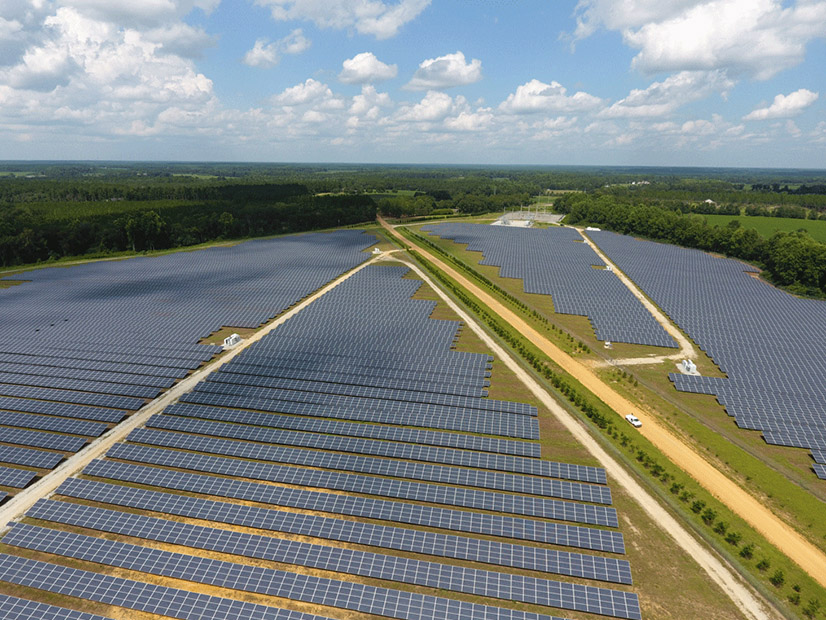
A three-judge panel of the D.C. Circuit Court of Appeals on Sept. 9 upheld its decision to side with FERC over whether a solar plant in Montana is a qualifying facility under the Public Utility Regulatory Policies Act without relying on Chevron deference.
The Supreme Court had remanded the initial decision in July 2024, after it had ended the Chevron doctrine in Loper Bright Enterprises v. Raimondo. (See PURPA Case Offers FERC Early Glimpse of Post-Chevron World.) Under the doctrine, courts would defer to regulatory agencies in their administration of a law as long as their decision-making was reasonably explained.
In Solar Energy Industries Association v. FERC, the D.C. Circuit still sided with the commission that the Broadview facility, with 160 MW of nameplate capacity, is a QF. The solar plant includes a 50-MWdc battery, limiting the power that actually flows to the grid to PURPA’s 80-MW maximum, FERC found.
FERC has consistently defined power production capacity as the amount of power a facility can ship to the grid. Petitioners in the case, including NorthWestern Energy, argued it should be applied to the nameplate capacity.
Initially, the court sided with FERC under the Chevron precedent, but in the decision issued Sept. 9, it concluded under Loper Bright that power production capacity should be defined as the amount of power that can be sent to the grid.
“That reading accounts for all the facility’s components working together, not just the maximum capacity of one subcomponent, and it appropriately focuses on grid-usable AC power,” the court said. “Because the Broadview inverters’ maximum output capacity at any given time is 80 MW of AC power, the entire facility’s send-out capacity is capped at that level consistent with FERC’s decision to certify it as a small power production facility.”
The generator is linking to the grid through NorthWestern’s transmission system. The utility filed an objection to its certification at FERC along with the Edison Electric Institute. In a September 2020 order, FERC initially denied the certification, finding that the relevant capacity was the 160 MW of solar.
Broadview sought rehearing, and in March 2021 (soon after President Joe Biden took office), FERC reversed course and granted it QF status under PURPA.
FERC rejected arguments from EEI that the setup was designed to “game” PURPA’s power production capacity limit. The facility’s design enables a higher capacity factor, achieving its maximum 80-MW output about 35 to 40% of the time, with FERC finding that a permissible use of technology to boost its capacity factor while remaining under PURPA’s limit.
After the D.C. Circuit sided with FERC in 2023, EEI and NorthWestern sought Supreme Court review. The high court granted the petition without deciding the merits, vacating the earlier decision based on the Loper Bright decision. On remand, the circuit court followed the Supreme Court’s directive to exercise its independent judgment in deciding whether the agency had acted within its statutory authority.
“We hold that a small power production facility’s ‘power production capacity’ refers to its maximum net output of AC power to the electrical grid at any given point in time,” the court said. “Because the amount of power the Broadview facility can send out to the grid is limited by its inverters to 80 MW, it qualifies as a small power production facility under PURPA.”
Based on the law’s text, “facility” applies to all components as they function together, which includes the inverters and their 80-MW limit. The power production capacity rule refers to a “facility” rather than a particular subcomponent, such as a generator.
“The only grid-usable form of electric energy the facility produces is AC power,” the court said. “The most natural reading of ‘power production capacity’ of the facility, then, is the amount of AC power that the overall facility transmits to the electrical grid.”