SPP says it has cleared its backlog of generator interconnection requests that dates back to 2018, paving the way for a transition to its “first-in-the-country” Consolidated Planning Process.
The grid operator said in a news release that the six study clusters through 2023 have all reached the restudy phase. Each request in the clusters has completed the two-part study phase and is either signing GI agreements, moving into GIA negotiations or undergoing a restudy, an SPP spokesperson told RTO Insider.
“SPP’s interconnection customers deserve an efficient study process to enable their proposed generator projects,” Jennifer Swierczek, the RTO’s manager of generation interconnection policy and study, said in a statement.
SPP said efficient interconnection studies are critical and give developers and utilities the cost certainty and regulatory approvals needed when energy demand is rising.
Staff have completed 24 cluster studies since 2022, analyzing 340 GW of generation — six times SPP’s peak load — and evaluating 1,652 projects through its definitive interconnection system impact studies (DISIS).
The work has resulted in 190 signed GIAs for more than 30 GW of generation. Another 20 GW of additional generation is expected to execute GIAs in the next 12 months, the RTO said.
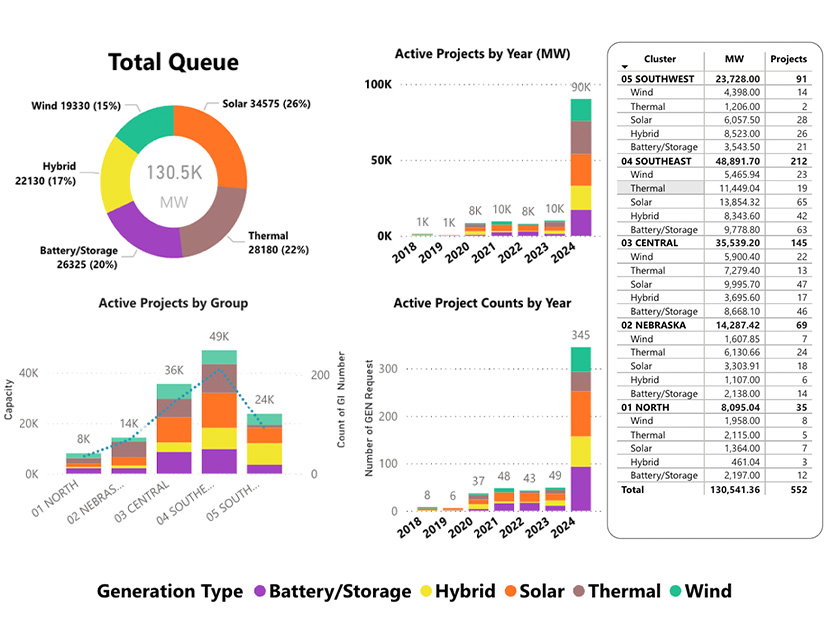
According to SPP’s GI queue dashboard, 191 active requests from the backlog remain in the GI queue. The 2024 study cluster, which has not yet gone through DISIS, includes 345 requests for about 90 GW of capacity.
SPP began tackling the backlog in 2022 with the 2018 cluster. The queue contained 1,139 active requests for 221 GW of capacity at the time; it now has 552 active requests for 130.5 GW of capacity. (See “SPP Modifies GI Backlog Process,” SPP Markets & Operations Policy Committee Briefs: Oct. 15-16, 2024.)
The grid operator’s board, state regulators and members approved the CPP in July and August. It replaces the current sequential planning and GI studies that have led to an average of six-year wait times before resources go into service.
The new process includes a long-term 20-year study and an annual 10-year assessment, aligning system modeling, planning assumptions and cost allocation across load and generation needs. The CPP-10 includes a GI capability study, a GI decision point and a regional transmission assessment that recommends projects for construction. The CPP-20 establishes a 20-year regional vision. (See SPP Celebrates Novel Consolidated Planning Process.)
Staff will be able to use the process once it has FERC approval, significantly accelerating the addition of new generating resources to the grid. SPP has said it plans to file the tariff change with the commission by October and will request an effective date of March 1, 2026.
Full implementation will begin in 2027, and the first CPP portfolios are expected to be delivered in 2028. Transitional work will bridge the gap between the CPP framework and the current study process for the 2026 and 2027 assessments.