Several panelists and public commenters at the quarterly meeting of the ISO-NE Consumer Liaison Group criticized the RTO over its record on accountability and accessibility, as well as its policy related to distributed energy resources.
Several panelists and public commenters at the quarterly meeting of the ISO-NE Consumer Liaison Group criticized the RTO over its record on accountability and accessibility, as well as its policy related to distributed energy resources.
The tenor of CLG meetings has been critical of ISO-NE since a coalition of climate activists took control of the group’s coordinating committee in 2022. (See Climate Activists Take Over Small Piece of ISO-NE.) Many of the same themes and critiques from past CLG meetings resurfaced as the group met in Manchester, N.H., on Sept. 11 for its third-quarter meeting.
Marla Marcum, an activist associated with the climate group No Coal No Gas, criticized the closed nature of NEPOOL stakeholder proceedings. She said grassroots climate activists are interested in engaging in discussions around ISO-NE’s ongoing overhaul of its capacity market but are prevented from meaningfully participating in discussions because they are not members of NEPOOL. (See ISO-NE Kicks off Talks on Accreditation, Seasonal Capacity Changes),
Responding to the criticism, Anne George, ISO-NE’s chief external affairs and communications officer, said all materials and minutes from stakeholder meetings are posted publicly, and members of the public are welcome to submit input for review by the RTO’s market development team.
“The ability for us to throw our comments into the whirlwind, no matter how good they are, is not the same as being able to meaningfully participate in this process,” Marcum responded.
Meanwhile, New Hampshire Consumer Advocate Don Kreis repeated his past criticisms of the RTO for being incorporated in Delaware, arguing that it would be more accountable to ratepayers in the region if it was incorporated in New England.
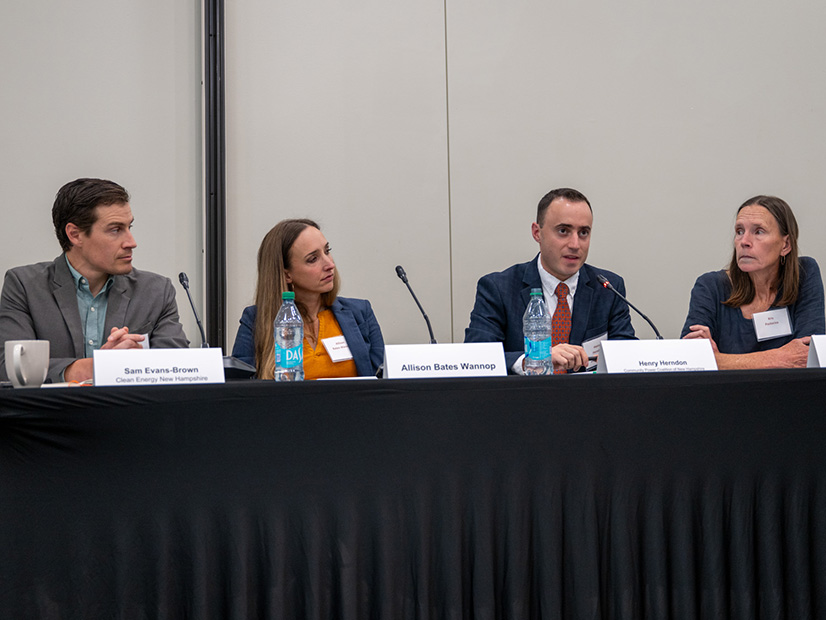
The meeting also featured a panel on how ISO-NE can help address energy affordability. Several panelists urged the RTO to do more to help demand response and DERs participate in its markets.
Allison Bates Wannop, a lawyer and DER advocate with experience working in all U.S. RTOs, said she has “found ISO-NE to have a preference for not enabling distributed energy resources.”
While she praised the work of ISO-NE staff, she said the RTO generally appears “distrustful” of DER aggregators and has been overly conservative in its compliance with FERC Order 2222, which requires RTOs to lower barriers to DER aggregators to participate in wholesale markets.
Bates Wannop highlighted FERC Commissioner Allison Clements’ concurrence on FERC’s ruling on ISO-NE’s original Order 2222 compliance proposal, in which Clements strongly criticized the RTO for putting forward “a proposal that was almost universally panned by prospective market participants seeking to integrate behind-the-meter resources into its markets.” (See FERC Gives ISO-NE Homework on Order 2222.)
Clements wrote in her concurrence that ISO-NE’s submetering proposal for DER aggregations is significantly more burdensome for aggregators than the proposals of other RTOs, adding that ISO-NE’s unique circumstances do not “necessarily provide an excuse for not adopting an approach similarly to those successfully pursued elsewhere.”
Also during the panel, Kreis asked speakers about a recently passed bill directing the New Hampshire Department of Energy to study the possibility of withdrawing from ISO-NE. Multiple speakers expressed hope that the study would allow for a constructive look at improving the RTO.
However, several speakers expressed skepticism about the viability of leaving ISO-NE, along with the benefits this move would have for New Hampshire consumers.
Henry Herndon, acting general manager of the Community Power Coalition of New Hampshire, said the bill poses an “interesting opportunity to ask questions.”
Bates Wannop said that “while I don’t think New Hampshire should leave ISO-NE, I think constantly asking the question how it can be reformed is important.”
Imagining an Ideal RTO
Also at the CLG meeting, Ari Peskoe, director of the Electricity Law Initiative at Harvard Law School, delivered a keynote speech centered around imagining an ideal grid operator for the region, unincumbered by history, compromises and agreements that have led to the current structures and roles of ISO-NE and NEPOOL.
“ISO-NE’s governance is tied to the peculiar history of New England utilities, rather than any particular attributes,” he said.
Peskoe noted that, due to the history of ISO-NE’s formation, New England transmission owners participate in ISO-NE voluntarily and retain filing rights over the revenue requirements for their own system. Meanwhile, candidates for the ISO-NE board of directors are nominated by a committee made up of current board members and NEPOOL participants and are approved by the NEPOOL Participants Committee and the board.
If the region was starting from scratch, Peskoe said, it still would be beneficial to have some form of nonprofit regional entity to ensure cost and operational efficiency across the region’s grid, but he would like to see greater independence from market participants and a stronger emphasis on innovation.
While the hypothetical, redesigned RTO would remain a non-regulatory independent entity, Peskoe said the states could take on a larger role. He floated the idea of allowing each governor to nominate one non-state employee candidate to the board.