
The PJM Members Committee overwhelmingly voted to appoint Robert Ethier, a former ISO-NE executive, and Le Xie, faculty co-director of the Power and AI Initiative at the Harvard School of Engineering and Applied Sciences, to fill two vacant positions on the RTO’s Board of Managers.
Both nominees were elected with 97% sector-weighted support during the MC’s Sept. 25 meeting. (See Robert Ethier, Le Xie Nominated for PJM Board.)
Their ascension brings the board back to its full 10-member roster after the membership declined to re-elect Chair Mark Takahashi and Terry Blackwell during the 2025 Annual Meeting in May, citing transparency concerns and frustration with the capacity market design. (See PJM Stakeholders Reaffirm Board Election Results.)
In the weeks leading up to the election, several governors of PJM member states requested that PJM’s Nominating Committee consider naming former FERC Commissioners Mark Christie and Allison Clements to be considered for the board. During a multistate technical conference on Sept. 22, Virginia Gov. Glenn Youngkin called for PJM to reopen the nomination process. (See Governors Call for More State Authority in PJM.)

Prior to the MC vote, Philip Sussler, of the Maryland Office of People’s Counsel, said PJM needs deep governance reform, and holding an election on board candidates without accompanying statements from the RTO about how it will change its path is disappointing.
Following the election, Xie told stakeholders that he aims to begin his tenure with a comprehensive listening tour across the region. He said PJM is facing complex, urgent challenges that will require the membership to think about what unites them.
Xie began teaching at Harvard in 2024, before which he was a professor at Texas A&M University starting in 2010. He previously held roles at the Massachusetts Institute of Technology and the University of California, Berkeley. He also is a fellow and distinguished lecturer at the Institute of Electrical and Electronics Engineers and has served as an editor for the group’s Transactions on Power Systems journal.
During his more than 24 years at ISO-NE, Ethier filled three vice president positions — system planning, market operations and market development — between 2008 and 2024. He now is a principal at Stickney Brook Consulting, based in Florence, Mass.
Technical Conference Calls for Overhaul of PJM Governance
Headlined by governors calling for a greater role for the states in PJM decision-making, panelists participating in the multistate technical conference debated the future of the RTO’s governance structure and whether it is prepared to rise to the challenge of accelerating data center load.
Former FERC Chair Mark Christie said a crisis of confidence should be apparent when both the governors of Pennsylvania and Virginia speak about the need to either reimagine PJM or a future outside of it. The issue is not economic or technical, he said, nor does it lie with the experts at Valley Forge, but a problem of governance.
PJM started as a power pool, then morphed into a system operator focused on coordinating power flows. Over time it has been empowered to take a more proactive role in planning resource adequacy as well. Christie said that has put it in the position of becoming a policymaking body when it determines how to allocate transmission costs and how it integrates the load forecast into the variable resource requirement curve that sets capacity prices.
Legislation over the Transource Independence Energy Connection transmission project underscores that point, Christie said, with the courts finding that the Pennsylvania Public Utility Commission violated the Constitution’s Supremacy Clause in denying permits for the project. If states cannot make their own determinations on the need for transmission within their borders, he said, it underlines the governors’ message that the states need more of a role in PJM decision-making.
“The states in PJM simply do not have a substantive role in PJM governance,” he said.
Christie cautioned that his message isn’t that state legislatures should be running PJM; it is to recognize that the question of how to address the interconnection of large loads and the associated costs is a technical and policy question. At a minimum, PJM states should have the same Federal Power Act Section 205 filing rights as member states of SPP and MISO, he said.
Joshua Macey, associate professor at Yale Law School, said granting Section 205 filing rights to the states is one of the most powerful governance changes that could be made. He said FERC defers to the entity filing a tariff change under Section 205 so long as it falls within a zone of reasonableness, while the bar for making changes under FPA Section 206 is much higher.
Macey said filing rights are not the end of the conversation between PJM and the states, which hold their own negotiating power through their ability to liquidate and restructure utilities to no longer be part of an RTO. He said there is a risk in taking too much autonomy away from PJM, which does hold deep expertise on technical issues. He said there often are actuarily correct cost allocation methodologies that have not been adopted because of political fighting.
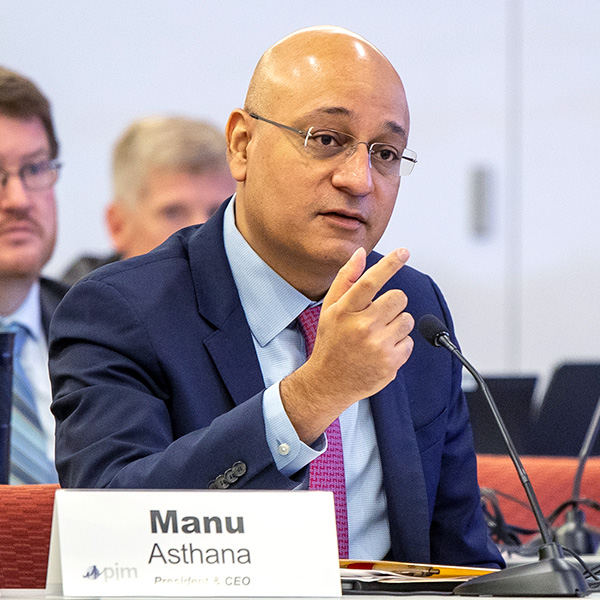
During a “fireside chat” with Clements during the conference, PJM CEO Manu Asthana said the RTO does not hold the unilateral power to grant the states Section 205 filing rights; that would have to be endorsed by the MC and approved by FERC. He said governance reform is a conversation worth having, but there should be a parallel focus on the actual rule changes that are needed to address the resource adequacy problem in front of PJM.
Panelists also debated whether states should be granted voting rights in PJM’s stakeholder process, with some arguing it would grant them both a voice and skin in the game.
Macey argued that PJM’s stakeholder process favors incumbent asset owners, through dominance of the five membership sectors at the MC and holding even more power in the lower committees where votes also are allowed for affiliates.
Stacey Burbure, vice president of FERC and RTO strategy and policy for American Electric Power, said her company owns more than a quarter of the transmission in PJM, but holds only 2% of the votes.
Vincent Duane, principal at Copper Monarch and former general counsel for PJM, said the RTO already is ungovernable, and adding more votes to an already crowded body likely would leave the states disappointed. Instead, he said the focus should be on developing strong executive decision-making. He said transmission owners should have a substantial role because of their place at the intersection of private capital and accountability to their states.
During his time at PJM, Duane said he regularly received questions from board members about who they owed their fiduciary duties to, and he found it difficult to give a specific answer. Until that can clearly be determined, along with the question of who manages the stakeholder process, he argued governance should take a back seat.
Dan Scripps, chair of the Michigan Public Service Commission, said MISO’s requirement that one seat on its Nominating Committee be appointed by its member states allows them to have a seat at the table, rather than criticize the results from the sidelines.
“If you’re locked out, you end up throwing rocks from outside,” he said.
Maryland Del. Lorig Charkoudian said legislators and public utility commissions are charged with managing the resource mix in each state, but their efforts can be undermined by PJM decisions, which are made through an opaque stakeholder process. She said the primary cause of instability in PJM’s market has been an interconnection queue unable to keep up with the pace of new requests. Now that PJM has put reforms in place to speed processing those requests, she argued the blame should not be shifted to state clean energy efforts, but to federal policies creating barriers to developing wind and solar generation.
Without more confidence that the transmission projects planned by PJM are truly necessary for reliability, she said it will be a hard sell to convince elected representatives to advocate to skeptical voters.
Duane said PJM is one of the most transparent organizations he has been a part of, with a deluge of information published. He said the complexity of those postings should not be mistaken for a lack of transparency.
PJM Stakeholders Discuss Governance
The MC and board discussed the issues raised during the technical conference during the Sept. 25 meeting — a standing agenda item recently established by board Chair David Mills in response to the calls for more transparency and accessibility to board members.
John Horstmann, senior director of RTO affairs at AES Ohio, said he heard a lot of criticism and finger-pointing at PJM’s leadership, but little in the way of solutions to the issues the states and RTO face together. He said there seems to be little interest in being involved in the stakeholder process to advance their causes.
“The real issue is load is growing faster than we can make supply … and they don’t like it, but I didn’t hear how they would fix it if you handed them the keys today,” he said.
He said he did not see how creating a governors’ organization is going to be any different from the deference PJM and its membership already provide to the Organization of PJM States Inc. (OPSI).
Manager Matt Nelson said the governors want to bring load growth to their states and see it interconnected at the least cost.
“There’s a real goal of making sure we can show the value of PJM, and that isn’t just PJM itself but this whole process. And when I hear governance, I hear them say they want a way to engage in this process,” he said.
Sophia Dossin, manager of regulatory affairs for Middle River Power, said the growth of large load customers felt like a hot potato at the technical conference, and while PJM will have a role to play in how to manage that growth, it is limited by its jurisdiction.
“Everybody wants the benefits; nobody wants the cost,” she said.
Dossin also said the membership should consider what Christie said at the conference: that individuals the PJM membership might call “consumers” are referred to as “voters” by elected officials. Communications between PJM and state leadership would be well served by approaching those conversations as speaking to voters, she said.
OPSI Executive Director Gregory Carmean said PJM should provide easily understandable information about rule changes being considered. Pointing to the slate of Quadrennial Review proposals voted on during the Sept. 25 meeting, he said a short description could have been provided on each, along with a statement on how it would benefit the public.
Asthana told the MC that his interpretation of what states are requesting from PJM is a measure of control over the RTO and lower prices, which he said the membership should keep in mind and consider how those goals can be addressed. That control is not PJM’s to give, he said, and instead is under the purview of the membership, with management considering how to facilitate that conversation.
To address the need for a 10-fold increase in the amount of capacity coming online, he said solutions spanning the state and federal jurisdictional boundary will be needed, creating an opportunity for PJM to partner with the states in a different way than it has in the past.