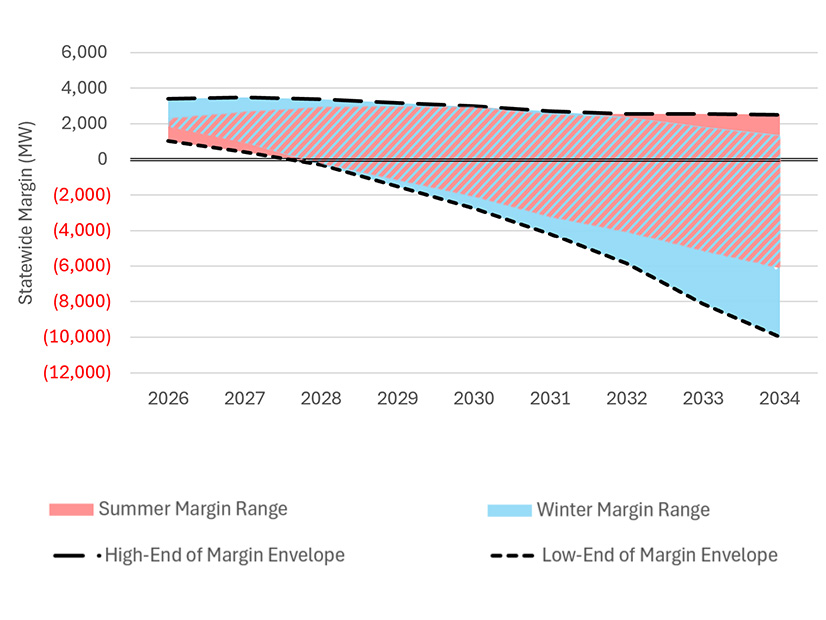
NYISO released an updated draft of its Comprehensive Reliability Plan for 2025-2034 that calls for the acceleration of new generation development and preservation of “critical, dispatchable capability.”
“New York’s electric system faces an era of profound reliability challenges as resource retirements accelerate, economic development drives demand growth and project delays undermine confidence in future supply,” NYISO writes in the plan’s conclusion. “While this 2025-2034 CRP … identifies no actionable reliability need, this outcome should not be mistaken for long-term system adequacy. The margin for error is extremely narrow.”
This is from the broad range of scenarios for load growth, generation retirement and new generation construction. The majority of NYISO’s scenarios forecast statewide reserve margin declines. (See NYISO Dogged by Uncertainty in Comprehensive Reliability Plan.)
“In the best-case scenario we might have a reliability margin of 2,000 MW,” Ross Altman, senior manager of reliability planning for NYISO, told the Electric System Planning Working Group on Oct. 7. “Worst case, we could be deficient by 10,000 MW.”
The ISO is calling for “several thousand megawatts of new dispatchable generation” by the 2030s.
“Depending on the load and the way that demand grows, the projected [amount] of green generation may not be enough,” Altman said. “Storage and renewables help, but they don’t get us all the way there.”
Environmental stakeholders at the meeting said this amounts to a call for new fossil fuel generation without outright saying it. But Matt Schwall, director of regulatory affairs for Alpha Generation, noted that NYISO did not “parse words” in its comments on New York’s draft State Energy Plan. “They clearly indicate there’s a need for fossil fuel-based generation: retention of existing and installation of new.”
He went on to say that if the word “dispatchable” was an issue, then maybe the term that should be used is “fossil fuel generation.”
“Well, I would ask for the empirical basis of that as well,” replied Michael Lenoff, an attorney representing Earthjustice.
Another stakeholder asked whether the ISO could highlight a “maybe not probable,” but possible, scenario where the reserve margin slips as soon as 2028. The stakeholder said that such a scenario was critical for evaluating the risks to the grid over the next five years.
NYISO recommends that reliability planning move away from a “reactive posture” toward a more proactive approach. The ISO’s preliminary recommendations include:
-
- accounting for a wider range of outcomes in reliability planning rather than relying on a single “expected future”;
- strengthening reliability planning beyond reliance on emergency measures;
- including more approaches to address resource shortfalls beyond additional transmission planning; and
- addressing system voltage performance issues from changes in flow patterns caused by distributed generation and large upstate loads.
NYISO said these recommendations may require changes to its planning process manual and tariff, which it plans to discuss with stakeholders in upcoming meetings.