Stakeholders spent much of the Electric System Planning Working Group’s meeting Oct. 20 debating the validity of NYISO’s recent finding of a reliability need in New York City by summer 2026.
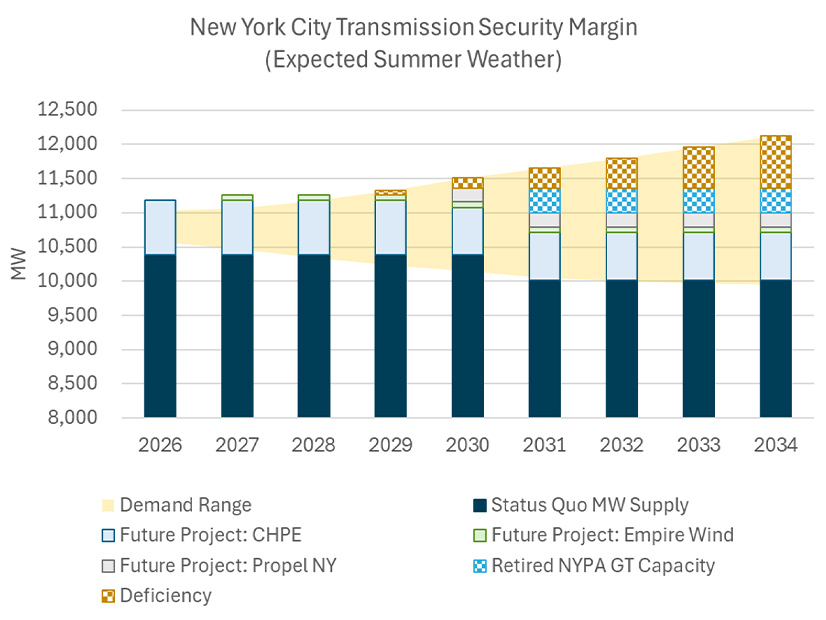
In its third-quarter Short Term Assessment of Reliability (STAR), the ISO said there would be a shortfall in the city if several ongoing projects — including the Champlain Hudson Power Express (CHPE), Empire Wind and the Propel NY Transmission Project — fail to be energized by their anticipated in-service dates. The projects would provide the power that would be unavailable from the planned retirements of the Gowanus and Narrows generators. (See NYISO Again Identifies Reliability Need for NYC.)
“Until these plans are completed and demonstrate their power capabilities, the identified reliability needs in New York City would continue to remain,” said Keith Burrell, a transmission planning adviser for NYISO.
Stakeholders tried to get the ISO to clearly articulate how likely it might be that that CHPE would be in service by the second quarter of 2026, potentially solving the nearest-term reliability need for New York City.
“I guess I’m trying to understand whether CHPE needs to be proposed as a solution or is it a solution that is going to be looked at in each STAR?” asked Tony Abate, representing the New York Power Authority.
Another NYISO staff member repeated Burrell, saying that once CHPE has demonstrated its ability to provide power, that would be a solution.
“I’m struggling to understand what has changed in the last 90 days,” said Howard Fromer, director of regulatory affairs for Bayonne Energy Center, referring to the most recent STAR. “It can’t be the load. Has it materially changed from what you were using in the Q2 STAR?”
“We’ve been identifying needs in the STARs all along and continue to identify CHPE as a potential solution,” Burrell said. He pointed to a figure in the most recent report that illustrated the city’s transmission security margin. According to those forecasts, if CHPE entered service as planned, there would not be a deficiency until 2029.
After some discussion about what future STAR reports might look like if CHPE came online as expected, the ISO clarified that each STAR was a snapshot of system conditions in time. If a project, or deactivation, meets the base inclusion criteria, it gets into the latest STAR.
“I think what people are trying to identify is, ‘What is the next step?’” said Yachi Lin, director of system planning for NYISO. “And the next step is that NYISO will be soliciting [solutions] starting in early November. In that solicitation we will have more details about the solicitation type.”
Lin said that a market-based solution that could potentially come online earlier to serve the need found in the STAR would be “something for the NYISO to consider.”
“But we don’t know yet what the kind of proposed solution or answer to the solicitation is. It’s difficult for us to forecast what the outcome is going to be,” Lin said.