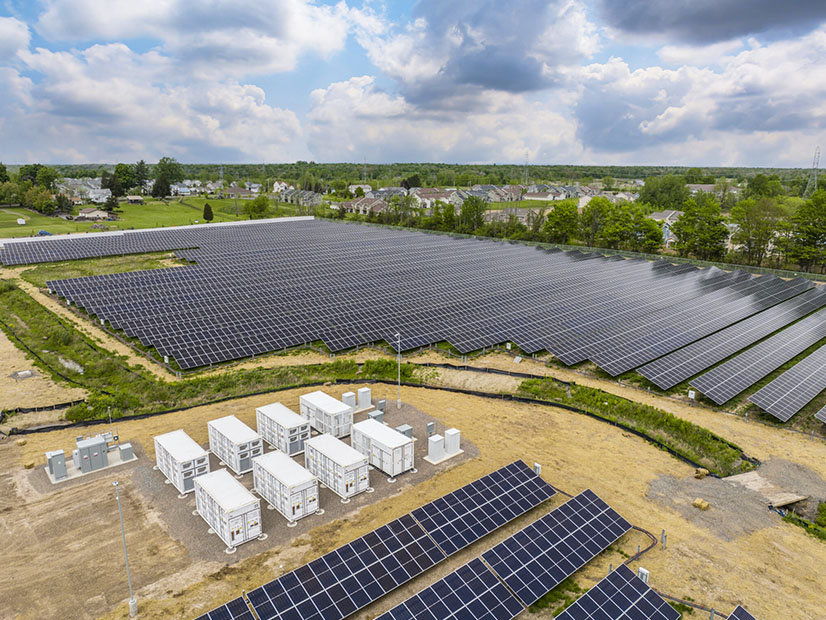
ISO-NE’s first interconnection cluster study held under new rules is made up mostly of large battery resources and contains only five wind and solar projects.
The transitional cluster study, which ISO-NE initiated in early October, includes 26 interconnection requests, with a net total of 7,205 MW. The requests include 21 battery storage projects, two solar projects, two offshore wind projects and one onshore wind project.
FERC Order 2023 required RTOs to transition from serial, first-come first-served interconnection processes, to first-ready first-served cluster study processes. The reforms are intended to reduce queue backlogs by disincentivizing speculative interconnection requests and sharing infrastructure upgrade costs among interconnection customers.
The transitional study marks the first cluster study under the new rules and is set to conclude in August 2026.
Alex Lawton, director at Advanced Energy United, said he expects the Order 2023 interconnection changes to “raise the bar for interconnection requests” and “increase the likelihood of projects actually being constructed.”
Looking at the projects included in the first cluster study, he said he was “a little bit surprised to see so few solar projects but not surprised to see so much storage.”
“We absolutely need a lot more storage, but we also need other low-cost clean generation resources too, to bring new supply to meet growing demand,” he said.
The storage requests in the cluster study total 5,632 MW, ranging in size from about 19 to 706 MW, with a median size of 214 MW.
The cluster includes a 1,200-MW interconnection request from SouthCoast Wind; a capacity-only request from Avangrid’s New England Wind 1 project (previously called Park City Wind); and an 18-MW land-based wind project in Maine.
For solar, the cluster includes a 102-MW project in New Hampshire and a 253-MW project in Maine.
In its announcement of the study, ISO-NE noted that “more than 50 other requests with previously completed studies, most of which have signed interconnection agreements, remain in the queue and can continue working toward completing the interconnection process.”
Francis Pullaro, president of RENEW Northeast, said the large number of storage projects in the cluster study likely is a result of procurement opportunities for large-scale storage projects in the region.
Massachusetts has an ongoing procurement for up to 1,500 MW of storage. The state received 13 bids from eight companies in September and is scheduled to select winning bids in December. (See Massachusetts Seeks 1,500 MW of Mid-duration Energy Storage.)
Maine has been working toward a 200-MW storage procurement, and Connecticut is in the process of selecting projects for a procurement open to solar, onshore wind and co-located storage. Meanwhile, state incentive programs generally are focused on small-scale projects.
“Frankly, there’s not a lot of procurement opportunity for transmission-level solar,” Pullaro said.
He added that it is “very challenging to find sites for large projects where you can get through siting and manage public acceptance,” and that, to site large-scale solar projects, “you’re usually talking about farmlands or having to clear cut forests.”
The relatively small number of non-storage projects in the cluster, coupled with the significant number of withdrawals that have occurred over the past year, appears to be a major challenge for state clean energy goals, said Aidan Foley, founder of Glenvale Solar.
According to ISO-NE data, 22,480 MW of FERC-jurisdictional battery and clean energy projects have withdrawn from the RTO’s interconnection queue this year. This includes about 10 GW of batteries, 11 GW of wind and 1.3 GW of solar.
“The sheer supply of projects, other than offshore wind, is terrible,” Foley said. “The region is just totally screwed in terms of meeting its clean energy goals, and the next five years is going to be an absolute dead zone.”
He said cost and new technical requirements posed barriers for projects seeking to enter the transitional cluster study. Because the ISO-NE queue has been closed since June 2024, newer projects without queue positions were not able to join the study, he added.
“The cost is really a humongous amount to anybody trying to weigh the investment needs of their portfolio,” Foley said. He estimated the study process would require a roughly $6 million investment for generators larger than 20 MW seeking to participate in the transitional cluster.
Foley has argued that the study costs — including a $5 million commercial readiness deposit — are disproportionately burdensome for smaller resources that fall under ISO-NE’s Large Generator Interconnection Procedures (LGIPs).
Notably, the cluster study contains only three projects smaller than 100 MW. All three of these requests are less than 20 MW, which is the size threshold that determines whether resources are subject to ISO-NE’s LGIPs or Small Generator Interconnection Procedures (SGIPs).
Generators seeking to interconnect under the SGIPs were required to submit a $1 million commercial readiness deposit in the transitional cluster, compared to the $5 million deposit required from LGIP resources.
In the stakeholder process leading up to ISO-NE’s Order 2023 compliance proposal, several stakeholders pushed for lower commercial readiness deposits, and Foley advocated for scaling deposit requirements to resource size. (See NEPOOL PC Backs ISO-NE Tariff Revisions for Order 2023 Compliance.)