One of the foundational lessons of journalism holding the powerful to account is the downfall of President Richard Nixon, who resigned rather than face impeachment after reporting uncovered evidence he’d lied about Watergate. No one ever called Nixon “probably the best president.”
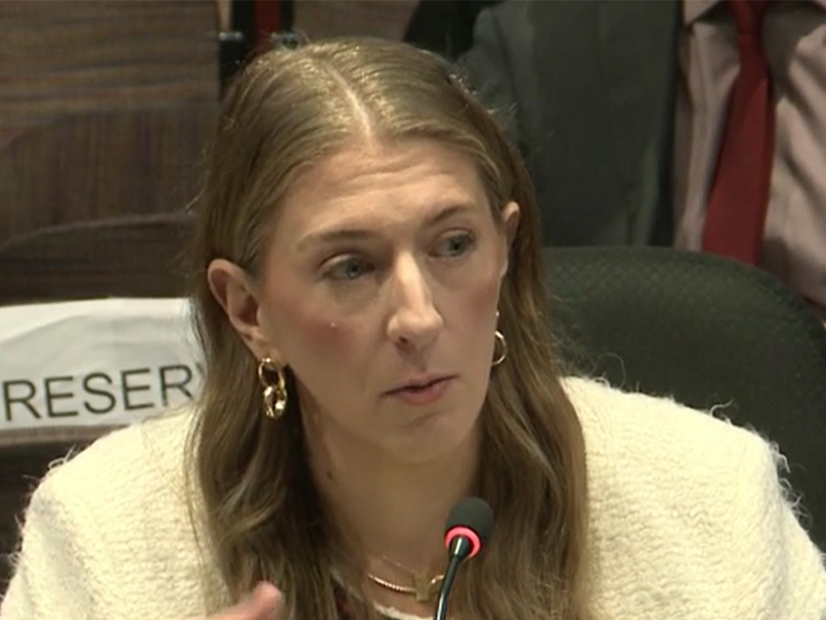
Yet after Connecticut’s chief utility regulator, Marissa Gillett, resigned while facing an impeachment hearing, we are reading fans of her advocacy calling her “probably the best regulator in the country.”
Gillett’s exit tracks President Nixon’s — and the lesson that the cover-up is worse than the lie is being proven again because certain journalists are doing their job.
The hagiography of Gillett as a superior, ground-breaking regulator flies in the face of the circumstances of her exit, and unfolding evidence that the Public Utilities Regulatory Authority (PURA) under Gillett hid public records that would have proved clear bias in an agency that is quasi-judicial in mission and by statute.
Here are the facts. Gillett, a lawyer, denied under oath before the Connecticut General Assembly that she restricted her fellow commissioners’ access to PURA staff. Stunningly, a printed color copy of an email laying out those restrictions appeared in The Hartford Courant, which had requested it under Connecticut’s Freedom of Information Act.
This prompted a call for her impeachment by the Republican minority, and agreement by the Democratic Speaker of the House to entertain that request for what would have been the first such hearing in Connecticut in two decades.

House Minority Leader Vincent Candelora wrote in his letter seeking an impeachment inquiry that “in direct contradiction to Ms. Gillett’s sworn testimony during her confirmation hearing, she did in fact issue a directive to the other commissioners of the Authority that restricted access to support staff.”
I was aware from PURA sources over a year ago that the email and directive existed, yet it was not produced by the agency until there was no choice. Unfortunately for PURA’s leadership, a sitting commissioner had kept a hard copy — who handed it over to the attorney general’s office.
What followed was stunning sequence of events: The attorney general’s office, defending PURA in a lawsuit over two rate cases filed by two of the state’s natural gas utilities, capitulated and offered to give the utilities the legal relief they sought by sending the cases back to PURA with Gillett recused.
Subsequently, the presiding judge admonished both PURA’s general counsel and the attorney general’s office for failing to produce the documents they knew existed. PURA on Oct. 27, in another attempt to settle the case, admitted Gillett violated the law.
At the center of this case was the utilities’ assertion that Gillett was biased, which arose from a previous scandal in which Gillett denied authoring an opinion article signed by the chairs of Connecticut’s Energy and Technology Committee, PURA’s committee of jurisdiction.
Months of litigation over two utilities’ rate cases had come to hinge on whether Gillett was involved in writing a December 2024 op-ed under the names of two legislators to whom she is inarguably close. The litigation revealed more cover-up attempts in apparent contravention of state law, such as her decision in November 2023 to set her phone to auto-delete text messages after just 30 days.
The opinion article accused Connecticut’s utilities of paying credit ratings agencies to lower their credit ratings — after all five of them had their ratings slashed because of PURA’s aggressive, erratic cuts to rate requests. This prompted Bank of America to say Connecticut had “probably” the “worst regulatory environment in the country” and Moody’s to declare it “the least credit supportive utility regulatory environment” in the U.S.
The opinion article is an example of inartful blame-shifting, because its premise is utterly absurd to anyone with even a passing understanding of how federally regulated credit ratings agencies work — never mind the Enron-level legal exposure both the ratings agency and the company involved would face.
None of this came about because of some “escalating conflict” with utilities: all of it was the unforced error of Gillett and a few high-ranking PURA officials, combined with their later attempts to lie and cover it up. By turning regulation away from collaboration and into an adversarial process, the regulated companies have no choice but to press their case.
There is likely to be no let-up on that front, especially in light of new allegations of a cover-up. PURA’s executive secretary wrote a letter on Oct. 6 outlining orders he’d been given by PURA’s general counsel to deny that adverse public records existed. PURA declined to comment because of an ongoing personnel investigation, a Oct. 28 report in The Hartford Courant says.
Alas, Gillett — emboldened by her allies in the legislature and the governor’s office — which for six years refused to appoint PURA’s statutorily required five commissioners lest Gillett’s power be diluted — acted with perceived impunity and got caught because of journalistic vigilance.
Seeking a fresh start without the embarrassment of an actual investigation, Gov. Ned Lamont (D) on Oct. 20 appointed four new PURA commissioners and named Thomas Wiehl, formerly of the Connecticut Office of Consumer Counsel, as chair. With PURA at a full complement of five commissioners with diverse expertise, Wiehl signaled in his first press conference that he will emphasize collaboration and return PURA to its traditional role as a professional, impartial regulator.
For PURA to succeed, an honest, thorough accounting of the Gillett era is required. Since collaboration is at the core of smoothly functioning regulation, trust with the regulated companies and the ultimate end users — the people of the state of Connecticut bearing some of the nation’s highest retail electricity rates — must be rebuilt.
This is not just to ensure that Connecticut’s regulation is proper, reasonable and working in the interest of the people, but to ensure that PURA’s record under Gillett is not portrayed as a model of propriety or best practices in the national conversation about the future of regulation.
The facts speak otherwise, thanks to good, old-fashioned journalism that uncovered a record riddled with deceptions. If Gillett is the nation’s best regulator, the U.S. is in real trouble. Let Connecticut’s embarrassing regulatory saga be a lesson for other jurisdictions on what not to do.
Bryson Hull, Consumer Energy Alliance’s deputy Northeast director, is a former journalist who has written about energy issues since being hired to cover Enron Corp. a year before its then-record bankruptcy.