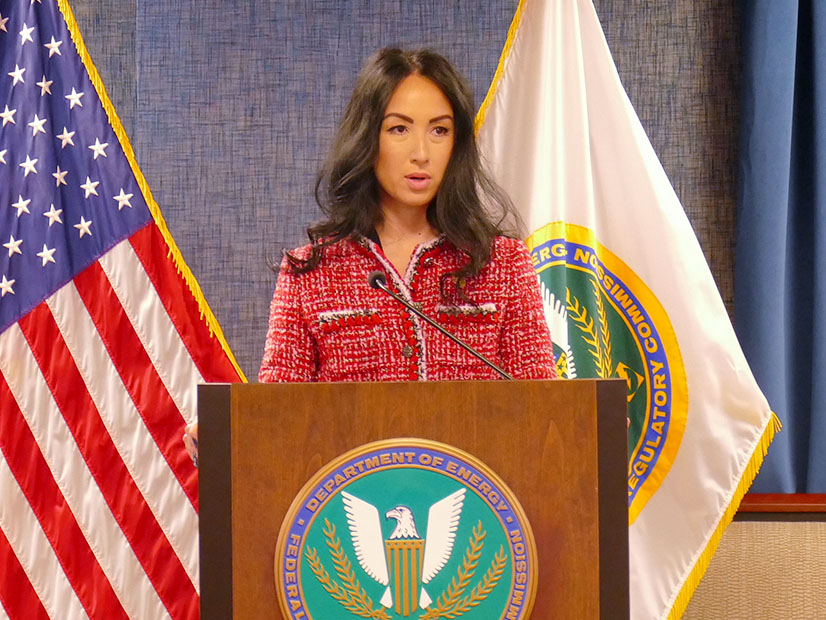
WASHINGTON — FERC Chair Laura Swett presided over her first monthly open meeting at the helm of the commission, giving her a chance to set the tone for her tenure.
“Regarding my priorities, we are at a critical juncture in our nation’s history, a time to cement the United States’ energy dominance,” Swett said. “It is crucial to our economic and national security that we win the artificial intelligence data race for our country so that American data does not go abroad. In addition to our core mission of keeping the lights on for all Americans at reasonable costs, my priority as chairman is to ensure that our country can connect and power data centers as quickly and as durably as possible.”
Another priority is to streamline regulations at FERC to ensure that needed infrastructure can get built as quickly as possible, she added.
Commissioners David Rosner, Lindsay See and Julie Chang all welcomed the new chair, as well as new Commissioner David LaCerte, in comments at the start of the meeting.
“We had some more elaborate talking points, but somebody abbreviated them to say, ‘Yay, five!’” Rosner joked.
As it also was his first open meeting, LaCerte laid out his priorities for the job.
“I understand our nation’s need for critical expansion of generation and transmission,” he added. “Now, more so than ever, it’s important that companies seeking to generate and transmit our energy are not thrown unnecessary obstacles to stymie their efforts. [National Environmental Policy Act] reviews across the federal government have run off course, failed to protect the environment and often only serve to delay or derail infrastructure projects. All American people deserve better, and we have to do better.”
He added that the AI race needs to be met with bold action to ensure economic and national security.
The Department of Energy already put that issue on FERC’s plate with an Advance Notice of Proposed Rulemaking urging it to assert jurisdiction over the interconnection of large loads like data centers for AI. (See Energy Secretary Asks FERC to Assert Jurisdiction over Large Load Interconnections.)
“That obviously is top of mind for me,” Swett said during a post-meeting press conference. “That issue is my biggest priority, and an issue facing our country of this import cannot be solved by any one person or one agency alone. And that’s why we are so excited to open this docket for comments, because it is so important that everyone weighs in.”
Comments are due in the docket (RM26-4) by close-of-business Nov. 21, and Energy Secretary Chris Wright asked for a final decision by April 30, 2026.
Another issue looming over FERC and other independent regulatory agencies is Supreme Court case Trump v. Slaughter, which will decide whether the president has broad authority to fire members of the Federal Trade Commission, which could be extended to FERC. Recently, a group of 11 former commissioners filed a brief arguing for the court to uphold “for cause” removal protections across the board, or at least separately for ratemaking agencies such as FERC and the Federal Reserve. (See Former FERC Commissioners Ask Supreme Court to Preserve Agency Independence.)
Swett was asked about her position on the issue, and she said the law still preserves FERC’s independence.
“Everything that FERC does is independent, and it is independently voted on by five people with very diverse viewpoints,” Swett said. “I have the honor of being designated chairman based on the president’s faith in my independent experience and my independent judgment to run this agency. And by the nature of the statute that created FERC — the DOE Organization Act of 1977 — we are explicitly carved out of DOE jurisdiction, with no review powers from anyone at DOE on FERC’s independent actions.”