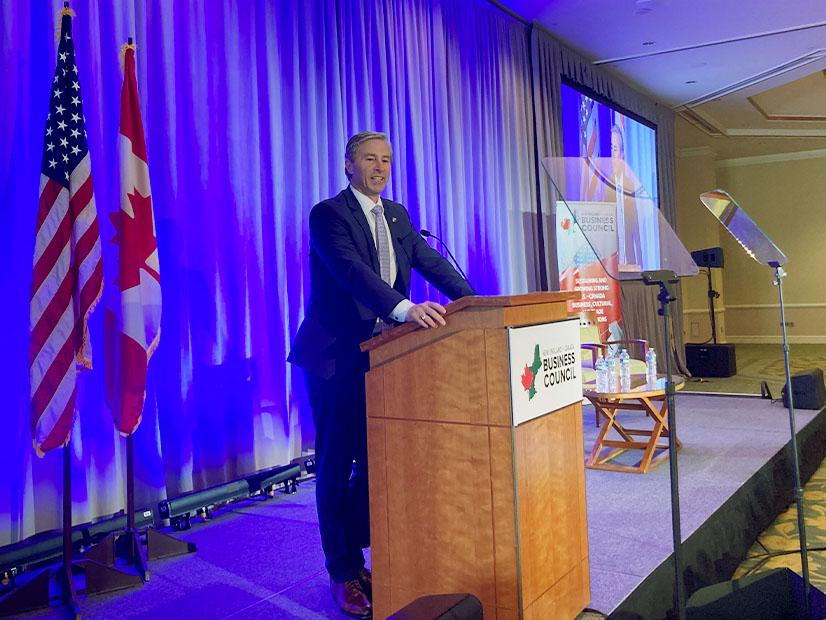
BOSTON — Energy affordability and regional collaboration dominated talks at the New England-Canada Business Council’s annual Executive Energy Conference on Nov. 19-20.
While the event featured similar themes and rallying cries as the 2024 conference, calls for collaboration have taken on a different tone amid heightened tensions between Washington and Ottawa. (See US, Canadian Leaders Discuss Affordability of Energy Transition.)
Massachusetts Gov. Maura Healey (D) and Nova Scotia Premier Tim Houston both attended the event and emphasized the strong ties between the people and economies of the Northeast states and provinces.
“Our energy future is inextricably tied to Canada’s,” Healey said, noting that states and provinces are in regular communication on energy policy and planning through the Northeast International Committee on Energy, which reconvened in 2024.
She highlighted a resolution passed at the Annual Conference of New England Governors and Eastern Canadian Premiers during the prior weekend reaffirming “the importance of continued regional collaboration, including interregional information sharing, planning and analysis on energy matters.”
“We look forward to continuing to build on that and to strengthen the ties that bind us, especially on energy transmission,” she said.
Healey directly criticized the tariffs imposed by President Donald Trump for creating “needless friction” between the countries and driving up costs throughout energy infrastructure supply chains.

“Higher infrastructure costs ultimately make higher energy costs for our people, and it’s our businesses, our consumers and our residents who lose out,” Healey said. “Lift these tariffs, Mr. President, and lower housing costs and lower energy costs for the American people.”
Houston also touted the strength of cross-border relationships in the Northeast while emphasizing his commitment to transforming Nova Scotia into an “energy superpower.” The province has outlined plans to scale up offshore wind and offshore oil and gas drilling, with an eye toward ramping up its exports.
“Nova Scotia is the next frontier in generation,” Houston said. “As long as I’m in this chair, I will do everything I can to grow this industry.”
Several presenters spoke about the massive potential for wind generation in the province. According to the strategic plan for the province’s Wind West project, “Nova Scotia’s already studied and identified sites alone [that] have the capacity to generate 62 GW of new electricity supply, with capacity factors of up to 60%,” equal to about a quarter of Canada’s total energy capacity.
The Canada-Nova Scotia Offshore Energy Regulator has initiated a process of issuing licenses to develop up to 3,000 MW across three areas, while leaving the door open for licenses up to 5,000 MW.
Houston said he is confident about the viability of the sites, ports, workforce and matureness of the technology to support a large-scale wind buildout but acknowledged that questions remain about how to transport the power to markets in Canada and the U.S.
Dave MacGregor, associate deputy minister for the Nova Scotia Department of Energy, said he is “struck by the fact that we were talking about the exact same things 25 years ago — and I’m referring specifically to transmission.”
But despite the challenges of the past, he expressed hope that renewed collaboration efforts finally could make transmission projects a reality.
“For the first time in close to three decades, the staff are coming to Nova Scotia to figure this out,” MacGregor said. “I really have seen marked improvement, and I do see a path where New England can benefit and Canada can benefit.”
Transmission paths to New England or Quebec could follow either submarine or overland routes. Several panelists at the conference advocated for a subsea path.
“We would say submarine cable all day long,” said Donald Jessome, CEO of Transmission Developers Inc. “There’s no engineering issues; the technology is there today.”
Stuart Nachmias, CEO of Con Edison Transmission, agreed that the technology is available to support a submarine line but said there are challenges related to siting, permitting and offtake.
“Who’s going to pay? That’s always the issue,” Nachmias said.
Phil Bartlett, chair of the Maine Public Utilities Commission, concurred, emphasizing the importance of understanding what the costs would be and how they would be shared.
“It’s going to take regional collaboration. I think you would need multiple states interested in a project to move forward,” Bartlett said.
He expressed optimism about the recent increase in collaboration between the states on transmission issues, pointing to the ongoing ISO-NE Longer-term Transmission Planning (LTTP) procurement, which aims to reduce transmission constraints in Maine and help support the connection of 1,200 MW of onshore wind. (See ISO-NE Provides More Detail on Responses to LTTP Procurement.)
The newly established LTTP process includes a cost allocation framework, in which the costs of a solution selected by ISO-NE will, by default, be allocated by load share. The states have the option to submit an alternate cost allocation method or terminate the process.
In coordination with the LTTP solicitation, Maine has initiated a separate process to procure onshore wind in northern Maine and a transmission line connecting the generation to a new substation that would be created through the LTTP process.
Bartlett said he expects at least five of the six New England states to participate in this separate procurement, adding that “having the states working together on these procurement issues really helps to get it done.”
Bartlett said that 1,200 MW of onshore wind “is just the “tip of the iceberg of what’s available in Maine,” and that “we consider this Phase 1 of that buildout, recognizing there’s a lot more to do.”
‘Build, Baby, Build’
Some speakers called for increased efforts to address the infrastructure constraints that limit the flow of gas into New England.
Toby Rice, CEO of the EQT, praised the Trump administration’s energy policy approach and stressed the need to build more gas infrastructure to “win this AI race.”
“I don’t want to find out what happens if we don’t win this race,” Rice said.
It will be won, he said, by the country that can scale up generation most quickly. He noted that China is adding power at a far faster pace than the U.S.
“It’s no longer about ‘drill, baby, drill’; it’s about build, baby, build, and we’re hopeful that permitting reform will be a priority over the next 12 months,” Rice said.
He said the growth of intermittent renewables has caused gas resource capacity factors to decline, putting strain on the economics supporting gas generation in some areas. To address the issue, he advocated for increased incentives for gas resources to be available on standby.
At the same time, he opposed capping capacity prices, saying, “We have to experience a little bit of pain for the market signals to be there.”
John O’Brien, CEO of JERA Americas, said industry leaders should do more to advocate for adding gas pipeline capacity into the Northeast.
Business groups, such as the Associated Industries of Massachusetts and regional chambers of commerce, “have to be re-energized to actually take on those issues,” O’Brien said. “You should take on an agenda, and the agenda might be controversial, but that’s why you pay the big dues.”
He said New England “should recognize that we need this infrastructure to continue to have our key industries” and pushed back on the idea that it is a foregone conclusion that the gas constraint will prevent the region from hosting data centers.
“Are we going to say, ‘We’re going to forgo that opportunity because we would have to expand the gas system?’” O’Brien asked.
Other speakers focused their comments on the importance of demand-side actions and reining in spending on upgrades to existing assets.
Weezie Nuara, Massachusetts’ deputy secretary for federal and regional energy affairs, emphasized the “need to add transparency and scrutiny” to local transmission spending. She said ISO-NE’s recent work to establish a new in-house asset condition reviewer should “help us get our hands around the largest component of [transmission] spending.” (See More Oversight Needed on Local Transmission Spending in NE, Panel Says.)

Massachusetts Department of Public Utilities Commissioner Liz Anderson noted that, under state law, electric utilities cannot charge ratepayers for long-term gas pipeline contracts. She said the DPU is focused on addressing affordability through the means within its jurisdiction, including demand-side actions and scrutiny on infrastructure spending.
In recent years, the DPU has pursued an ambitious strategy promoting a phased electrification of the state’s gas distribution network. (See Outgoing Mass. DPU Chair Van Nostrand Discusses Gas Transition.)
Advocates of this strategy argue that, without a focus on strategic electrification and pipe decommissioning, gas customers will be saddled with a rapidly increasing share of the gas network’s fixed costs as electrification customers exit the system.
In an op-ed published in the Boston Globe on Nov. 17, former DPU Chair Jamie Van Nostrand wrote that gas supply, which accounted for about two-thirds of customer costs a decade ago, now makes up less than a third. Meanwhile, “roughly 70% of the bill pays for infrastructure, profits and taxes,” he argued.
Anderson emphasized the importance of investment in energy efficiency and advanced metering infrastructure (AMI). The Massachusetts electric utilities aim to complete their deployment of AMI infrastructure by 2029. Once in place, the meters likely would enable development of time-varying rates that incentivize customers to reduce demand during peak periods.
“That’s a huge untapped resource, and I think that’s something we can do at the state level,” Anderson said.