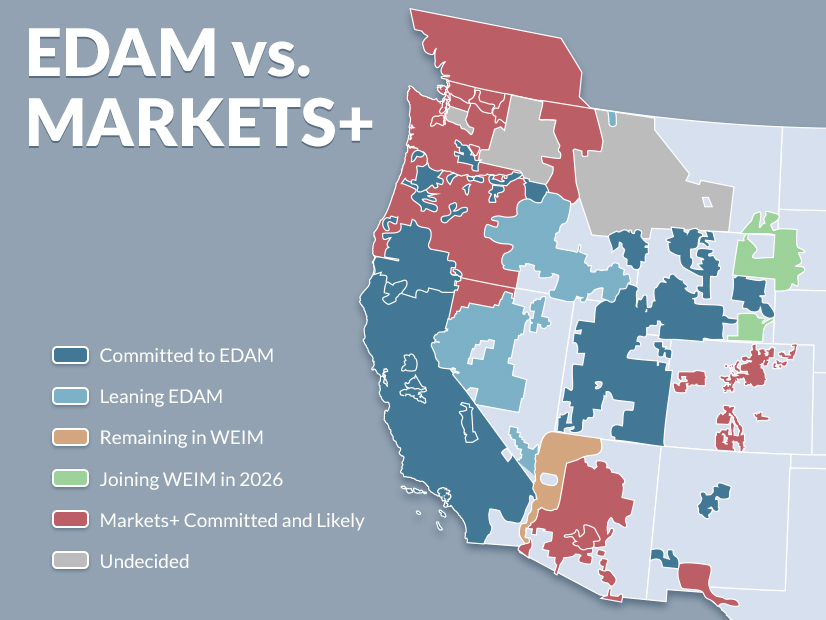
A new FERC report adds to the growing body of work showing the complexity of confronting the seams issues likely to arise between the West’s two day-ahead markets when compared with challenges at the borders between RTOs and ISOs in the Eastern U.S.
In their white paper “Seams Coordination in the Western Interconnection,” released Nov. 21, FERC staff urge Western electricity industry stakeholders to get ahead of seams issues before CAISO’s Extended Day-Ahead Market (EDAM) and SPP’s Markets+ both go live, scheduled to occur in 2026 and 2027, respectively.
And the authors recommend steps the two market operators can take to manage the myriad challenges — mostly unique to the West — related to the existence of seams between the markets.
The authors acknowledge the analyses already published on the issue, saying their report is intended “to support the ongoing discussions among stakeholders and highlight the importance of collaboration by relevant parties to address these complex issues.” (See ‘Islanded’ BAs Face Tough Choices in Western Market Future, Experts Say and Western Market Seams Issues to Differ from East, Study Finds.)
“These seams can create operational and reliability hurdles that arise from several related issues: overlapping transmission ownership and rights, differences in transmission modeling, and congestion caused by loop flow,” they said. “The same issues could diminish the economic benefits of EDAM, [CAISO’s Western Energy Imbalance Market], and Markets+ by limiting the ability to trade across markets.”
The paper outlines the history of seams coordination in the Eastern Interconnection, including the development of congestion management processes and market-to-market agreements typically wrapped into the joint operating agreements among RTOs such as PJM, MISO and SPP, and their neighboring non-market areas. Those JOAs include provisions for handling emergency energy flows between balancing authorities and managing trades across boundaries, such as through coordinated transaction scheduling (CTS), FERC staff noted.
The paper points to two efforts already underway to address seams issues in the West.
The first, not directly related to the two markets, is the joint work by CAISO’s RC West and SPP RC to propose improvements to the Western Interconnection Unscheduled Flow Mitigation Plan to the North American Energy Standards Board.
In April 2024, NAESB’s Enhanced Curtailment Calculator (ECC) Task Force — which includes members from both reliability coordinators — issued a white paper describing the problems with current unscheduled flow mitigation practices in the West. It explained that the region’s BAs and transmission operators largely rely on their own individual methods to resolve unscheduled flows, meaning that transmission customers on one system might experience curtailments for different reasons than similarly situated customers on a different system. To remedy the problem, the task force recommended expanded use of the ECC tool to bring more uniformity.
The second seams effort underway is the Markets+ Seams Working Group (MSWG), as well as work undertaken by other working groups helping to develop that market.
“From its inception, the MSWG was charged with supporting the development of seams coordination frameworks and identifying potential seams-related tariff content; early discussions on the working group’s scope included import/export and wheel-through issues and congestion management topics,” the paper says.
At the direction of the Markets+ Participant Executive Committee, the MSWG in 2024 began developing the Seams Strategy and Roadmap, designed to identify focus areas for policies and governing documents related to seams issues with neighboring areas.
Going to Flow-based Modeling
In the paper, FERC staff called out “three primary categories of issues that Western entities should consider addressing through seams coordination agreements,” including:
-
- use of flow-based modeling rather than contract path modeling;
- coordinating interchange between market areas to prioritize maintaining reliability and managing congestion; and
- coordinating electricity flows to maximize economic efficiency.
On the modeling issue, the authors note that transmission availability in the West is mostly modeled on contract path-based models that assume flows on contracted paths between generation sources and load sinks, compared with the flow-based approach in the East that relies on a flowgate methodology to calculate available transfer capability (ATC).
“Because flow-based modeling uses actual power flows to model the transmission system, it is generally considered to be more efficient and robust than the contract-path based methodology,” FERC staff wrote, adding that use of the two methods is “inconsistent” across the West.
“The continued use of contract path-based modeling and the use of different modeling methodologies may complicate efforts to maintain reliability, mitigate congestion and enhance economic benefits in the Western Interconnection. Thus, before discussing more specific approaches to coordinating operations in the West, it is important to ensure that the transmission availability and usage metrics these markets rely on be modeled as consistently and accurately as possible,” they wrote.
Adoption of flowgate modeling would have two benefits, they said: more accurate estimation of ATC and “better coordination across seams during day-ahead and real-time operations by market operators and BAs.”
Given that EDAM and Markets+ will rely on transmission capacity being made available by market participants rather than transmission owners handing over control of their systems as in a full RTO, FERC staff said, “flow-based modeling of ATC could provide a more accurate view of how much transmission is actually available to allocate between the markets compared to the results of contract path-based modeling prior to the actual day-ahead and real-time market runs.
“Western entities could investigate whether this would ease longer-term transmission expansion needs and make more transmission available for day-ahead and real-time market optimization.”
Managing Reliability, Congestion
On the subject of coordinating interchange between markets, FERC staff called the process a “key tool” in maintaining reliability and managing congestion.
“Agreements that formalize interchange procedures during critical system conditions between markets, as well as those between markets and non-markets, have generally provided greater certainty to system operators and improved cooperation between BAs. These include agreements such as emergency energy agreements, reserve sharing arrangements and JOAs,” they wrote.
The paper recommends that Western entities consider how reliability agreements across seams address data and model coordination, emergency event protocols, and loop flow management.
FERC staff wrote that the expansion of centralized markets in the West “introduces new challenges and opportunities for managing congestion between markets areas as well as between markets and non-markets,” with EDAM and Markets+ schedules potentially causing loop flows that extend beyond their borders.
To limit the effects of congestion, the paper recommends the adoption of M2M coordination, which seeks to reduce congestion at the lowest cost through the sharing of market pricing data between two RTOs/ISOs to bring about the most efficient redispatch.
Economic Trading Across Seams
The paper says cross-seam coordination of electricity transfers for cost savings likely will take on different forms in the West than in the East.
Part of that has to do with the differences between how EDAM and Markets+ deal with bidding at their interties with non-participating BAs.
Under existing WEIM and EDAM rules, participating BAs can decide whether to allow non-resource specific bidding at their interties with non-participating BAs. In Markets+, intertie economic trading will be implemented uniformly along its seams, allowing participants to submit buy and sell offers for imports and exports as long as they have the necessary transmission rights — an approach the authors say “could facilitate more economically efficient trading across its seams.”
FERC staff suggest that Western market operators could implement coordinated economic trading between their two areas. That might entail a practice such as CTS, which allows market participants to use a single portal to submit bids based on spreads between delivery points on either side of market seam.
The market operators also could implement “some form of interchange optimization” that gives them visibility into each other’s system and pricing for each trading interval. That approach would allow market participants to submit bids within their own markets, with the operators then using that information to determine whether they can meet their needs most economically from their own resources or from transfers out of a neighboring area based on transmission constraints and other factors.
The FERC paper did not explore another complicating factor for the Western markets compared with the East: the highly fractured boundaries between EDAM and Markets+ that likely will effectively island some participants — particularly in Markets+.
During a meeting of CAISO’s Western Energy Markets Regional Issues Forum in April, Richard Doying of Grid Strategies, one of the designers of the MISO market, noted that non-contiguous market zones “will require drive-out, drive-through and drive-in transmission service and schedules,” an arrangement that will require new types of transmission service and coordination to avoid diminishing the value the markets are intended to bring.
“The complex seams arising in the West from the expansion of Western markets presents challenges to operations, reliability and the efficiency of the markets,” FERC staff wrote in the conclusion of their paper. “To address these challenges, FERC staff believe it is important that Western entities continue their work coordinating operations to ensure the reliability and efficiency of their markets and BAs as Western markets proceed toward implementation and in advance of live operations.”