By Tom Rutigliano and Claire Lang-Ree
Load growth beyond PJM’s ability to serve is a clear and present danger to the reliability of the grid and the functioning of PJM’s markets. After stakeholders tried and failed to meet this challenge, it falls on PJM’s board to solve.
The politics around this are complex, but the answer is clear: The board’s duty is to protect the power grid and the 67 million people who depend on it. This requires decisive action. Putting off the problem or relying on hope are not options. (See PJM Stakeholders Reject All CIFP Proposals on Large Loads.)

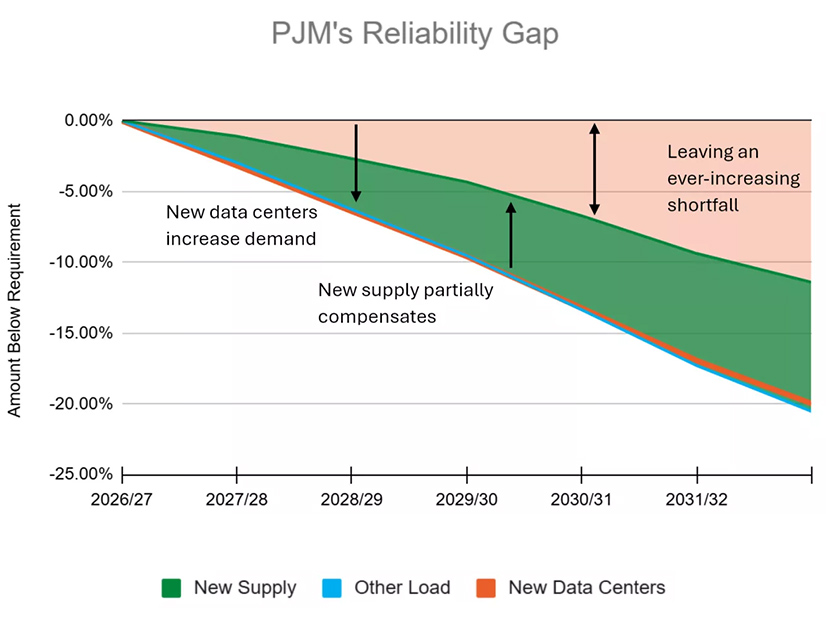
The sudden explosive growth of data centers might promise to add more load every year than PJM has added in the past 20. Persistent yearslong delays in getting new electrical generation online due to difficulties with the queue, supply chains and construction leave a sobering outcome.
PJM will barely meet reliability standards in 2026 and almost certainly will fall below them in 2027. The capacity market is pegged at its price cap with no prospect of relief. While the flood of new data centers overwhelms the trickle of new generation, things will only get worse.
In a way, the dire situation makes the board’s decision easy. The only way to keep PJM reliable is to hold back the flood. There are a few ways to do that.
Possible Solutions to Demand Growth
The Independent Market Monitor has proposed the direct approach of not letting data centers connect to the grid until supply is available.
Others, including NRDC and 50-plus state elected officials, have taken a softer approach: Let states decide if data centers can connect, but if they add demand faster than capacity, they will be first to be turned off in an emergency. (See Regulators Urge FERC to Honor State Authority over Large Load Interconnections.)

Whichever solution the board chooses first and foremost must prepare for the possibility PJM won’t have enough power to promise it to everyone who wants it. Physics leaves no room for compromise.
Other proposals before the PJM board have helpful components. State governors proposed a package of incentives for data centers to support the grid. Many point to the old bugbear of speculative data centers in the hope that more rigorous forecasts can shrink the problem.
These are encouraging, and we hope they work out. But these are just hopes. Hope may be the currency for poets and politicians, but it’s poor coin for engineers and economists. While the board should support every fair chance for a positive outcome, its duty is to prepare for the worst.
Capacity Price Relief Needed
The PJM board’s solution must include capacity price relief. The prices coming out of the reliability pricing model (RPM) right now serve no purpose. Thanks to delays, high prices won’t stimulate new entry in reasonable time frames. Nor are high prices needed to prevent retirements.
We’re coming off a six-year run of prices under $200/MW-day. It’s silly to argue that plants will retire if they can’t get paid double that. No matter what RPM does, any power plant that can make a spark should be able to name its price to tech companies.
The capacity market is being asked to do a job entirely outside what it was designed for, and it’s failing in a way that transfers tens of billions of dollars from the public to lucky generation owners who already were comfortably profitable. Those owners should be thinking about geese and golden eggs.
Avoid Two-tiered Queue System
One thing the PJM board should not do is enable any kind of fast track for new generation that harms projects that already are waiting in the queue.
For many years, PJM has been telling projects — including some required by state law or supported by federal policy — to wait in line. It would be unconscionable for PJM to reverse itself now and let projects that support data centers jump to the front of that line.
This threatens to create a permanent two-tier interconnection system, with one level of service for power plants that support data centers and second-class service for clean energy. PJM stakeholders rejected those concepts, perhaps remembering that open access and fair competition are one of the reasons PJM exists in the first place. The board should do the same.
There’s still room for improvement on interconnection. ERCOT has kept up with the data center boom in Texas in part thanks to their “connect and manage” approach, where new power plants join the grid as-is, accepting the risk that sometimes the transmission system might not be able to deliver their power. PJM should consider reforms like this. But no matter what PJM does on interconnection, no state should tolerate its clean energy laws being treated worse than tech companies’ commercial interests.
PJM requires independence from its board members. Nobody with conflicts of interest that could influence their objectivity is even eligible to serve.
This is for good reason. The board makes final decisions on vital issues for the power grid, often with billions of dollars at stake. There are 67 million people who rely on PJM making independent, objective decisions, even when those are unpopular or painful to some. Now is the board’s chance to justify this confidence.
Tom Rutigliano is senior advocate and Claire Lang-Ree is advocate for the Sustainable FERC Project at the Natural Resources Defense Council.