

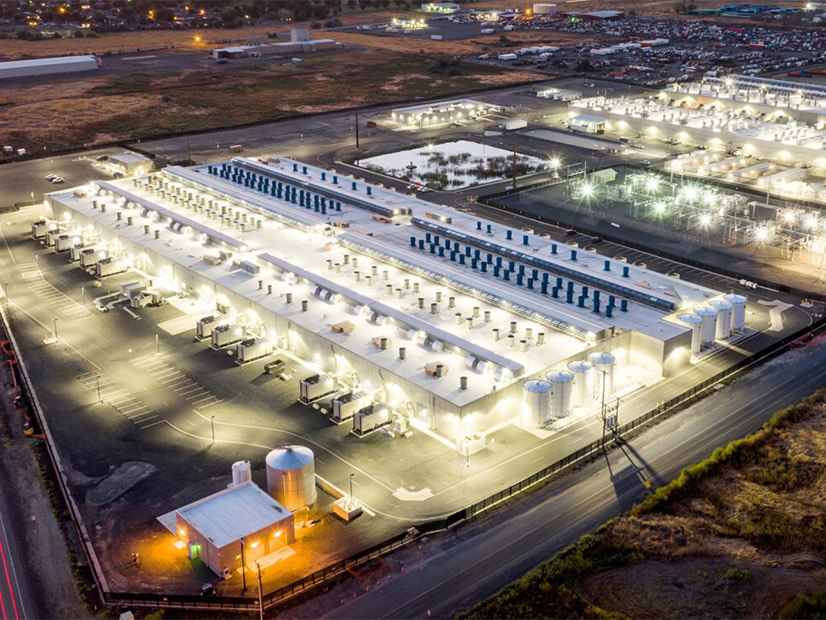
FERC has approved a transmission security agreement between PECO Energy and Amazon for a data center planned in Falls Township, Pa. (ER25-3492).
The data center is among the first in a $20 billion pool of investments Amazon announced it is making across Pennsylvania. It would not be co-located with any generation and would receive retail service under a schedule approved by the Pennsylvania Public Utility Commission, FERC said in an order issued Nov. 21.
The agreement includes a set of provisions intended to prevent costs associated with the interconnection from being shifted to other customers if the data center does not materialize. It lays out a ramp schedule on which the load is expected to come online, with shortfall payments if those milestones aren’t reached and termination fees if the load is permanently reduced. There is a committed revenue contribution that sets the baseline Amazon must pay, equal to 80% of what a load-serving entity would pay to serve 80% of the monthly load and billing — though that is subject to a customer shortfall event liability cap.
Monarch Energy Development and Constellation Energy argued the agreement should be considered on its own and not as setting precedent on other large load interconnections. The former said there are parallels between the agreement and a pending proposal from Commonwealth Edison seeking to require large loads to obtain a TSA.
Monarch also encouraged the commission to explore whether the PECO-Amazon agreement adheres to cost-causation principles, overestimates the risks large loads present to other customers and conflicts with the federal government’s goal of developing the infrastructure needed to support artificial intelligence.
The PJM Independent Market Monitor argued the agreement should not be approved unless it could be demonstrated that the data center would not adversely impact transmission reliability and resource adequacy. It also faulted the agreement for not considering the implications for energy and capacity market costs the added load could present for customers across PJM.
Throughout PJM’s Critical Issue Fast Path (CIFP) process focused on large load interconnections, Monitor Joe Bowring held that the RTO should not be obligated to accept load it cannot serve reliably, a stance the IMM extended to LSEs in comments on the TSA.
“Despite the protections included in the TSA, it is not just and reasonable to allow the interconnection of this large new data center load when it has not been demonstrated that either PECO or PJM has the capacity available to reliably serve this load,” the Monitor wrote.
It also filed a complaint against PJM on Nov. 25 arguing that its CIFP proposal would require it to accept large load interconnections it cannot reliably serve, degrading the quality of service for existing customers while imposing higher costs (EL26-30).
The commission determined the agreement can be limited to ensuring that Amazon contributes to PECO’s transmission revenue requirement without needing a demonstration that the load will not affect reliability.
“Given that the IMM raises no issue with the terms of the transmission security agreement itself, but rather raises concerns with the provision of service to the data center under PECO’s retail tariff and the provision of transmission service to large loads generally, the IMM’s concerns do not provide a basis upon which to reject the transmission security agreement,” FERC wrote. “We also note that the Pennsylvania commission retains authority to establish terms of retail service between Amazon and PECO, including retail consumer protection provisions.”
Commissioner Judy Chang concurred, writing that the agreement includes some consumer protections and recognition of state authority over retail rates, while urging the commission to develop a comprehensive framework for assigning transmission upgrade costs.
As large load interconnections with significant impacts to the grid become more common, she said the commission’s “higher of” policy could serve as a framework for determining how those costs could be allocated. Under that model, large loads pay the greater of the embedded or incremental cost rates, which she wrote would ensure that a large load pays for network upgrades it triggers.
“It may be time for the commission to proactively consider how to guarantee sufficient customer protections, such as the ‘higher of’ pricing policy, to ensure that we do not outsource our customer protection responsibility to bilateral agreements by the utilities we regulate,” she wrote.
She wrote it’s especially important for agreements between utilities and large customers to recognize the contours of state jurisdiction, particularly when the Mobile-Sierra public interest standard of review is applied, as in the PECO and Amazon agreement.
“Given the potential magnitude of new transmission investment triggered by large load additions, concerns about costs are increasingly spilling into commission proceedings, raising complicated jurisdictional and policy questions with significant implications for both state and federal regulators,” she wrote. “This critical affirmation will help ensure that the commission’s acceptance of the agreement and possible similar agreements in the future recognizes and preserves states’ essential role in protecting retail customers.”



