The Supreme Court appeared ready to overturn a precedent that has maintained the independence of regulatory agencies like FERC for the past 90 years.
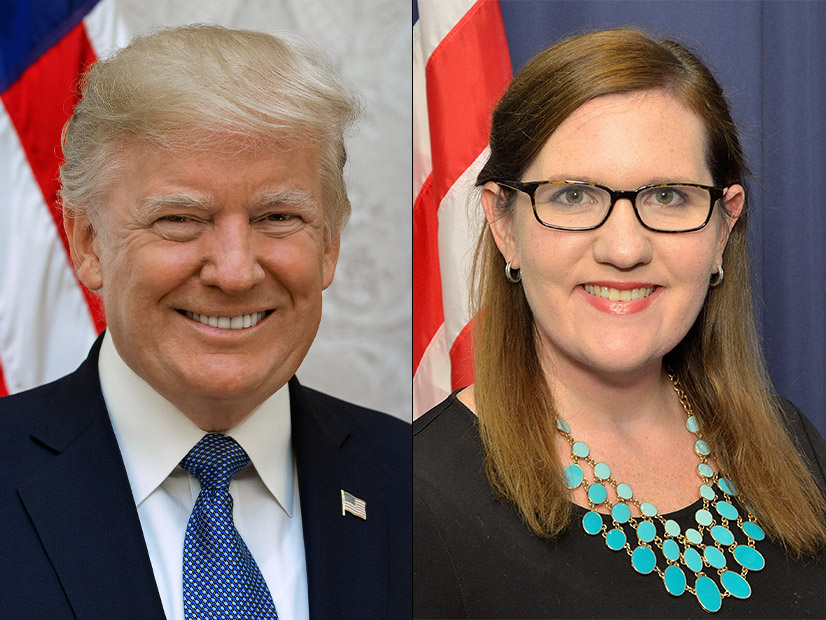
Justices heard oral arguments in Trump v. Slaughter, a case that springs from President Donald Trump firing Federal Trade Commissioner Rebecca Slaughter earlier in 2025. Commissioners at the FTC, FERC and other agencies enjoy “for cause” firing protections under Humphrey’s Executor, which a recent amicus brief argued has ensured agency independence. (See Former FERC Commissioners Ask Supreme Court to Preserve Agency Independence.)
Multiple justices appointed by Republicans questioned Amit Agarwal, the special counsel for Protect Democracy who argued for Slaughter, on why Congress could not just expand multimember commissions to take over the work of EPA or the Commerce Department, thus insulating them from presidential oversight.
Some executive agencies, including the State Department and the Department of Defense, are pre-empted from that entirely under the Constitution because they are wielding the president’s “conclusive and preclusive constitutional authorities,” Agarwal said.
Chief Justice John Roberts asked whether Congress could reorganize the Department of Veterans Affairs, or the Department of Education, so they are run by a commission with officers that could be removed only for cause.
“Yeah, I think that it is probably within the realm of possibility for agencies, yes, Chief Justice Roberts,” Agarwal said. “And the constraint historically has been that these types of determinations have been made through a process of political accommodation between Congress and the president.”
Justice Elena Kagan argued that the bigger risk would not be Congress usurping executive authority with new bipartisan commissions, but that if the Trump administration wins, then the Education Department still would be authorized by Congress but without any employees.
“I think you’re absolutely right, Justice Kagan, that there are competing dangers here, and it makes a whole lot of sense to us to weigh the real-world dangers that we know are a virtual certainty that would result from adopting petitioners’ constitutional theory,” Agarwal said.
He then added that Congress has never tried to convert an executive agency, as Roberts and several other justices postulated it could. Justice Amy Coney Barrett said that does not prevent that from happening in the future.
In Humphrey’s Executor, the court recognized that such agencies exercise legislative and judicial powers while still engaging in some executive function, but that does not make it an executive agency, Justice Ketanji Brown Jackson said.
Many agencies have been involved in civil enforcement cases, and the Supreme Court has never found any of them were therefore ineligible to have principal officers covered by for-cause protection, Agarwal said.
“You are just saying that the way the law has been interpreted by the court here, the existence of Humphrey’s and Congress’ reliance on these kinds of multimember agencies for something like 90 years plus, that’s the background rule,” Jackson said. “And so now it’s up to the government and the solicitor general to come in to suggest that there’s a constitutional problem with that.”
The FTC Act is 111 years old, and Humphrey’s has been case law since 1935, Agarwal noted, and he argued that similar setups go back to the earliest days of the U.S.
Justice Brett Kavanaugh asked whether it would be appropriate to give FTC commissioners or others with protections under Humphrey’s Executor terms of up to 20 years. Agarwal argued that would be prevented by the Take Care Clause in Article II, Section 3 of the Constitution, as commissioners’ time in office would span multiple presidencies.
“We don’t dispute that the activities of these agencies are operating within the purview of the executive branch and they should be subject to constitutionally appropriate presidential supervision,” Agarwal said.
Most of the regulators at issue in the case allow the president to pick a chair from among Senate-approved members for any reason, and Kavanaugh asked if that was required. Agarwal said it was not constitutionally required because when Humphrey’s Executor was decided, the chair of the FTC was not removable, though the law changed 15 years later.
“I think putting those three together, your position would allow Congress to create independent agencies, maybe converting some of the existing executive agencies into independent agencies with no political balance requirement, with a long term, say, 10 or more years, and with the chairs not subject to removal as chair,” Kavanaugh said. “So, you can imagine a situation — and I just want to give you a chance to deal with the hard hypothetical — when both houses of Congress and [the] president are controlled by the same party [and they create] a lot of these independent agencies or extending some of the current independent agencies … so as to thwart future presidents of the opposite party.”
That would be constitutionally untenable because the president needs the authority to enact the law, Agarwal said. He cited Seila Law v. CFPB, in which the court found that the Consumer Financial Protection Bureau, which was run by one executive director, was not covered by Humphrey’s Executor, but the FTC, with its staggered seven-year terms and removeable chair, is on the right side of the line.
“If it is really true that these kinds of for-cause removal protections, which after all authorize the president to fire commissioners just for good cause, if they really pose this fundamental threat to the Republic, petitioners could take their argument across the street and Congress could solve the problem tomorrow,” Agarwal said. “They’re not willing to do that.”
The Federal Reserve Board of Governors benefits from the same protections as the FTC and FERC, but in a decision earlier in 2025 overruling the stay a lower court had placed on Trump’s firing of National Labor Review Board (NLRB) and Merit Systems Protection Board (MSPB) members, the Supreme Court indicated its own separate legislative history.
Kavanaugh asked Solicitor General D. John Sauer about whether the effort to bring other regulatory agencies under greater presidential control would undermine the central bank’s independence.
“We recognize and acknowledge what this court said in the [Trump v. Wilcox] stay opinion, which is that the Federal Reserve is a quasi-private, uniquely structured entity that follows a distinct historical tradition of the First and Second Banks of the United States,” Sauer said.
Any issues of removal restrictions from the Federal Reserve would raise their own unique distinct issues, he added.
Justice Kagan then asked, based on the arguments that all executive power is vested in the president, what would stop the courts from expanding the decision to cover even the civil service.
“Employees are wielding executive power all over the place, and yet we’ve had civil service laws that give them substantial protection from removal for over a century,” Kagan said. “How about those?”
Sauer said the case was not challenging the structure of the civil service, and the court has made clear in past decisions that its impacts are limited to the issues at hand.
“Logic has consequences,” Kagan said. “Once you use a particular kind of argument to justify one thing, you can’t turn your back on that kind of argument if it also justifies another thing in the exact same way. Putting a footnote in an opinion saying, ‘We don’t decide X, Y and Z because it’s not before us,’ doesn’t do much good if the entire logic of the opinion drives you there.”
D.C. Circuit Weighs in
Just days before the Supreme Court heard oral arguments in the Slaughter case, the D.C. Circuit of Appeals issued a decision in the case involving fired members of the NLRB and MSPB.
The court sided with Trump in the firings, but without overturning Humphrey’s Executor.
“Congress may not restrict the president’s ability to remove principal officers who wield substantial executive power,” the two-judge majority said. “As explained below, the NLRB and MSPB wield substantial powers that are both executive in nature and different from the powers that Humphrey’s Executor deemed to be merely quasi-legislative or quasi-judicial.”
The majority noted that after Humphrey’s Executor, other decisions had erased the distinction about “quasi-legislative” and “quasi-judicial,” while others found that only three kinds of constitutional power exist and only executive power can be delegated.
“These considerations suggest that very little remains of Humphrey’s Executor,” the circuit court said.
Judge Florence Pan filed a dissent to the decision, saying some agencies’ independence benefits the public and the multimember commissions at issue in Humphrey’s Executor have been around for 138 years.
“For at least 90 years, it has been settled law that Congress may impose statutory for-cause removal protections in the exercise of its authority to organize and structure the executive branch,” Pan wrote. “But today, my colleagues make us the first court to strike down the independence of a traditional multimember expert agency: They hold that the for-cause removal protections that safeguard the political independence of the National Labor Relations Board and the Merit Systems Protection Board are unconstitutional.”