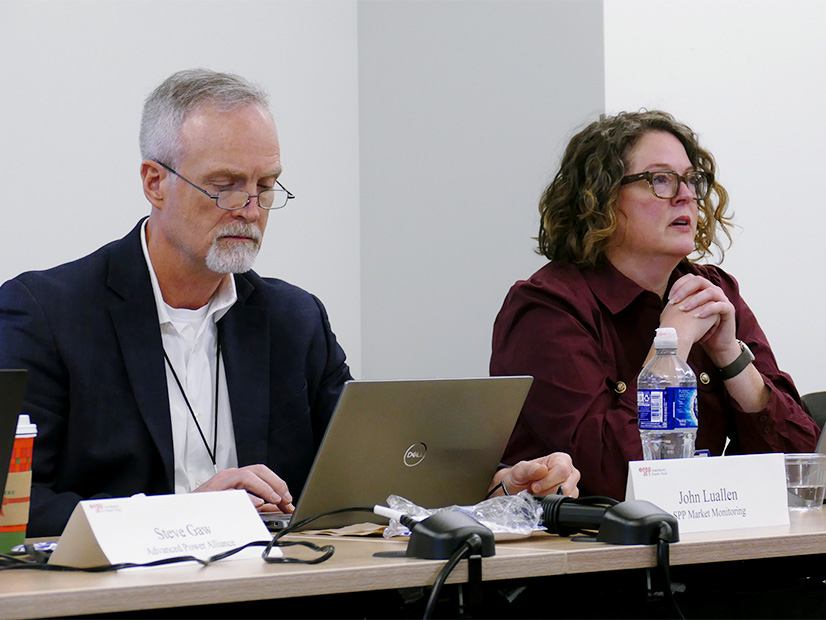
DENVER — The SPP leadership team responsible for strengthening the grid operator’s resource adequacy construct and recommending policy directions closed out 2025 by endorsing two protocol changes related to demand response and the cost of new entry.
Meeting Dec. 3 during Denver’s first snowfall of the season, the Resource Energy and Adequacy Leadership (REAL) Team approved combined policies for demand response and load-responsible entity peak demand assessments and the value of the cost of new energy for 2026, representing the cost to build a new power plant.
The CONE value, increased to $139.85/kW-year for summer 2026, passed unanimously. However, the REAL Team split 7-5 over the DR and peak demand assessments (RR703), emblematic of the difficulty SPP has had in developing a demand response policy since 2017.
“Everyone knows that SPP has been in increasing complex and challenging issues all the time, and here we are again,” REAL Chair Kristie Fiegen, with South Dakota’s Public Utilities Commission, said after the vote. “The stakeholders have worked very, very hard on this. We have listened to a lot of comments the last six months, and we’ve made a lot of changes. Is it perfect? No.
“So, it may not be perfect today, but we can always come back to it, because we will continue to monitor and adjust this in the future.”
“We’re at a point where staff has considered input from a bunch of different stakeholders … It’s gotten us to a point where I think at least staff is comfortable and [can] support the policy, but it’s not ever going to be ideal,” said Natasha Henderson, SPP’s senior director of grid asset utilization. “I think the policy that we have before us does an adequate job of balancing that as we walk forward. We are going to learn and check and adjust.”
Henderson said the policy has reached the point where “hopefully, people can agree that it’s just and reasonable” and that it balances the affordability and reliability equation at the forefront of the utility industry.
SPP says demand response is “increasingly critical” as it looks at a future with rapid load growth, evolving resource mixes and tighter energy conditions. DR supports reliability, stabilizes prices during uncertainty and helps the region adapt to changing system dynamics, it said.
Staff said a structured DR policy provides entities with multiple participation pathways and market, reliability and potential load-modifying products. It will also help defer the cost of new generation and supporting resource adequacy compliance.
The intent is to increase the visibility and ability to deploy demand response by creating a participation model and accreditation framework for non-price-sensitive DR. SPP seeks to incent LREs to manage peak loads by qualifying non-registered or load-modifying demand response capable of performing when their peak loads exceed their qualified resources.
The assessment will require LREs to use qualified resources to meet demand when accounting for the risk considered in the loss-of-load expectation study that sets the planning reserve margin requirements. That will mean an accurate 50-50 forecast and not one that incorporates all risks.
The peak demand assessment (PDA) is a CONE-based evaluation performed after a weather season based on the variation of actual load from the entity’s load forecast.
The measure was opposed by Evergy’s Denise Buffington, Oklahoma Corporation Commission staffer Jason Chaplin, the Advanced Power Alliance’s Steve Gaw, Oklahoma Municipal Power Authority’s Dave Osburn and American Electric Power’s Richard Ross.
Ross proposed what he called a post-season review to identify the LREs with the largest underforecast amount, requiring them to explain their error in a report that would be delivered to the board’s Oversight Committee. He referred to the review as casting sunshine on any chronic forecasting problems and force members to “sharpen their pencils.”
“I think ours is pretty sharp as it is, but we can do more,” Ross said. “Some folks make fun of my cute little phrases, but the framework would be much like SPP is going to do already.”
“I can’t help but point out the irony of Richard’s ‘sunny day’ proposal when it’s snowing,” Henderson said, gesturing to the falling snowflakes outside.
She reminded the REAL Team that SPP’s tariff requires that a post-season analysis be conducted and a report published. Henderson said the report reviews every LRE and is then discussed by the Supply Adequacy Working Group.
Carrie Bivens, vice president of SPP’s Market Monitoring Unit, said the Monitor still had some outstanding issues with the proposed changes, despite its engagement with RTO staff. She called for clarity around dual participation to “clearly prohibit” loads that are already in a retail program from participating in DR but saved the bulk of her comments for the LREs’ peak demand assessment.
“This is a significant one for us,” Bivens said.
She said the MMU supports the policy’s key objective of efficiently deploying load-modifying resources to manage peak loads and could support a PDA to accomplish this if it assesses deficiencies based on actual load but does not support the current framework.
“If we continue down the path … we think that the deficiencies need to be based on actual load, and that would mean no error tolerance and no weather normalization,” she said. “We do think that this framework, the way it is proposed, actually weakens the RA incentive structure. We just think this policy inappropriately socializes risk to the members.”
In response, Henderson said SPP has already opened three DR-related strategic initiative requests (SIRs 812, 814 and 816) to tackle the MMU’s concerns. The grid operator uses SIRs as part of its strategic road map to meet its long-term goals.
CONE Value Changed
The REAL Team endorsed the CONE’s value — setting it at $139.85/kW-year, up from the current $85.61/kW-year — but did not vote on any changes to the calculation’s process.
SPP bifurcated the proposed tariff change (RR729) following feedback from the REAL Team, the Supply Adequacy Working Group and other stakeholders. Staff said a new revision request will be introduced to address broader process changes, allowing additional time for stakeholder feedback and further development of the inputs and assumptions used to recalculate the CONE’s value.
The grid operator sets its CONE value annually by Nov. 1. Resource adequacy staff adjust the value for inflation and update tax rates and interest rates. It uses U.S. Energy Information Administration data for a generic generator in a region without any special considerations for altering cost as part of the calculation.
The REAL Team unanimously endorsed the measure, with Buffington abstaining.
The Board and Directors and Regional State Committee must both approve the CONE value change.
Fall Alert Hours Drop in 2025
SPP staff told the REAL Team that operations alerts and advisories, which have increased over the past three fall seasons, resulted in only 45 alert hours this year. In October 2024, the grid operator issued a conservative operations advisory and went through 194 alert hours.
Staff said mild September weather and fewer resource outages in late October led to the decrease.
More than 26 GW of outages were recorded in mid-October, consistent with outage trends during the shoulder months in the last three years. By early November, outages were tracking as much as 4 GW below the five-year norm.
Still, the grid operator issued its first resource advisory of the winter Nov. 29 for the entire balancing authority because of expected high peak loads, wind forecast uncertainty, severe cold weather and potential for above-normal generation outages.
SPP treats resource advisories to be normal operating conditions, two steps away from a Level 1 energy emergency alert. Resource advisories are issued to raise awareness in the market and don’t require conservation measures.
The RTO issued seven resource advisories and three conservative operations advisories — the last step before an EEA — during the summer. Staff issued 11 resource advisories during the summer of 2024 and three calls for conservative operations.
New Leadership to Meet
The REAL Team meeting was the last for Fiegen, who has chaired the group since its inception in 2023.
Chuck Hutchison, a member of the Nebraska Power Review Board, will succeed Fiegen as chair in 2026. He said he and SPP Board Chair Ray Hepper and SPP’s Henderson and Casey Cathey will meet to discuss the REAL Team’s work plan for next year.