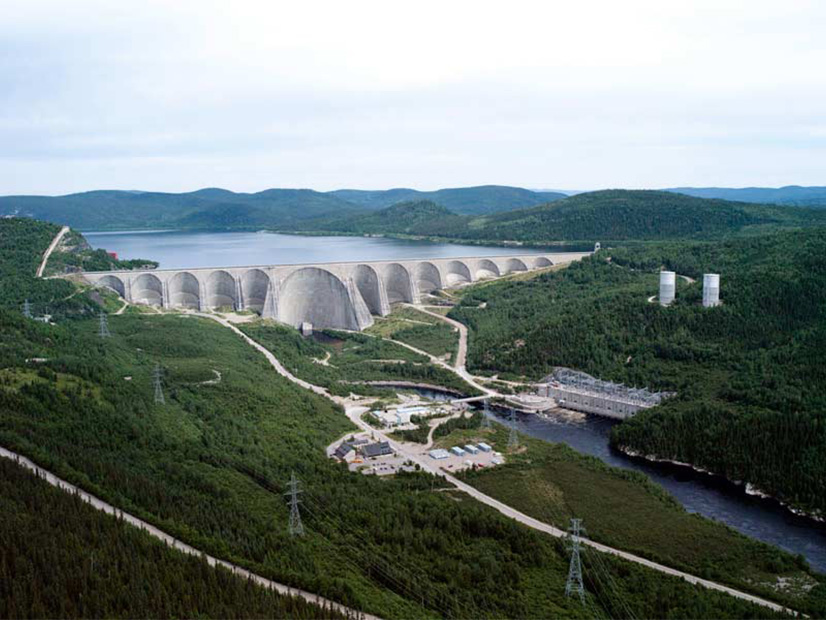
ISO-NE presented the final stakeholder-requested sensitivities for its 2024 Economic Study at the Dec. 17 meeting of the Planning Advisory Committee, discussing the potential effects of adding 3.9 GW of hydropower to the Hydro-Québec system.
The study, which began in March 2024, aims to evaluate long-term changes to the region’s power system. ISO-NE published the final report in September. The RTO previously discussed stakeholder-requested sensitivities related to advanced solar panels, demand flexibility, thermal generator retirements and a halt on offshore wind development.
The hydropower sensitivity is intended to reflect the potential impacts of a preliminary agreement between Newfoundland & Labrador Hydro and Hydro‑Québec to add a large amount of new hydropower capacity.
Growing demand, extended drought conditions and international HVDC transmission projects have caused Québec to pull back on its exports to New England in recent years. (See Drought, Climate Drive Uncertainty on New England Imports from Québec.) However, ongoing efforts to add significant amounts of new generation throughout Eastern Canada may provide a long-term answer to tightening system conditions.
ISO-NE’s modeling indicates that the added hydropower capability would increase New England’s net imports by about 6.2 TWh relative to the reference case, equal to about a 60% increase.
Net imports to New England from Hydro‑Québec increase by 5.6 TWh under the scenario, while New England remains a net exporter to New Brunswick, ISO-NE’s Ben Wilson said.
The modeling indicates that the increased imports would reduce annual production costs in New England by about $448 million relative to the reference case. This would reduce the economic benefit of congestion relief on the New England system by lowering the potential cost gains associated with displacing marginal resources.
Wilson added that power exchanges with Hydro‑Québec likely would be “much more bidirectional than in recent years, which have seen mostly unidirectional interchanges.”
ISO-NE conducted a sensitivity analysis looking at gas price differentials across New England and New York. The RTO modeled a uniform gas price across the Northeast Power Coordinating Council in the reference case. ISO-NE said this approach was needed because of its limited insight into the trends affecting fuel prices and by the challenges associated with forecasting fuel prices a decade into the future.
Modeling gas price differentials caused gas prices in New England to increase, pushing up ISO-NE locational marginal prices and production costs.
“Net imports into New England increase by 3.6 TWh while using a gas price differential, with most of the additional energy coming from [New York],” Wilson said, adding that the higher New England energy costs in this sensitivity increased the value of congestion relief.
Asset Condition Projects
Also at the PAC meeting, representatives of transmission owners presented on asset condition projects.
Dave Burnham of Eversource Energy introduced a nearly $6 million project to replace optical ground wire on a line in Western Massachusetts.
The project was placed in service in October, he said, noting that Eversource initially did not present the project to the PAC because it fell short of the $5 million threshold for project presentations. Cost overruns, stemming in part from “unanticipated requirements” from the Massachusetts Department of Transportation, pushed the project past the threshold, he said.
The extra fiber capacity is needed “to support critical communications and to provide redundancy to avoid loss of communications during failures or outages,” Burnham said.
Joshua Cefaratti of United Illuminating gave an update on a flood mitigation project in Connecticut. Estimated project costs have increased from about $26 million to about $43 million since the company initially presented the project in 2021. The higher cost is largely from increased labor and materials costs, he said.
Kyra Lagunilla of Rhode Island Energy gave an update on a line rebuild project that initially was presented by National Grid in 2005. Rhode Island Energy bought National Grid’s Rhode Island gas and electric utility business in 2022. The project’s drawn-out timeline has been driven largely by delays associated with community engagement, ISO-NE said.
Rhode Island Energy has withdrawn the original transmission cost allocation for the project and plans to submit a new one, Lagunilla said. The project has an estimated pool transmission facility cost of nearly $14 million.