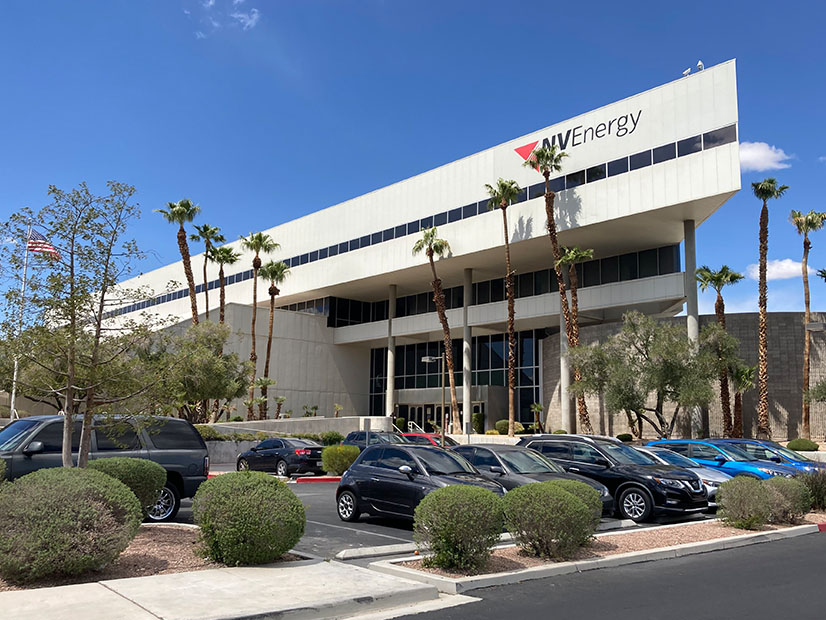
Future participants in CAISO’s Extended Day-Ahead Market already have held extensive talks about developing an alternative to the Western Power Pool’s Western Resource Adequacy Program for non-CAISO EDAM members, NV Energy confirmed in a filing with Nevada utility regulators.
A smaller group of utilities began initial discussions as early as spring 2025, with participation expanding during the summer, according to the Dec. 18 filing the Las Vegas-based utility holding company submitted to the Public Utilities Commission of Nevada (PUCN) in response to questions about its decision to withdraw from the WRAP.
The Pathways Initiative’s Regional Organization for Western Energy has been floated as a potential overseer of an EDAM-aligned RA program. (See Pathways’ ROWE Could Offer Western RA Program, PGE Says.)
“Currently, the discussions have been informational to gain a better understanding of CAISO’s capabilities for this type of service and a high-level understanding of other resource adequacy design choices,” NV Energy, parent of Nevada Power and Sierra Pacific Power, wrote in the filing. “The group is beginning to discuss high level preferences on design in order to understand if there is enough consensus to move forward into more detailed discussions.”
“CAISO is participating in regular discussions with those EDAM participants that are exploring concepts around resource adequacy in the West,” ISO spokesperson Jayme Ackemann told RTO Insider in an email. “Those exploratory conversations are being led by participating utilities. CAISO’s involvement to date has been engaging through participation in a technical advisory capacity in weekly, informal work group discussions.”
Ackemann said CAISO could potentially play a role in facilitating the program, “but no specifics have been determined at this time.”
The group of EDAM utilities, whose names have been redacted from the version of the document made available publicly, met seven times this summer to discuss a potential program.
Discussions among the larger group began after a summer meeting between WRAP participants and WPP leaders to talk about “outstanding issues” with the WRAP ahead of the upcoming Oct. 31 deadline for committing to the program’s first “binding” — or penalty phase — season in winter 2027/28.
Five utilities withdrew from the WRAP before the deadline, including four future EDAM participants: NV Energy, PacifiCorp, Portland General Electric (PGE) and Public Service Company of Nevada (PNM). Of the 16 participants committing to the program, most plan to join SPP’s Markets+, which requires participation in the RA program. (See WRAP Wins Commitments from 16 Entities.) Some withdrawing entities have indicated they could re-enter the program if certain concerns are addressed.
According to the filing, the EDAM group discussed whether “there was a desire to work on a potential resource adequacy program for EDAM and what guiding principles might be important.”
The group on Oct. 15 held a kickoff meeting for “more robust” and regular discussions and weekly meetings began Oct. 31, with a two-day, in-person session to be held in January 2026.
“The group is working towards high-level design consensus between potential participants with an understanding that the overall program will need to be designed in detail through a stakeholder process,” NV Energy wrote.
The filing reveals that the smaller group met almost every other week from April until August, commissioning the Western RA study published by The Brattle Group in November that found “the non-CAISO EDAM footprint offers significant resource adequacy benefits, on par with and possibly exceeding the resource adequacy benefit of the current WRAP footprint.” (See Brattle Study Finds Similar PRMs Under Alternative Western RA Footprint.)
Brattle prepared the report on behalf of the Balancing Authority of Northern California, Idaho Power, the Los Angeles Department of Water and Power, NV Energy, PacifiCorp, PGE, PNM, the Sacramento Municipal Utility District and Seattle City Light.
Among that group, only Idaho Power and Seattle City Light have committed to the WRAP’s first binding season, although the former’s commitment came with qualifications about how certain elements of the program takes shape over the next two years.
“The Brattle study illustrates that an EDAM resource adequacy footprint would be comparable to the subregions that currently exist in WRAP,” NV Energy wrote in its filing. “Therefore, there is potentially a viable option that could be developed for EDAM without the WRAP issues identified in” the company’s Aug. 29 testimony to the PUCN, which pointed to the “high financial risk” it faced from WRAP penalties in the binding phase, along with other issues with the program. (See NV Energy to Withdraw from WRAP.)
Although it did not sign on to the Brattle study, California’s Imperial Irrigation District has told RTO Insider it has participated in the EDAM RA program discussion.
‘Excessively High’
NV Energy’s Dec. 18 filing quantifies the financial risk the company foresaw from participating in the WRAP.
While a chart in the filing redacts the megawatt values of NV Energy’s capacity surpluses and deficiencies for the WRAP’s summer and winter seasons between 2023 and 2028, the company notes its subsidiaries have met program requirements for every non-binding winter season since 2022/23 and likely would meet winter requirements for 2026/27 and 2027/28.
But summer is a different matter. NV Energy was short resources for each summer season between 2023 and 2025 and is expected to come up short in the first binding summer of 2027. That shortfall would have exposed the company to more than $90.7 million in deficiency charges, or just under $22.7 million with a potential 75% reduction in penalties in the early part of the binding phase, according to its estimates.
NV Energy pointed out that its “primary issue” with WRAP is its “excessively high” deficiency charge, which is calculated on a $91.81/kW-year cost of new entry (CONE) value, set by the WRAP CONE Penalty Task Force in 2022.
A WRAP proposal “states that the WPP will update the CONE annually, but this has not occurred. This is the only value that has been published to date; therefore, this is the value that [NV Energy] utilized for the deficiency charge calculations knowing that today’s penalties are likely much higher,” NV Energy wrote.
NV Energy notes that a proposal by the WRAP’s Resource Adequacy Participants Committee to implement a policy of deferring deficiency charges for up to five years if a participant shows it is making a commercially reasonable effort to resolve a shortfall does not address its concern about the level of the charges.
“Regardless, this proposal has merit and could be of assistance in the event of any penalty, given the supply chain issues and industry uncertainty currently in place,” the company wrote.
NV Energy also expressed concerns about the feasibility of efforts by the WRAP’s Day-Ahead Market Task Force to possibly align the program’s operational subregions with the EDAM and Markets+ footprints.
“The approved concept paper envisions an operations program sharing calculation that occurs at each individual market footprint for sharing amongst those participants before a sharing calculation between the participants in both markets,” it wrote.
The company said the concept remains “incomplete” in that it does not yet address how participants that will remain in CAISO’s Western Energy Imbalance Market and not join a day-ahead market will function under a paradigm designed for the two day-ahead markets.
NV Energy said the concept paper also fails to address how the WRAP’s forward showing regions would be affected by such an alignment with respect to issues such as transmission connectivity to support the viability of a footprint.
“The forward showing footprint matters because it is utilized for the modeling of the one-event-in-10-year loss-of-load metric to determine the [planning reserve margins] or resource adequacy requirement for the participants,” the company wrote. “If the market footprint does not have access to the same forward showing footprint used for planning, then the participants within that market will no longer be planning for the reliability metric which has been used as an industry standard.”