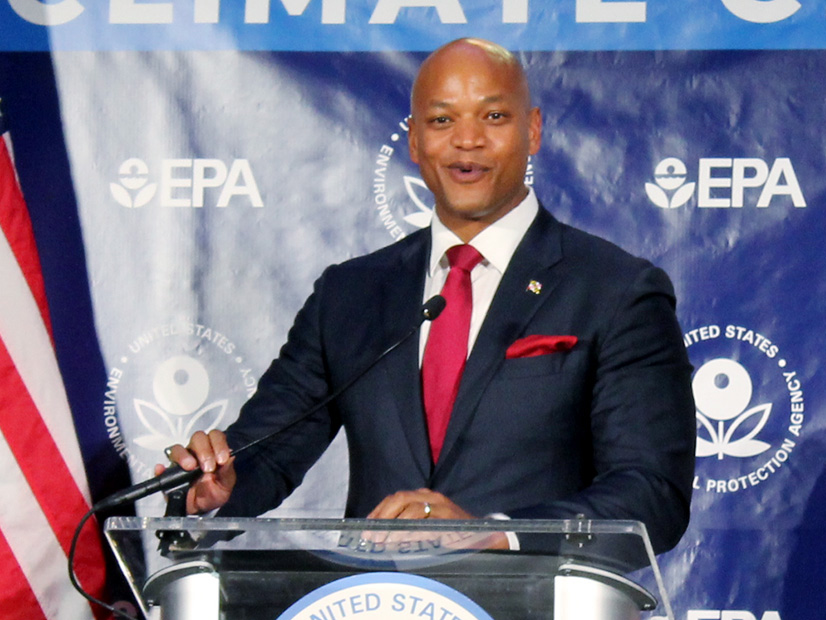
Maryland Gov. Wes Moore (D) issued an executive order aimed at ensuring reliable and affordable power just a couple of days after PJM’s capacity auction cleared short of its reserve margin target. (See related story, PJM Capacity Auction Clears at Max Price, Falls Short of Reliability Requirement.)
The order, “Building an Affordable and Reliable Energy Future,” was issued Dec. 19 and seeks to optimize permitting processes, agency review and site preparation to facilitate the deployment of shovel-ready projects needed to close the projected capacity gap.
“Over the last few years, utility bills have spiked, and for many Marylanders, energy policy has stopped being technical and started being personal,” Moore said in a statement. “This order addresses the untenable system causing these costs to skyrocket. We are putting affordability and reliability at the center of the conversation to ensure our system works for the people who use it, not just the companies that run it.”
The order creates a new “Energy Subcabinet” that will be chaired by the director of the Maryland Energy Administration (MEA), with members from cabinet agencies, Moore’s deputy chief of staff and other cabinet-level officials as designated by the governor.
A day before the executive order, Moore’s office announced that Kelly Speakes-Backman would be the new director of the MEA effective Dec. 24, after former Director Paul Pinsky retired. Speakes-Backman is a former Maryland PSC commissioner and deputy assistant secretary at the U.S. Department of Energy.
“Kelly Speakes-Backman is a trailblazer in the energy industry with the deep expertise and track record to lead the Maryland Energy Administration,” Moore said in a statement. “She is a proven public servant who believes in our state, understands our energy system and knows how to turn policy into lasting results. We are proud to welcome her back to state service as we work together to build a more affordable, competitive and sustainable future for all Marylanders.”
The Energy Subcabinet will meet at least quarterly to align state resources and ensure that energy policy decisions support the state’s affordability, reliability, economic competitiveness and environmental goals. The subcabinet will review proposed energy legislation or administrative policies and draft recommendations on them.
In addition to the subcabinet, the order creates the Maryland Energy Advisory Council, which will be chaired by Speakes-Backman and include representatives from the state Senate, the House of Delegates, the PSC, the Office of People’s Counsel, the Maryland Clean Energy Center, regulated utilities, PJM and other stakeholders.
The council is charged with identifying barriers to the deployment of generation facilities and affordability. Within 180 days, it will submit a memorandum to the subcabinet identifying the biggest challenges to affordability and reliability.
The MEA must submit written recommendations to the speaker of the House of Delegates and the president of the Senate by Jan. 16, 2026, that identify strategies to mitigate rate impacts. It will evaluate regulatory, administrative and planning tools that align implementation of the State Energy Plan with affordability and reliability, and it will outline consideration for any energy legislation next session.
The order includes a clause saying nothing in it will impact the PSC’s independence, but MEA will file some petitions with the regulator. The first will seek a review of the budget billing programs at utilities. The second will seek a regulatory strategy that prioritizes flexible and optimized lower-cost grid solutions. The third will seek rule changes requiring utilities to evaluate advanced transmission technologies (ATTs) and grid-enhancing technologies (GETs).
A work group of the subcabinet will examine ways to modernize the state’s transmission infrastructure, including using ATTs and GETs and building new transmission lines and other infrastructure such as battery storage on state-owned rights-of-way.
Another work group of the subcabinet will be set up to examine sites around the state that can be used quickly to develop new energy infrastructure.
The American Council on Renewable Energy welcomed Moore’s executive order in a statement.
“ACORE commends key provisions in the order to increase the deployment of advanced transmission technologies; streamline the siting and permitting of high-voltage transmission, energy storage and other infrastructure; advance wholesale market reforms; and more,” ACORE CEO Ray Long said. “As the country enters a new era of electricity demand, initiatives like Gov. Moore’s will facilitate significant progress toward building a modern and reliable grid needed to maintain economic competitiveness and keep the lights on.”