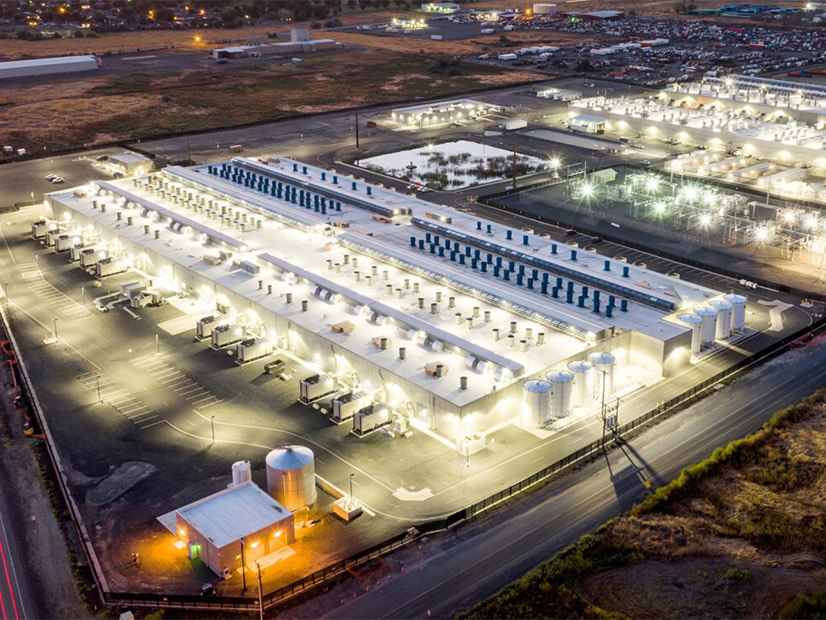
PacifiCorp filed a partial motion to dismiss a complaint Amazon Data Services submitted to Oregon regulators alleging the utility had breached agreements to provide electric service to four data centers in its service territory.
Portland-based PacifiCorp filed the motion with the Oregon Public Utility Commission on Dec. 19, along with a nearly 40-page answer to the complaint contending the utility has “at all times … negotiated in good faith with ADS and diligently worked to discharge its obligations under the parties’ agreements.”
Amazon’s complaint (UM 2410), filed Oct. 30, said the company has been working since 2021 to develop four data center campuses in PacifiCorp’s territory in Eastern Oregon. (See Amazon Files Complaint Against PacifiCorp for Lack of Data Center Power.)
Amazon contended that, for the first campus, called Specialized, PacifiCorp has been “supplying significantly less power than promised,” while the second campus, Litespeed, has received no power.
For two other campuses, called Pivot and Gray, PacifiCorp has “refused to even complete its own standard contracting process,” Amazon alleged.
The company said it had exhausted “all reasonable efforts” to work with PacifiCorp to comply with the agreements and asked the PUC to either require the utility to provide the contracted volumes of power or shift the data centers into the territory of another utility willing to supply electricity — effectively shifting utility boundaries.
PacifiCorp’s partial motion for dismissal focuses on that latter request, arguing that, contrary to Amazon’s argument, there is no basis under Oregon law for the PUC to reallocate a service territory or electric customers “without the agreement of the affected utilities.”
“There is no legal basis for the commission to remove portions of PacifiCorp’s exclusive service territory so that the territory can be served by a different utility. Such a process is prohibited by the Territory Allocation Laws, which set forth the exclusive process for allocating and reallocating service territory and do not recognize the process ADS requests,” the utility argued.
‘Intervening Events’
PacifiCorp’s broader answer drills down into the specifics of Amazon’s complaint.
The utility said that under the terms of the master electric service and facilities improvements agreement (MESA) it entered with Amazon to serve Specialized, it paid nearly $100 million for transmission system upgrades and obtained transmission service from the Bonneville Power Administration, Umatilla Electric Cooperative and PacifiCorp Transmission.
PacifiCorp said it began serving the Specialized campus on a date that was redacted from the public version of the document and since that time has “provided all power required by ADS’ current operations” at the facility.
“Contrary to ADS’ allegations in the complaint, ADS has consistently requested PacifiCorp to deliver far less power than the amounts it is entitled to under the Specialized MESA. But if ADS were to increase its load to the full amount to which ADS is contractually entitled, PacifiCorp would be prepared to serve the full amount,” the utility wrote.
Regarding Litespeed, PacifiCorp wrote that, after “extended negotiations” with the property owner, it has acquired necessary easements for the “significant upgrades” required to power the facility and has begun their construction.
The utility said it has been supplying “bridging power” to the Litespeed site since a date also redacted from the document. It noted that Litespeed’s projected in-service date — also redacted — is later than the target completion date set out in the facility’s MESA, signed in 2023, but attributed the delay to “factors outside PacifiCorp’s control.”
“ADS has contributed to the delay by failing to timely complete required steps in the project construction and energization schedule, and the current projected in-service date is driven by the construction schedule for necessary upgrades that Portland General Electric is completing at one of its substations,” PacifiCorp added.
PacifiCorp said that meeting the full contracted future demand at Specialized and providing desired redundancy would require additional system upgrades, including building a new substation and 230-kV line — the cost estimates for which were redacted. The utility said it likely would incur similar costs to serve Pivot.
PacifiCorp argued that Amazon had failed to pay all “actual costs” required to serve Specialized and Litespeed, pointing to the company’s refusal to pay “gross-up” charges that reflect the amount of income tax the utility incurred from ADS’ financial contributions to construction.
“Cost responsibility for these upgrades is not discussed in the Specialized MESA because the upgrades were necessitated by intervening events and therefore were identified after the MESA was executed. However, ADS has been aware of the need for these upgrades since 2023, and PacifiCorp understood that ADS was willing to pay for these upgrades,” the utility said.
Among those intervening events was this year’s passage of Oregon House Bill 3546, which requires that utility contracts with data centers avoid shifting network upgrade costs to other retail electricity customers.
PacifiCorp said it and ADS recognized this past summer that negotiations over a contract to cover all four sites “had become protracted” but that ADS rejected the utility’s “last, best and final” offer that would be consistent with rules under HB 3546.
“While PacifiCorp remains ready and willing to serve all four data center campuses, it cannot agree to terms for electric service to ADS that contravene Oregon law or policy or otherwise shift costs or risks to PacifiCorp’s other customers,” the utility said.
Reached for comment on PacifiCorp’s answer, Amazon spokesperson Lisa Levandowski said the company has paid more than $100 million for PacifiCorp over the past four years “to build and upgrade its electrical infrastructure” to “ensure it can deliver the power we’ve agreed on for our data centers … without passing additional infrastructure costs to its other customers.”
“Despite these investments and our compliance with all commission-approved policies, PacifiCorp has delivered only a fraction of its contractual obligations, forcing us to file with the Oregon Public Utility Commission,” Levandowski said in an email.