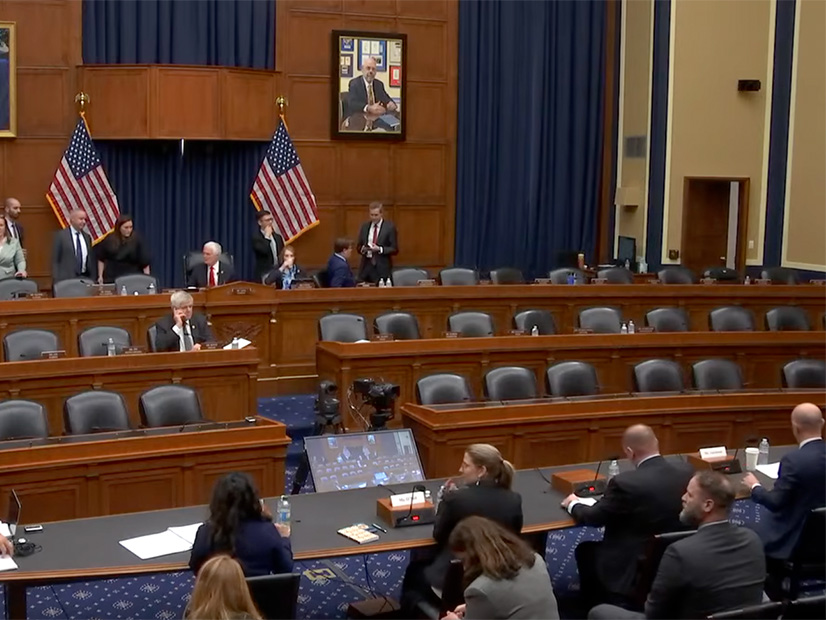
Democrats used a House Energy and Commerce Subcommittee on Energy hearing on bills to shore up the electricity sector’s physical and cyber security as an opportunity to criticize Trump administration policies affecting resource adequacy in PJM.
“This is an area where the committee has a history of bipartisan success, and we should build on that,” Rep. Kathy Castor (D-Fla.), ranking member of the House Energy and Commerce Committee, said during the Jan. 13 hearing.
“However, we cannot ignore that right now, the greatest threat to grid reliability and security is the president and Republican policies. The arbitrary project cancellations, higher cost and uncertainty have driven the country into an electricity crisis,” she said.
Castor criticized the Trump administration’s December decision to revoke permits for the country’s remaining offshore wind projects, some of which were close to completion. Developers have challenged that decision in court and already won an early victory. (See Judge Again Lifts Revolution Wind Stop-work Order.)
Castor asked acting Under Secretary of Energy Alex Fitzsimmons whether he had a role in any of the administration’s orders under Section 202(c) of the Federal Power Act to keep fossil fuel-fired power plants open, to which he said he did as director of Office of Cybersecurity, Energy Security, and Emergency Response.
In response to a follow-up question, Fitzsimmons affirmed that orders to keep open the Eddystone plant in Pennsylvania came in response to a looming shortage of supply in PJM. (See Energy Secretary Wright Issues 3rd Order Keeping Eddystone Open.)
“If you believe there is an energy shortage in PJM, why did you take what the federal court described as an ‘arbitrary and capricious action’ to cancel offshore wind projects that were permitted and ready to go?” Castor asked.
To submit a commentary on this topic, email forum@rtoinsider.com.
Fitzsimmons said PJM had asked DOE to issue the 202(c) order and that Eddystone has supported grid reliability since the first such order was issued last May.
“Offshore wind is some of the most expensive energy that exists,” Fitzsimmons said.
Castor responded that canceling projects at the last minute is very expensive as well.
“A business has invested billions of dollars,” Castor said. “They’ve gone through and they’ve gotten permits. They’ve hired a bunch of people, and then at the 11th hour, a president who’s focused on retribution, who the court said ‘acts in an arbitrary and capricious manner,’ comes and takes a hatchet to it, and it’s costing people a lot of money, and they’re angry about it.”
The Department of the Interior ultimately made the decision to withdraw the permits for offshore wind plants, Fitzsimmons said.
Castor asked to enter into the record a brief from PJM that was filed with a federal court recently to support Dominion Energy’s request to overrule the stop-work order on its Coastal Virginia Offshore Wind (CVOW) project.
“The CVOW project, with a nameplate rating of 2,489 MW, is an integral component of needed new generation that PJM has been relying upon to timely achieve commercial operation,” PJM said in the brief. “The CVOW project’s continued development and ability to produce 2,489 MW for the interstate grid will help mitigate the capacity shortfall PJM is now experiencing, which is projected to continue into the future.”
Extended delay of the project will cause “irreparable harm” to the 67 million Americans served by PJM given its critical need for new generation to achieve commercial operation in the next few years, the RTO added.
Later during the hearing, Fitzsimmons defended the 202(c) orders in more depth, saying they are needed in response to shrinking reserve margins in all the major ISO/RTOs at the same time they need to grow supplies to meet new demand.
“To meet the reserve margin requirements that are necessary for future load growth and to win the AI race, we need capacity that gets accredited by the grid operators, and that is dispatchable capacity,” Fitzsimmons said. “So, you can build as much non-dispatchable capacity as you want. It does not obviate the need for more always-on electricity.”
Cyber and Physical Security Legislation
While the minority took the opportunity to conduct an unofficial oversight hearing, the committee also took testimony on several bills, including the SECURE Grid Act from Subcommittee Chair Bob Latta (R-Ohio) and Rep. Doris Matsui (D-Calif.). It would give states funding to study the resilience and security of their electric grids.
Another piece of legislation would extend the operation of the Energy Threat Analysis Center (ETAC), which was set up as a pilot to improve information sharing on security threats to the industry.
“The ETAC Reauthorization Act of 2025 promotes improving operational collaboration between the government and industry securing critical energy infrastructure from cyber threats and protecting information sharing, thereby strengthening the nation’s energy security,” Fitzsimmons said.
In his written testimony, Edison Electric Institute Vice President Scott Aaronson said one way Congress could help the industry is by limiting its liability when it follows government directions during a security event.
“The government may order utilities to ensure certain areas have power during an emergency for national security purposes,” his testimony said. “Or, conversely, an agency may ask that a utility allow a threat to persist to support an investigation. While utilities stand ready to collaborate with the federal government to address threats and emergency situations, existing law does not provide sufficient legal liability protection for utilities that accommodate such an order.”
Both the American Public Power Association and the National Rural Electric Cooperative Association asked the committee to extend DOE’s Rural and Municipal Utility Cybersecurity Program.
“We operate in resource-constrained rural areas, defending lines and substations that are often remote and difficult to access,” Dairyland Power Cooperative Vice President Nathaniel Melby told the subcommittee. “We operate on thin margins without profit incentives or shareholders. We must balance costly security needs against the financial reality of our members. Every dollar we invest in cyber defense comes directly from our members’ pockets.”
DOE’s program for municipal utilities and co-ops helps the close the “rural resource gap” while building partnerships, collaboration mechanisms and information sharing capacities, he added in testimony made for NRECA.