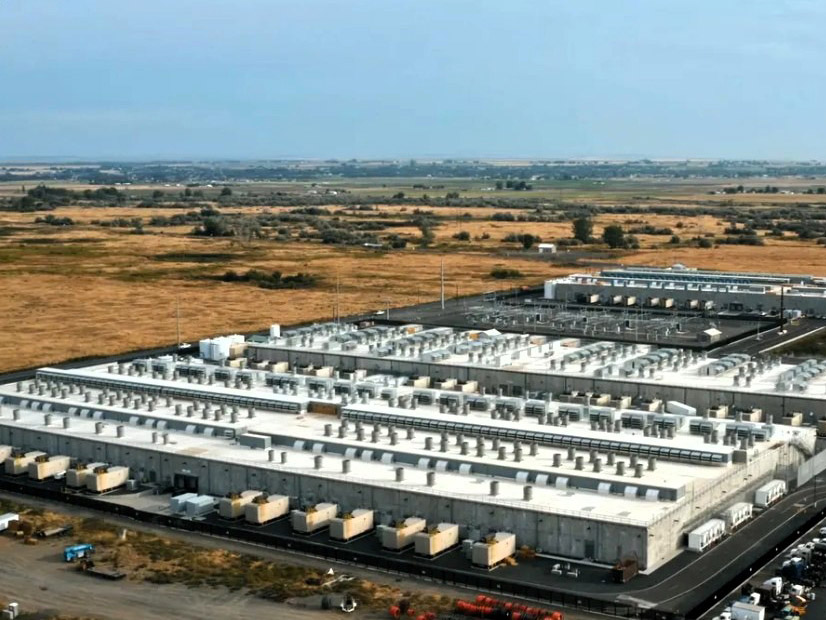
FERC has approved SPP tariff additions that deploy novel study processes to quickly review requests for “high-impact” large loads seeking to interconnect to its system.
The new attachments to the tariff incorporate transmission, generation and load interconnection services into a single framework, effective Jan. 15. They establish a 90-day study-and-approval process for interconnecting large loads that will be paired with new generation or with current or planned generation (ER26-247).
In its Jan. 15 order, FERC said SPP showed that “unprecedented” growth in large loads in its footprint presented “significant and unique operational and planning challenges.” It found the grid operator’s addition of a high-impact large load (HILL) study and high-impact large load generation assessment (HILLGA) processes address those challenges “while maintaining the reliable operation of SPP’s transmission system.”
SPP CEO Lanny Nickell said in a statement that the grid operator is proud that it is “first in the nation” to blend transmission, generation and load interconnection services into a single framework.
“It’s essential to our nation’s competitive future that we can quickly, reliably and affordably meet vastly increasing energy demands,” he said. “We are now in a great position to enable this future.”
SPP defines HILLs as new commercial or industrial load, or an increase in the load, at a single site connected through one or more shared interconnection or delivery points, and where load is either 1) 10 MW or more if connected to the transmission system at a voltage level less than or equal to 69 kV; or 2) 50 MW or more if connected at a voltage level greater than 69 kV.
Customers registering their load as HILLs and with plans to acquire generation will get a 90-day study and provisional approval, with upgrades directly assigned until the customer acquires firm service for the new generation. They will not be required to have current generation or a generator interconnection agreement.
Under the HILLGA process, HILL customers bringing supporting generation will also receive a 90-day study and a limited interconnection agreement. Upgrades will be directly assigned to the generation customer.
Commissioner David Rosner filed a concurring opinion calling on other U.S. transmission providers to consider similar proposals to SPP’s “pragmatic steps” supporting economic growth in its footprint.
To submit a commentary on this topic, email forum@rtoinsider.com.
“Today’s order is a productive step toward facilitating the energy needed to win the AI race, bring back American manufacturing, and deliver the reliable and affordable energy on which families and small businesses depend,” he wrote.
FERC noted SPP’s filing contained several “ministerial errors” and directed the RTO to make a compliance filing within 30 days.
SPP developed the processes following a May directive from board Chair John Cupparo that staff deliver a timely, scalable and reliable approach to manage the exponential growth of load demand across the footprint. Staff’s first attempt was rejected by members in July before a revised version won endorsement from stakeholders and then the board in September. (See “Large Load Integration OK’d,” SPP Board Approves 765-kV Project’s Increased Cost.)
A third service, conditional high-impact large load service (CHILLS), was split out from the HILL/HILLGA policy package to give stakeholder groups sufficient time to refine and address concerns. Stakeholders have since approved the final framework and its two paths for load’s conditional connection.
SPP’s board will consider the CHILLS framework during its Feb. 3 meeting in Little Rock, Ark.