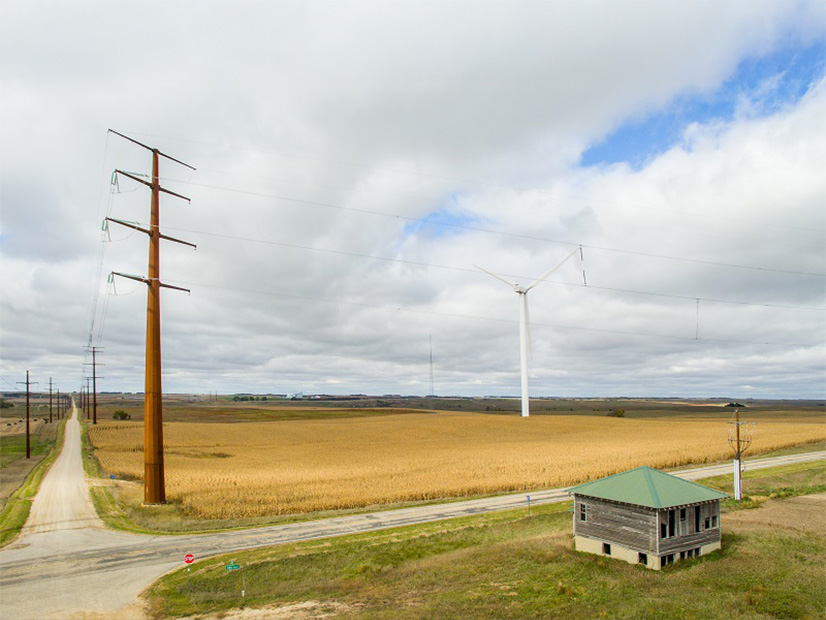
Stakeholders told MISO it might have anticipated an impending cost increase for a long-range transmission project under development in Minnesota that jumped about 43% in price to nearly $1.4 billion.
The 345-kV Iron Range-Benton County-Big Oaks project in Minnesota, from MISO’s 2022 collection of long-range transmission projects, is undergoing a variance analysis by the RTO for the cost increase. (See MISO Launches 2nd Review of Long-range Tx Project for Cost Overruns.)
Joint developers Minnesota Power and Great River Energy have upped costs to build the line from an originally estimated $970 million to $1.39 billion, citing an increase in labor and materials costs, an engineering refinement to substation work and routing redesigns. The project is set to connect Minnesota Power’s Iron Range substation in Itasca County to Great River Energy’s Benton County substation.
WPPI Energy’s Steve Leovy said MISO and stakeholders could have predicted cost overruns much earlier. He noted that the developers told the Minnesota Public Utilities Commission in August 2023 that costs could range from MISO’s $970 million estimate to $1.35 billion.
“It occurs to me that some of these things were known and should have been known some time ago,” Leovy said of the increases during a Planning Advisory Committee meeting Jan. 21.
“I just want all of us to get a better handle on cost estimates,” Leovy said. “We should have been on notice in August of 2023 that the costs would go higher. … I don’t think anyone should be surprised that it ended up in that neighborhood.”
Leovy said he didn’t want to suggest negligence or malfeasance on the part of the developers.
Jeremiah Doner, MISO’s director of cost allocation and competitive transmission, said the range Minnesota Power and Great River Energy submitted to the Minnesota PUC was not a final number, and the high end at the time represented a worst-case scenario.
Doner said the increase is a confluence of escalating materials costs and routing changes. He said the project first encountered routing cost changes because of permitting changes in Minnesota.
“Ultimately, Minnesota decided that there were additional co-location opportunities … to minimize impacts,” he said.
Some stakeholders said it shouldn’t be a surprise that state commissions would want routes to use existing rights of way as much as possible.
Doner said it wasn’t until the second half of 2025 that the transmission owners notified MISO of material and construction cost escalations.
“Collectively, that information drove the variance analysis trigger,” Doner said. “I note that everyone wants us to move as quickly as possible through this process.”
The Minnesota developers said the rise in costs for substation equipment, steel and labor accounts for 25% of the increase, while routing changes and the more fleshed-out work plan for the substation facilities account for the remaining 18%.
Doner said the developers still are trying to meet the project’s original 2030 in-service date.
Ørsted’s Eva Kaso-Collette asked if the timeline “slippage” brought on by the changes and review would last months or years. Doner said he could not speculate on the developers’ timeline.
Doner said he similarly could not put an estimate on how long MISO’s review would take.
“These truly are very case by case,” Doner said of the variance analysis process. “We are going to strive to work through these as quickly as possible.”
The first, $10.4 billion long-range transmission plan has grown to $10.7 billion, according to MISO’s latest quarterly reporting released in September 2025.
The Sustainable FERC Project’s Natalie McIntire asked if MISO transmission developers are encountering across-the-board cost increases for construction materials and whether the RTO should expect more overruns.
Doner said that while transmission owners are receiving larger-than-anticipated bids on materials, equipment and labor, it’s not a universal occurrence. He also said that in some cases, transmission developers are saving money by adjusting routes.
“We are not seeing a blanket, 30 to 40% cost increase,” Doner told stakeholders, though he acknowledged “upward pressure on prices and costs.”
Customers Call for Tighter Variance Analysis Rules, Oversight
Meanwhile, MISO’s transmission customers continue to advocate for narrower triggers to set variance analyses in motion, citing escalating costs.
They have asked MISO to equip the variance analysis with a 20% overbudget threshold to trigger the study (instead of 25%) and to consult with third-party experts and its Board of Directors on projects’ fates. (See MISO TOs Oppose Tx Cost Containment Suggestions.)
At a Dec. 16 stakeholder meeting on cost allocation, Ken Stark, with the Coalition of MISO Transmission Customers, said the “Damocles sword of high energy costs does hang over consumers’ heads in the years to come.”
Stark said the MISO industrial customers’ viewpoint remains unchanged, especially given booming transmission planning and ratepayers’ rising bills for electricity service. He said MISO’s second variance analysis is further proof of the need.
After it wraps up a variance analysis, MISO can decide either to let projects stand as they are, develop a mitigation plan for them, cancel them or assign them to different developers if possible.
Stark argued that the board should approve the outcomes of variance analyses.
“The MISO board approves the MTEP [MISO Transmission Expansion Plan]. It only makes sense they should approve material changes to the MTEP,” he said.
At the time, Leovy said it might be time for MISO to sharpen its cost estimation so that it better anticipates financial impacts to transmission projects.
Relatedly, the Organization of MISO States has engaged with nonprofit Regulatory Assistance Project for “technical assistance” on transmission cost oversight over the first quarter of 2026.
MISO has two active requests for proposals for two 345/765-kV competitive transmission projects in Iowa.
The nearly $1.5 billion Marshalltown-Lehigh-Sub T-Montezuma-East Adair and the $1.23 billion East Adair-Minnesota/Iowa State Line-Arbor Hill-York Avenue projects hail from MISO’s second, $22 billion long-range transmission portfolio. The two Iowa projects round out the seven projects that were eligible for competition from the portfolio.
Proposal deadlines for both occur in May; both projects are expected to be completed in 2034.