With a major winter storm bearing down on Texas, state officials have assured residents the ERCOT grid is in much better shape to take on freezing conditions than it was five years ago when Winter Storm Uri caused a dayslong outage.
“The ERCOT grid has never been stronger, never been more prepared and is fully capable of handling this winter storm,” Texas Gov. Greg Abbott said during a Jan. 22 press conference. “There is no expectation whatsoever that there’s going to be any loss of power from the power grid.”
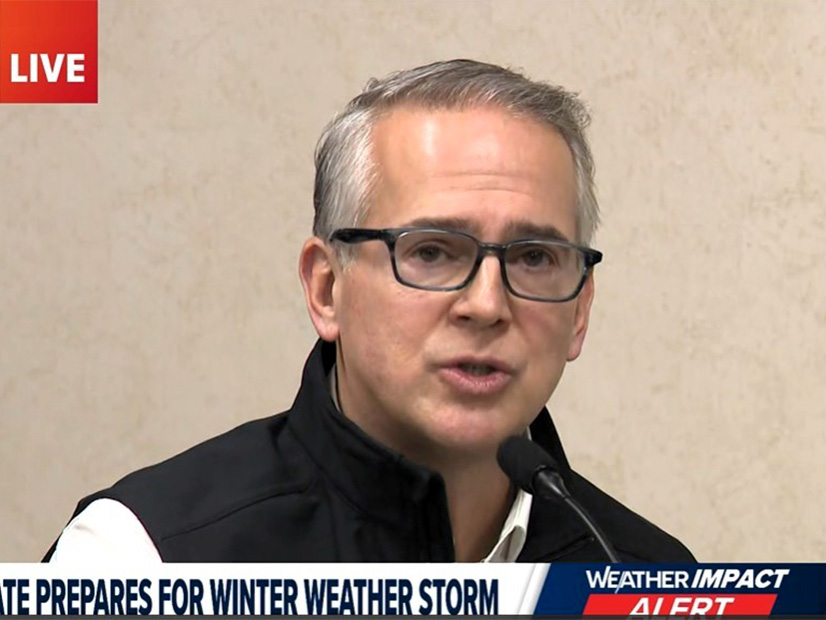
“We’ve been preparing for this storm over the last couple of days,” ERCOT CEO Pablo Vegas said. “At this time, we are not anticipating any reliability concerns on the statewide electric grid as a result of this weather event.”
Vegas said the grid operator published an operating condition notice telling generators and transmission operators to cut short outages to ensure as much capacity as possible is available. He said that since Winter Storm Uri, staff have conducted more than 4,000 weatherization inspections at generator and transmission facilities, and increased reserve margins to strengthen backup supplies.
ERCOT has issued a weather watch for Jan. 24-27 in anticipation of the storm’s forecast sub-freezing temperatures and the potential for frozen precipitation, higher electrical demand and possible lower reserves. It says grid conditions are expected to be normal during the watch.
The National Weather Service has placed much of Texas under a winter weather advisory through Jan. 25. It says Winter Storm Fern, as The Weather Channel calls the storm, is likely to bring mixed precipitation on its southern side, with “significant” ice accumulations from freezing rain and the potential for long-duration power outages.
ERCOT is expecting demand to peak at nearly 83 GW on the morning of Jan. 26, with about 125 GW of available capacity. The grid operator’s all-time peak is 85.3 GW, set in August 2023.
“[It’s] quite interesting to see ERCOT get closer and closer to be in the winter-peaking region,” Keith Collins, ERCOT vice president of commercial operations, said during a Jan. 21 meeting of the ISO’s Technical Advisory Committee.
He told stakeholders that “preparedness and communication” will be essential to minimize problems during the storm.
“We don’t anticipate any issues, but things do come up, and that’s where preparedness and communication is really important,” Collins said, “and so to the extent that things happen on your end, I think these are the two things that will help us.”
“We coordinate days in advance of an event like this making sure that the key supply chains, the access, the critical facilities, are known, and we know if there’s going to be any risks or issues on the grid that are ready to deal with those before they become a problem,” Vegas said.
Along with Public Utility Commission of Texas Chair Thomas Gleeson, Vegas and Abbott stressed any outages will be at the local distribution level. They noted most of the state’s utilities have launched vegetation-management programs following Uri and 2024’s Hurricane Beryl.
Gleeson singled out Oncor for its work, noting the North Texas utility has trimmed vegetation on an additional 8,000 line miles above and beyond what it would have done before state legislation passed after the 2021 storm.
A joint FERC–NERC report on that storm highlighted the role of natural gas supply disruptions from freezing infrastructure on the outages, which were not resolved for five days. Gleeson said he is not concerned about similar problems during Fern. (See FERC, NERC Release Final Texas Storm Report.)
“We have an historic amount of gas in our system. There will be adequate gas supply to fuel all of our gas units,” he said. “Additionally, [gas utilities] have put crews throughout the state to ensure if there is any type of freezing, that it can be addressed very quickly and responded to. I have no concerns at this point about any issues with our generation fleet.”