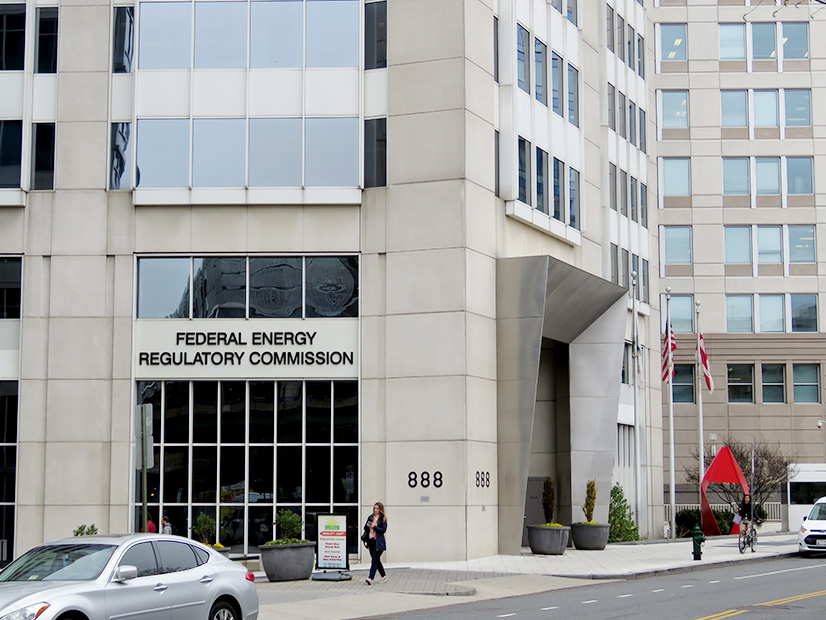
FERC must balance the need to grow the grid while keeping rates affordable for customers, the Electricity Customer Alliance argues in a recent white paper laying out suggestions to thread the needle.
The authors of “A Customer-Centric Agenda for FERC” argue that the commission will play a key role in making sure the wholesale power markets are designed in way that can serve exponentially rising demand from data centers, reshoring manufacturing and electrification. It also has an important role in convening state regulators to address issues, as it has in recent years alongside National Association of Regulatory Utility Commissioners meetings.
ECA’s members are all kinds of customers, from hyperscale data centers down to consumer advocates for residential customers, and it advocates for maintaining a reliable grid while keeping rates affordable, Executive Director Jeff Dennis said in an interview.
“We see a number of issues swirling around FERC and wholesale electricity markets and the transmission grid,” Dennis said. “There’s just a lot going on out there. And our goal is really to take a lot of those issues and put them in a customer-centric framework that really connects the dots for the commission and other stakeholders around our national bipartisan goals for AI leadership, national security, economic growth and improving affordability for customers.”
So far, the impact of the return of load growth has not led to lower prices, with PJM seeing its capacity market prices surge as demand from data centers has led the market to fall short of its target reserve margin.
A big reason for the climbing prices in PJM is the load forecasts that the RTO relies on to set the curve for its capacity market, Dennis said.
“I pinpoint the load forecast because I think as we’ve seen, those load forecasts are incredibly uncertain,” he added. “PJM itself has dialed those back almost in half. And so, the challenge that we’re facing right now is we have these load forecasts that are projecting large growth.” (See Pessimistic PJM Slightly Decreases Load Forecast.)
Load forecasts include many big developments that are unlikely to be economic any time soon and can suffer from double counting as well, Dennis said.
“I think on top of that, we’re living in a world where the price signal that the capacity market produces is being felt by customers much sooner because of the delays that we’ve experienced in the auctions in PJM over the years, and so we don’t have that three years forward,” he added.
Load growth can mean lower prices for existing customers as the costs of the bulk power system are spread over a larger base. ECA’s paper argues for steps to get to that end state, where development of supply keeps pace with demand growth. The right structures for regional planning and cost allocation need to be struck to get to that state.
“We have to integrate these loads into the network in order to get those benefits,” Dennis said. “The whole goal is, if you can bring in new customers and new load below the peak, then what you’re doing is you’re taking all the existing fixed cost that the market has already invested in, and you’re spreading it over more customers, which helps bring down those costs. So, the trick is, how do you do that in a way that also isolates any incremental additions to the peak [that] these loads are making and then appropriately allocate those costs to the new loads that are driving them?”
One area where FERC is going to be able to make a quick impact on the whole set of issues is through the RTO’s compliance filings for Order 1920, which changed transmission planning and cost allocation rules.
“Customers really do value the core tenants of Order 1920 around economic regional planning to identify the best options to build transmission that meets multiple needs and get us out of this paradigm we’re in right now, where we’re building lots of local transmission for one-off reliability needs, or other things like that, that are raising costs to consumers,” Dennis said.
The commission will have to weigh the tradeoffs between getting Order 1920 in place quickly to deal with the surging load growth and the standard practice for many large-scale rule changes, where jurisdictional utilities file multiple rounds of compliance filings, he added.
FERC has held collaborative meetings with states tied to NARUC for the past several years, but Dennis said those kinds of joint federal-state boards could be created to tackle more narrow issues than they have so far.
“FERC has a really important role in bringing together federal and state policymakers and regulators around these issues to understand where there is complication in that sort of intersection and handoff between what happens in the wholesale electricity market, what happens with the transmission grid and what happens at the retail level,” he added.
Flexibility has been discussed as a way to help data centers achieve speed-to-power, but it could bring up issues around cost allocation that would benefit from formal cooperation between FERC and the states, for example, Dennis said.
“There are opportunities to do more at a little bit more granular level than those quarterly meetings, which are very helpful as a place for them to talk about big issues,” Dennis said. “But that’s not the only thing that could be done with that authority.”