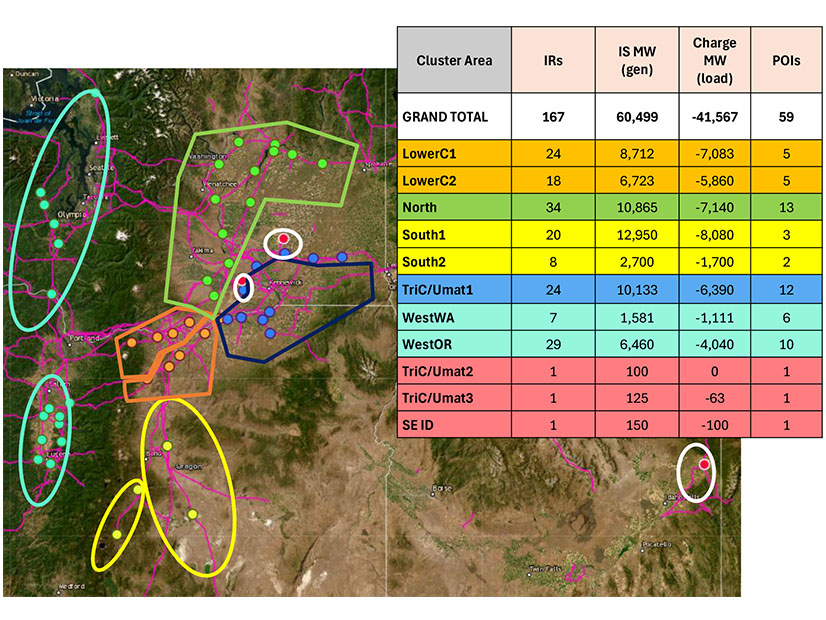
More than 60 GW of generation is a step closer to connecting to Bonneville Power Administration’s transmission system, following the release of Phase 1 of BPA’s interconnection cluster study.
BPA hosted a workshop Feb. 9 to give an overview of the study and to start reviewing 59 interconnection points within 11 cluster regions. Presentations by region were scheduled to continue Feb. 10-12.
“We tried to take all the available information that you guys provided in your submissions to find the most reliable, cheapest interconnection point for the entire cluster area,” Dave Cathcart, an electrical engineer in transmission capabilities planning, said during the workshop, which was geared toward BPA customers.
The 167 interconnection requests included solar, wind, biofuel, gas and nuclear generation totaling 60.5 GW, and grid-charging battery storage totaling 42 GW.
“[It’s] just a phenomenal amount,” said Jeff Cook, BPA’s vice president of planning and asset management.
Requests from wind and solar generation are spread throughout most of the 11 study areas.
But 18 of the 21 interconnection requests for biofuel generators are in western Oregon. The other three are in the South 1 area.
South 1 is also the site of three of five pumped hydro storage interconnection requests. The other two are in the Lower Columbia 1 region or western Oregon.
Two interconnection requests for steam/nuclear generation — with 270 MW and 1,120 MW requested — are in the area named Tri-Cities Umatilla 1.
The study includes estimated costs for each interconnection point.
New Interconnection Approach
BPA released its 2025 Transition Cluster Study Jan. 31 as a set of reports for each of the 11 study regions. The study reflects a new approach to generation interconnection requests.
When generation requests totaled 4 GW or 5 GW a year, Bonneville used a first-come, first-served model. But by late 2023, requests exceeded 60 GW, prompting a new “first-ready, first-served” approach, said BPA spokesperson Kevin Wingert.
To put the volume of new service requests in perspective, Wingert noted that total generation throughout the Pacific Northwest in 2026 is projected at 27.96 GW.
The cluster study was launched in 2025 under BPA’s new large generator interconnection transition process. The first phase is similar to a feasibility study, Wingert said, and the second phase will be like a system impact study.
A 90-day period for BPA customers to review the cluster study ends April 30. If no customers withdraw during that time, BPA will announce within 25 business days that there will be no restudy. Customers will then have 15 days to submit a Phase 2 study agreement and a deposit.
If there are withdrawals, BPA has 30 business days to decide whether a restudy is needed. If so, the goal is to complete the restudy within four months.
The study noted that construction of equipment and facilities to connect a generator to the grid typically takes three to 10 years.
“Every project will be different,” said Cherilyn Randall, an electrical engineer in BPA’s customer service engineering. “If you need a large substation, a line build, it’s going to be a lot longer than if you’re [in] Phase 2 of something and you only need a meter.”
During the first 45 days of the customer review period, customers may modify their requests. Requested nameplate capacity or interconnection service may be reduced by up to 60%.
Increasing an interconnection request is not allowed.
“At no point may you ever increase your interconnection service,” Randall said. “That would be queue jumping.”