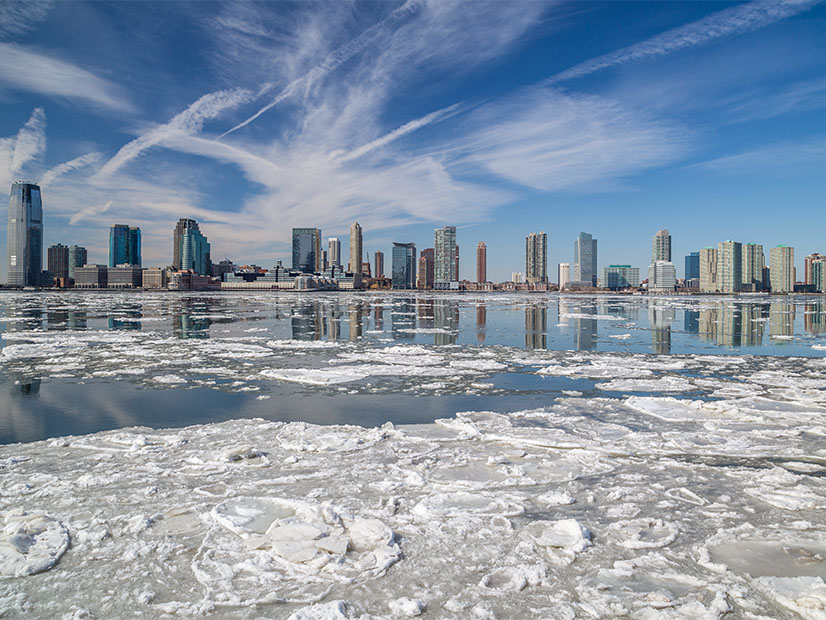
ALBANY — The year got off to a difficult start for NYISO, but the ISO successfully navigated through several events, including a major winter storm, Aaron Markham, vice president of operations, reported to stakeholders.
“We had 19 consecutive days below 32 degrees [Fahrenheit] in Albany starting on Jan. 23,” Markham told the Operating Committee on Feb. 13. “There was lots of lake-effect [snow] and other storms that happened. We had a coastal storm that raised some issues with barge deliveries of fuel.”
During the storm and the period of extreme cold that followed it, natural gas index prices ranged between $50 and $200/MMBtu, Markham said. Spot quotes exceeded $300/MMBtu at times, driving up statewide wholesale energy prices and pushing dual-fuel units to oil. (See Winter Storm Drives Potential Record for January N.Y. Electricity Costs.)
Markham said NYISO forecasts ahead of the storm had predicted roughly two weeks of extreme cold. This allowed the ISO to take early action to manage statewide fuel inventory, get generators committed and ensure units could operate. Over the first five weeks of the year, the state burned through enough fuel to lose 45% of its net liquid fuel inventory.
“Doing some rough math, that equates to 135 million gallons of liquid fuel that was burned during that period,” Markham said.
Despite this, some fossil fuel capacity was forced out of the real-time market because of difficulties with resupply. This peaked during the worst period of the storm around 5 p.m. Jan. 25, when roughly 1,900 MW were unavailable to dispatch. Markham said resupply was extremely challenging because of the weather. Barge routes were frozen or too rough to travel. Roads were hazardous for trucks. In some cases, the ISO directed gas units to “ease” the rate at which oil reserves were burned.
During the height of the storm, NYISO called external suppliers for all hours between Jan. 24 and 31. Special case resources and demand response were called for multiple hours across all zones to “avoid emergency conditions” Jan. 25-30. Load peaked at 24,177 MW on Jan. 30 around 6 p.m., the highest so far this winter.
“Our current estimates are that [demand response] reduced the demand between 350 and 400 MW,” Markham said. “Without the demand response, we would have been over the baseline forecast for the winter.”
On Jan. 26, NYISO requested and was granted a waiver from the U.S. Department of Energy under Section 202(c) of the Federal Power Act to temporarily bypass federal, state and local emissions limits during the storm, allowing them to run all generators at their maximum outputs. Markham said the ISO did not need to exercise the authority granted by the waiver because it balanced the system at the edge of emergency conditions.
In addition to the cold, NYISO also had to respond to a severe geomagnetic storm Jan. 19-20, the strongest since October 2003, according to the National Oceanic and Atmospheric Administration. The ISO restored out-of-service transmission lines and extended generator commitments to compensate.
Stakeholders requested that the ISO provide granular fuel data so they could understand the day-to-day constraints on the system. Markham said more information would be available at the end of winter.
Environmentalists praised the ISO for exercising diligence in avoiding emergency grid conditions and the need to burn units beyond local emissions limits.