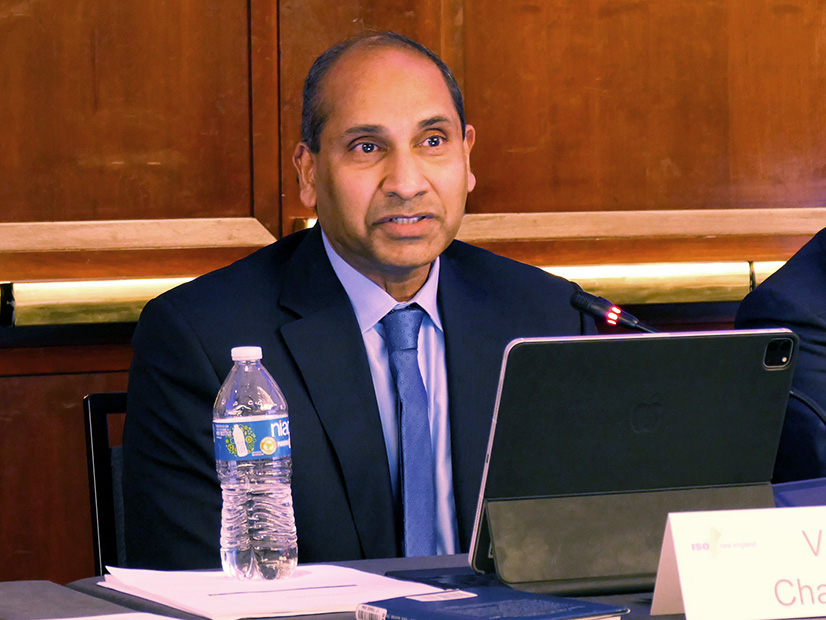
Just a few weeks after taking over as CEO of ISO-NE at the beginning of 2026, Vamsi Chadalavada faced a trial-by-fire introduction to the job.
Temperatures plunged Jan. 24, followed by heavy snowfall across the region the next day. With the snow suppressing behind-the-meter solar generation, ISO-NE exceeded its high-range winter peak load forecast.
The low temperatures persisted, averaging 14 degrees F below normal over the last nine days of January and leading to significant depletion of generators’ stored fuel inventories as gas prices skyrocketed. Energy costs shot up, and ISO-NE experienced the highest monthly energy costs in its history. (See Prolonged Cold Drove Record Monthly Energy Costs in New England.)
Despite the challenging conditions, ISO-NE met all reliability requirements throughout the prolonged event and officially lifted its preemptive abnormal conditions alert Feb. 11.
“I’m glad we’re through it,” Chadalavada said in a recent interview with RTO Insider. “The fact that we were able to maintain not only the energy demand but also operate with the levels of reserve margins that indicate that we’re capable of withstanding the first or second contingency, is extraordinary.”
To submit a commentary on this topic, email forum@rtoinsider.com.
While Chadalavada is new to the job, he is far from a new face at ISO-NE: He joined the RTO in 2004 and served as COO from 2008 through the end of 2025 under longtime CEO Gordon van Welie.
“A lot of what we’re doing right now I’ve had some experience with,” he said. He credited ISO-NE’s success throughout the extended cold stretch in large part to the high levels of collaboration among the RTO, state and federal agencies, and the region’s generation fleet.
He said ISO-NE also has benefited from technology investments made in recent years, including incorporation of probabilistic modeling into its rolling 21-day energy assessments, which the RTO published daily throughout the event.
“A tool like that is invaluable in preparing us with a higher degree of confidence than we’ve ever had,” he said, adding that the analyses gave the RTO “a good sense of the worst-case outcome,” allowing it to plan effectively.
Consensus and Agility
While ISO-NE’s performance during the cold snap has drawn praise from stakeholders, the price spikes brought by the event have fueled concerns about the design of the RTO’s new day-ahead ancillary services (DAAS) market.
At the February meeting of the NEPOOL Participants Committee, Chadalavada announced ISO-NE’s support for a series of “narrowly targeted” DAAS market changes recommended by the ISO-NE Internal Market Monitor (IMM), along with plans to evaluate changes to its pay-for-performance rate and its treatment of exports during scarcity events.
“Typically, those would all be 12- to 18-month projects,” he said. “We’re challenging our organization to do all of them in six to nine months, including a stakeholder process.”
These projects come on top of an already-packed annual work plan, which includes work to establish an internal asset condition project reviewer; select a preferred solution from the first iteration of the Longer-term Transmission Planning procurement process; and complete work on the RTO’s long-running Capacity Auction Reform (CAR) project.
The DAAS market has been the subject of growing concern from the end user and supplier sectors in recent months amid mounting costs. While ISO-NE’s initial impact analysis — based on 2019-2021 data — estimated the annual incremental costs of the market to be about $140 million, the IMM calculates those costs over the market’s first 11 months reached about $921 million.
The IMM’s proposed changes are intended to induce lower-priced offers and greater market participation. While the details have yet to be refined, ISO-NE has offered high-level support for the reforms.
The recommendations generally have been well received by market participants, while some stakeholders have asked for even more urgency from the RTO, with one group pushing for a vote on the proposals at the NEPOOL Markets Committee in March.
Chadalavada has emphasized the importance of being nimble in response to market issues while also building strong consensus among stakeholders to ensure durable solutions. The proposed DAAS market changes could be an important early test of this approach.
Long project timelines have been especially apparent in ISO-NE’s resource capacity accreditation efforts. The RTO initiated the ongoing project in 2021 before expanding the scope in 2024 to include broader capacity auction changes.
If everything goes according to plan with the CAR project, ISO-NE finally will file the accreditation changes by the end of 2026 and implement them for the 2028/29 capacity commitment period.
“If we have long life cycles — three to five years — by the time you deploy them, you’re already behind,” Chadalavada said.
To reduce project timelines, he said ISO-NE could look to split larger projects into smaller components; deploy artificial intelligence and technological innovation; and pursue simpler solutions, which it could refine after implementation.
Managing Uncertainty
Chadalavada said he intends to focus on planning “in five- to seven-year increments, making sure that each increment fits into the future direction for New England.”
This should help ensure ISO-NE is preparing for the future in the most cost-effective manner amid great uncertainty about the region’s future load profile and resource mix, he said.
On the supply side, New England faces significant uncertainty about how it will meet demand following the Trump administration’s efforts to undermine the region’s offshore wind industry. (See Facing Rising Demand, New England has Limited Options for New Supply.)
Predicting demand over the long-term is similarly challenging. While ISO-NE forecasts substantial demand growth through 2050 due to the electrification of transportation and heating, the pace of electrification has proven hard to predict, and the RTO has scaled back its 10-year forecast of electrification demand in each of the past two years. (See ISO-NE Scales Back Vehicle, Heating Electrification Forecasts.)
The possibility of data center development adds another major source of load-side uncertainty. While New England so far has experienced relatively limited impacts from the data center boom, some utilities have reported an uptick in data center interconnection requests.
Chadalavada said ISO-NE is “actively monitoring” the potential for new data center loads.
“We’re active behind the scenes,” he said. “I think we haven’t had to mobilize in earnest because we haven’t had the volume of requests and the urgency that’s playing out in PJM and other parts of the country. But I do expect that it’ll make its way to New England, and we will be ready.”
In late January, six New England senators signed a letter to Chadalavada seeking information on how ISO-NE plans “to protect residential ratepayers from data center-driven price increases.” It stressed the need “to require tech companies, not American families, to foot the bill for their load.”
In his response, Chadalavada noted that “no new large data centers (or other large electrification projects) have committed to proceeding with construction at this time.”
In conversation, he echoed the importance of preventing cost shifts onto other consumers. He also expressed optimism about the role markets will play in ensuring resource adequacy in the coming decades.
He said he views markets as “the most cost-effective way to not only provide incentives for new entry, but also price retirement and deactivation of resources.”
The capacity, energy and ancillary services markets all play an important role in signaling the need for new resources while protecting consumers from investment risks, he said, adding that he expects wholesale markets will continue to work for the region over the long term.
“Will it be easy? No. Will it be controversial? Yes, because there are always different sorts of opinions and viewpoints about the effectiveness of markets,” he said. “But from an ISO standpoint, I cannot think of a better way to achieve resource adequacy for New England while having cost effectiveness as an equally important measure.”