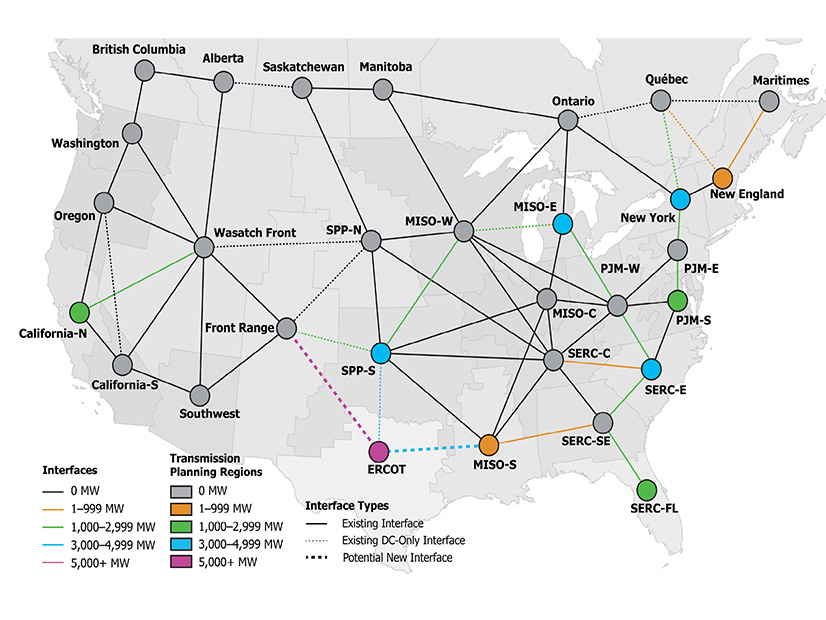
FERC declined to suggest any minimum transfer capability requirements to Congress in a legally required report released Feb. 25.
The report was a required follow-up from the commission on NERC’s Interregional Transfer Capability Study, which found shipping power between some regions produces significant benefits. (See NERC Releases Final ITCS Draft Installments.)
“Increasing interregional transfer capability can be a potent tool in addressing reliability issues and warrants further examination,” FERC Chair Laura Swett said in a statement. “However, it is crucial to recognize that this measure is not a cure-all solution and should be considered in conjunction with potential economic impacts and other reliability strategies.”
FERC staff declined to make any suggestions for changes to the law in response to the study. The report notes that while transfer capacity has benefits, they come about only if the region on the other end of the line has excess generation.
“If neighboring regions lack resources, additional transfer capability will provide limited help because there is not enough surplus energy to share,” the paper says. “These results suggest that using a heuristic approach to establish interregional transfer capability requirements — such as setting a target to achieve interregional transfer capability to match a fixed percent of peak load or historical outages — can inaccurately value interregional transfer capability compared to an approach that accounts for the complexity of the transmission system. As is true with setting a planning reserve margin, an intuitive or informal approach is unlikely to set the right target compared to a more systematic approach that includes thorough analysis to support decision-making.”
The study analyzed how electricity moves across regions and identified opportunities to improve links between regions. It found ERCOT would benefit from plugging into the rest of the bulk power system, with up to 14,100 MW of interconnection suggested, and it also found increasing links between many regions in the Eastern Interconnection could produce significant benefits.
But the report also notes that forecast deficiencies could be fixed with local generation development, demand response or simply by accepting more reliability risk during extreme weather events.
Some commenters on the study were not opposed to the idea of increasing interregional transfer capability, but another common theme was that the study is not a transmission planning document.
“According to the Niskanen Center, although the ITC Study combines historical and synthetic load to capture hourly variability, the United States is no longer experiencing a steady load growth as it did in the past decade, but rather accelerating load growth, and as a result the ITC Study results are already outdated,” FERC’s report says.
NERC’s initial study said that 35,000 MW of additional interregional transfer capacity would cut projected energy deficiencies and improve reliability, said Christina Hayes, executive director of Americans for a Clean Energy Grid.
“FERC’s staff report to Congress today stops short of translating those findings into meaningful statutory recommendations — despite mounting reliability pressures and accelerating electricity demand since the study was completed,” she added.
Failing to act decisively on transmission will undermine grid reliability, Hayes said, and Congress must include transmission in any permitting reform legislation.