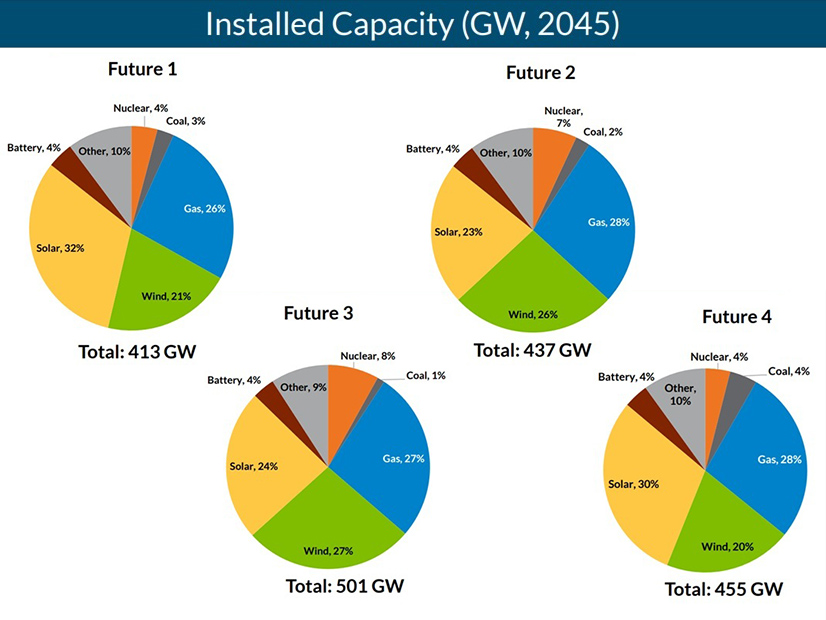
MISO said its modeling estimates show it could have 413 to 501 GW of installed capacity on its system by 2045.
The grid operator is nearing its final four futures scenarios, which estimate the system makeup 20 years down the road for transmission planning purposes. The nearly final estimates are higher than MISO’s prior draft release. (See MISO Draft Tx Planning Futures Envision 400-GW Supply or More by 2045.)
Across all futures, MISO shows that solar, natural gas and wind resources would jockey for lead fuel type:
-
- MISO’s low-end estimate of 413 GW includes 32% solar, 26% gas and 21% wind. However, it expects to use gas only 14% of the time and lean on wind and solar 28 and 27% of the time, respectively.
- The middle-of-the-road future has a 437-GW fleet at 28% gas, 26% wind and 23% solar. Gas would supply output 13% of the time, with solar at 17% and wind at 36%.
- The third future, which allows for the fastest fleet transition, contains 501 GW split among 27% wind, 27% gas and 24% solar. In that scenario, gas generation is dispatched 10% of the time, with solar at 18% and wind 36%.
- Finally, MISO’s supply chain-constrained scenario has a 455-GW fleet by 2045, at 30% solar, 28% gas and 20% wind. Gas and solar are used equally, 23% of the time, while wind is responsible for 28%.
In all four cases, battery storage remains at 4% of the mix. “Other” generation (oil, conventional hydro, biomass, geothermal and other resource types) takes a 10% slice in nearly all futures.
The most aggressive, 500-GW future contemplates an 8% share of nuclear power that supplies 25% of output — the highest MISO foresaw. Meanwhile, coal ranges between 4% (the supply constrained future) and 1% (the aggressive fleet change future) and mostly runs 1% of the time.
MISO said its resource mixes were shaped by planning reserve margin requirements and states’ carbon-reduction and renewable energy goals.
Members have 171 GW planned by 2045. Natural gas and solar take the largest share at 53 and 50 GW, respectively. Members also plan to add 30 GW of the “other” generation, 24 GW of wind, 12 GW of battery storage and 3 GW of nuclear.
MISO currently has 202 GW of installed capacity.
The RTO plans to finalize its 20-year transmission planning scenarios early in the second quarter of 2026; it will host a final stakeholder workshop April 9.
At a Feb. 26 workshop webinar to discuss the futures, MISO Policy Planner Logan Pollander said all four futures are resource adequate. He said the RTO’s loss-of-load expectation analysis exhibited no expected unserved energy in each of the selected study years (2030, 2035 and 2045).
The modeling doesn’t include a finalized capacity accreditation method for energy storage. Multiple stakeholders said MISO was missing a large piece of the puzzle if it didn’t decide accreditation values for storage.
Pollander said the results could change once MISO factors in storage accreditation.
Red States Ask for Comparison Model Free of Clean Energy Goals
Bill Booth, a consultant to the Mississippi Public Service Commission, asked MISO to create a purely economic expansion future that doesn’t consider any carbon goals in order to see how much transmission might be built for the purposes of decarbonization.
MISO Executive Director of Transmission Planning Laura Rauch said the RTO is not comfortable with scenarios that diverge from enacted carbon-reduction laws and the goals of members.
South Dakota Public Utilities Commission staffer Darren Kearney said he would like to see a “counterfactual” of what the buildout would be without the constraints of carbon abatement, so states with carbon-reduction goals don’t pass on their costs to those without them.
Rauch said MISO could have a discussion on that once new transmission is proposed.
But the Union of Concerned Scientists’ Sam Gomberg cautioned the RTO against singling out renewable energy goals to make some states’ cost allocation smaller.
“In each state you can find biases and preferences … written in state code that drive resource adequacy decision-making outside the bounds of least-cost planning,” Gomberg said.
For example, he said, if states restrict or shut out cost-effective solar or wind generation when their political climate is suited for it, that’s putting their thumb on the scale. “We could go in countless directions here … and find ourselves in a death spiral of paralysis by analysis,” Gomberg said.
According to MISO, just 3% of its load base is not associated with any carbon-reduction goals.
The Independent Market Monitor has been in discussions with MISO about introducing a sensitivity that reflects a maximum willingness to pay for carbon reductions. IMM David Patton has said the RTO should “balance cost objectives with carbon objectives” in the futures.
At previous futures workshops, Patton has said it’s worthwhile to examine the point at which members wouldn’t invest in a new clean energy technology because it would lose money or “produce retail rates that are astronomical.”
Representing MISO industrial customers, Kavita Maini said she had a hard time believing states would reason that “even if this standard costs a million-bajillion dollars, I still want to pursue this” when rates become unaffordable.
WEC Energy Group’s Chris Plante said he struggled with how MISO could assume no expected unserved energy from its modeling. “I don’t think that’s even possible based on the probabilities,” he said.
“It’s below the criterion. It doesn’t mean there’s no expected unserved energy. It just doesn’t exceed the one-day-in-10-years” standard, said RaeLynn Asah, MISO senior manager of regulatory and policy planning.
Plante argued the RTO can meet the loss-of-load criteria but still experience unserved energy. He said they are two separate concepts.
Asah clarified there was no significant unserved energy, not a complete lack of unserved energy.
MISO’s modeling does not factor in deliverability or transmission constraints.
Booth said it would behoove the RTO to consider transmission so it doesn’t rely on generation that’s situated in MISO South that might not be deliverable to the Midwest. He said its resource-adequate assumption is flawed without deliverability considerations.
Asah said MISO would consider deliverability when it sites its generation totals across the footprint. MISO’s Neil Shah added the method is in line with how the RTO conducts its loss-of-load expectation studies.
“How do you not consider whether these resources are actually deliverable?” Booth asked.
Shah said deliverability is handled in subsequent steps and said MISO doesn’t account for transmission constraints in its first step.