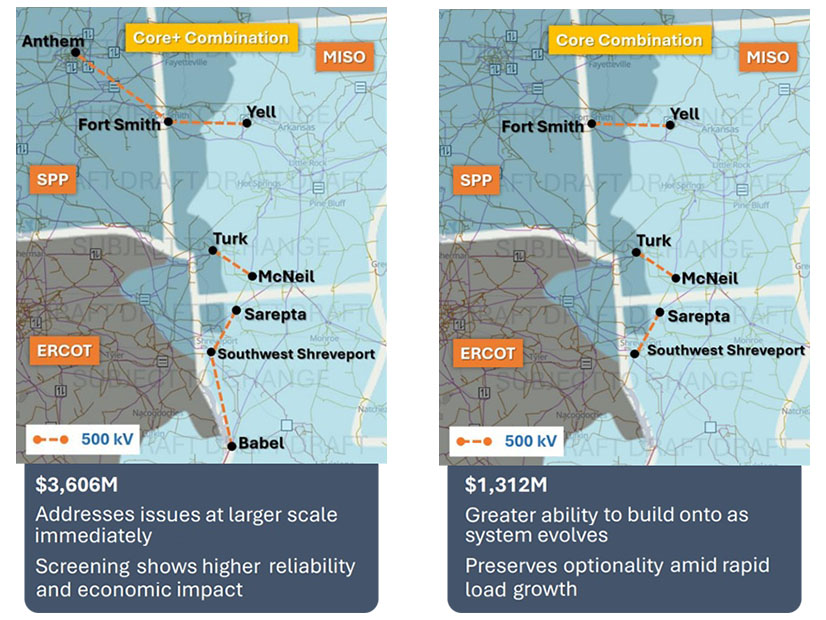
MISO and SPP put forth two potential 500-kV joint transmission portfolios valued at $1.3 billion and $3.6 billion to beef up their transfer capability.
The grid operators dubbed the two transmission options the “Core Combination” and “Core + Combination.” The more expensive, “plus” version features two additional 500-kV segments to connect neighboring transmission facilities.
MISO and SPP debuted a first look at the potential projects along northwest Louisiana, western Arkansas and east-central Oklahoma during an interregional planning meeting March 6.
The Core + Combination’s five 500-kV segments would:
-
- increase import capability by an average of 3,427 MW in MISO and 1,102 MW in SPP;
- resolve 94 thermal reliability violations in MISO, 75 in SPP and 32 across the tie lines; and
- offer nearly $300,000 in annual economic congestion relief in MISO, $1.5 billion in SPP and $336,000 across tie lines in a 2034 case.
The Core Combination’s three 500-kV segments, on the other hand, would:
-
- increase import capability by an average of 2,578 MW in MISO and 1,529 MW in SPP;
- resolve 53 thermal reliability issues in MISO, 89 in SPP and six across the tie lines; and
- extend nearly $83,000 in economic congestion relief in MISO, $895,000 in SPP and nearly $304,000 across tie lines in 2034 alone.
Ashleigh Moore, of MISO’s interregional planning division, said the larger upfront investment from the Core + Combination would establish a “broader” transmission solution set that would address more reliability and economic issues immediately, while the Core Combination would create “foundational upgrades” with the flexibility to add on more projects later.
Moore said the RTOs would use stakeholder feedback to decide which configuration to pursue and how to refine it.
MISO planner Jon George said the portfolio suggestions home in on the “hottest spots in the footprint for load expansion.”
The RTOs have not conducted a benefit-cost analysis on either option.
Benefits Pending
Missouri Public Service Commission economist Adam McKinnie asked if the RTOs have settled on what benefit metrics they would use to justify investment in the lines.
George said those are “not completely” worked out.
Southern Renewable Energy Association Transmission Director Andy Kowalczyk asked if the RTOs would use the seven transmission benefits established in FERC Order 1920 to gauge project usefulness.
“We have some more thinking to do on that,” George said. He added that though “both regions are headed” toward adopting Order 1920 benefit metrics, MISO and SPP are for now focused on “what are the different merits of the indicators we have from the screening” and ascertaining load growth estimates.
George said the RTOs don’t want to “get hung up forever on new business case methodology if we already have a pathway.” He said they can, according to current rules, already consider adjusted production costs and reliability and public policy benefits. He said the draft projects “promise to hit on a few of those and do so impressively.”
Advanced Power Alliance’s Steve Gaw said a broader set of benefits “that support interregional transmission that we know is needed” are critically important. He said MISO and SPP’s inability to devise big-ticket, regionally cost-shared transmission projects illustrates the importance.
“I’d hate to call them failures,” Gaw said of past Coordinated System Plan studies. “I hope we can weave [benefits] in so we’re not continually deciding which to include.”
MISO and SPP’s coordinated study process has never produced a workable interregional project.
The Alliance for Affordable Energy’s Yvonne Cappel-Vickery asked MISO and SPP to consider the more expensive plus portfolio route to achieve the biggest benefits to ratepayers. But she also asked the RTOs to present business cases for both options so stakeholders don’t “miss out on hearing the full breadth” of transmission benefits.
Bill Booth, a consultant to the Mississippi PSC, said the RTOs should develop a minimum benefit threshold soon and demonstrate that projects will actually deliver savings if retail ratepayers are to pay for them over the next 40 years.
SPP engineer Spencer Magby said the RTOs combed through 46 stakeholder-originated ideas and an additional 24 alternative solutions after they opened a second proposal window. (See 30+ Projects Under Consideration in MISO-SPP Joint Tx Effort.) Magby said they focused on three key corridors and conducted three rounds of studies to come up with draft recommendations.
WEC Energy Group’s Chris Plante said he’d like to see MISO and SPP’s recent level of planning and coordination applied to the MISO-PJM seam.
MISO and SPP initiated the joint study in 2024. While it evaluates its two project options, the RTOs are launching another CSP study to take place over the remainder of 2026 and beyond. They are required by their joint operating agreement to perform a CSP study at least every two years.
Some stakeholders suggested MISO and SPP use the upcoming joint study to go a step further than the 500-kV connections and consider linking up their planned 765-kV backbone systems.