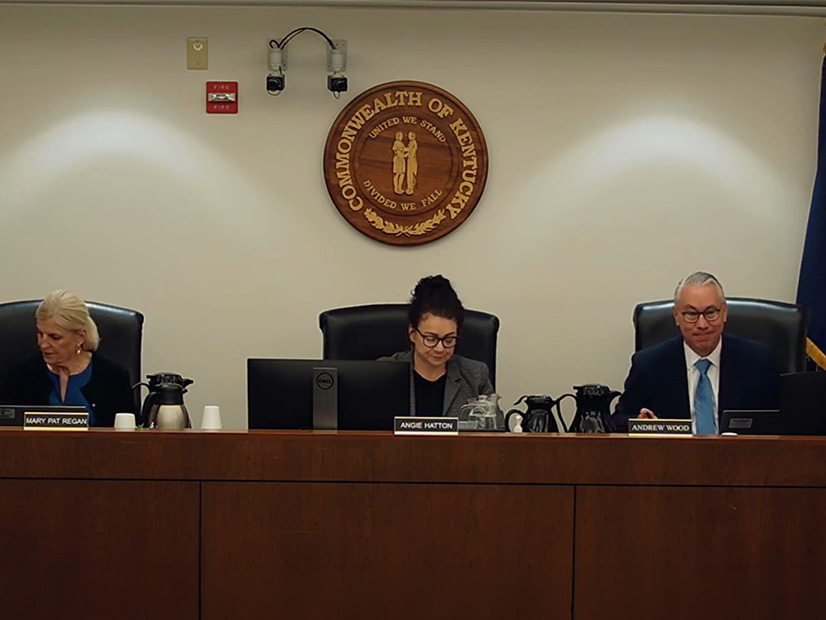
Kentucky lawmakers are working to overhaul the state’s Public Service Commission in what they say is an effort to combat rising utility rates, while Gov. Andy Beshear (D) has characterized it as political maneuvering.
The Kentucky Senate on March 6 passed Senate Bill 8, which would add two more members to the three-member PSC and impose professional qualifications on appointments, in a 30-5 vote.
Republican lawmakers say the bill would help address high utility bills by pulling in more experienced candidates.
The bill also would add new rules to the appointment process, where two members of the commission would be appointed by the state’s auditor of public accounts, currently Allison Ball (R). As it stands, Beshear holds authority to appoint all three commissioners, subject to Senate confirmation.
Sen. Brandon Smith (R), a sponsor of the bill, told local news outlets that he believes some past commissioners were appointed as political favors, with “very few” having any experience in the energy sector.
“I think we could all agree that a lot of people got parked over there,” Smith said.
But Beshear said the potential reshaping of the PSC is a partisan attempt at a power grab.
“They never did that while there was a Republican governor. … They’ve done these shenanigans for six straight years,” Beshear said during a press conference March 5. “I’ve never seen them try to move something from a Republican officeholder to a Democratic officeholder, but I’ve seen them try to move a whole lot in the other direction.”
Beshear added that the state auditor’s office has no history of working with the PSC.
At the end of February, the PSC granted a rate increase for American Electric Power’s Kentucky Power, raising electricity rates 5.87% in 2026 and increasing to 6.63% in 2027, over Attorney General Russell Coleman’s (R) objection. While the hike was less than Kentucky Power’s requested increase of 14.6%, residents said it was excessive because they already struggle to pay utility bills.
Prior to the vote, the bill shed some unpopular provisions that would have effectively expelled consumer and environmental advocates from arguing against rate increases or maintaining a thermal generation status quo.
A draft version of the bill stipulated that the office of the attorney general would be “the sole advocate for residential consumers” in cases in which it intervenes. It also would have disallowed individuals from intervening in a case “unless the person can demonstrate, by clear and convincing evidence, that the person has a special and unique interest in the specific rates or service of the utility that are at issue in the case.”
Smith said the intent was to keep out-of-state groups funded by special interests from delaying projects.
Now the bill specifies that individuals who intervene must disclose their interest in the case and attest they are not doing so for the sole purpose of delaying projects. The PSC would be able to restrict or remove parties that cause disruption or delays to proceedings.
The Sierra Club called the draft of the bill “dangerous” and said it would have “kneecapped” organizations’ efforts to “defend local people from increasingly high energy bills and corporate interests.” The nonprofit said the attorney general intervenes in nearly every case.
“Intervention by Sierra Club’s legal team has successfully mitigated bill increases for millions of Kentucky ratepayers and recently secured a tariff that guarantees data centers pay their fair share of costs and have the opportunity to secure clean energy that may help draw businesses to the state,” Sierra Club said in a statement.
In neighboring Indiana, state regulators have opened an inquiry into climbing energy bills and summoned its top five utilities to provide answers. (See Indiana Commission Opens Affordability Inquiry into Utilities.)
AES Indiana said it canceled community open houses that would have helped explain high utility bills because of violent threats it received on social media. The open houses would have occurred March 3, 10 and 11 around Indianapolis. AES announced in early March that it would be acquired by an investor group including BlackRock, Swedish private equity firm EQT AB, California Public Employees’ Retirement System and the Qatar Investment Authority. (See BlackRock and Others to Take AES Corp. Private for $33B.)