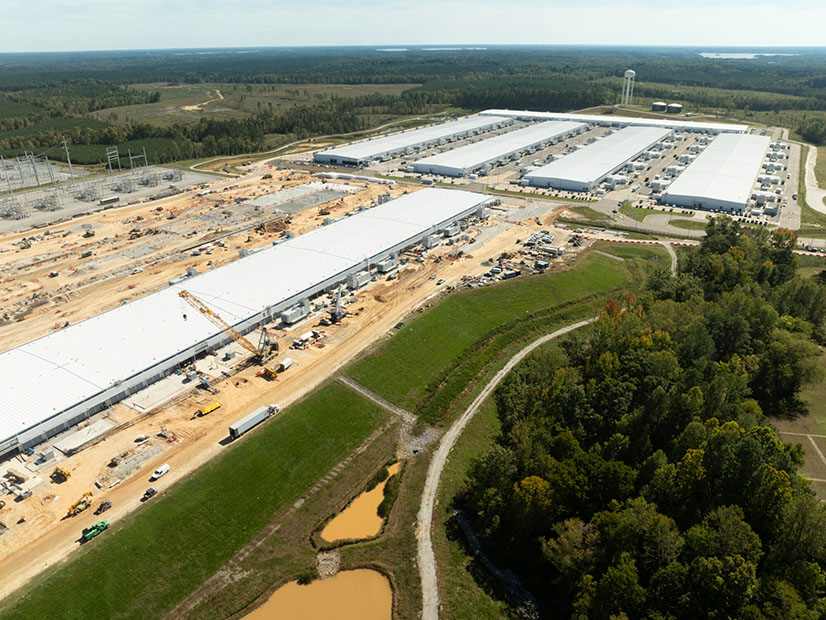
Although large loads are not new to California or the West, CAISO is formulating technical standards that address their potential boom over the coming years.
Developing the standards is a critical step to ensure artificial intelligence data center and electric vehicle large loads will reliably and safely interconnect to CAISO’s grid. The ISO established a working group on the issue in 2025 and opened a new large loads initiative Feb. 27.
“Large loads are a topic of extreme urgency and interest lately, especially with the emergence of artificial intelligence,” Danielle Mills, CAISO principal of infrastructure policy development, said at a March 10 workshop. “But we also consider large loads to be more than just data centers and AI. While data centers do present the largest use case, we are also looking at things like electric vehicle charging, electrification of buildings, and industrial processes and agricultural processes and the like.”
CAISO’s 2025/26 transmission plan shows 4.5 GW of data center capacity online currently, with an additional 1.8 GW added by 2030 and 4.9 GW more by 2040.
To submit a commentary on this topic, email forum@rtoinsider.com.
“We do proactively plan for these types of large loads through the integrated planning process with the California Energy Commission,” Mills said. “We are always trying to stay ahead of any new demand for large loads, but we are aware that this is really dynamic space right now and that we are seeing increasing numbers of large load interconnection service applications at the utilities.”
CAISO is developing a definition of what constitutes a large load and new requirements for voltage and frequency ride-throughs, along with setting limits on rapid ramping and pulsating load levels. (See CAISO Examines ‘Pulsating’ Data Center Loads.)
One topic of concern is how large loads consume power or reduce load during grid disturbances, such as during a post-fault active power recovery (PFAPR) moment.
“Our mission is to ensure large loads continue to draw power from the grid during and following grid disturbances,” Ebrahim Rahimi, CAISO senior adviser for transmission planning, said at the workshop.
During a PFAPR, large loads will be allowed to reduce their power consumption during and immediately after severe faults, Rahimi said. However, after the fault is cleared and voltage returns to normal, the power consumption from the grid should be required to recover to — or close to — pre-disturbance levels within a given time, Rahimi said.
Another concern is persistent small load fluctuations. Even modest but continuous fluctuations in load can produce voltage flicker or unacceptable variations in local power quality, CAISO staff said in a large loads issue paper.
Over time, these load fluctuations might increase mechanical fatigue in equipment, such as in rotating machines and transformers. Requirements will need to ensure that persistent small-signal load variations remain within acceptable limits, staff said.
CAISO is also following NERC’s formulation of national standards for large loads, such as for computation loads from AI training centers. Rahimi said those standards will be ready for approval at the end of 2026, and NERC plans a large load Level 3 alert in May or June.
NERC issued a Level 2 alert on the issue in 2025 and will release a related report soon. (See Panelists Say More Work Needed on Large Load Risks.)
CAISO has not yet decided where large load technical requirements ultimately will be documented and enforced, he said.
“Although we are coming up with these technical requirements … how these requirements will be documented has not been decided at this point,” Rahimi said. “The whole idea is to come up with these requirements and ensure reliability, and then at a later stage a decision will be made about where to document them.”
CAISO plans to publish a straw proposal in April that includes technical requirements, transmission service offerings and cost-allocation methods for large loads.