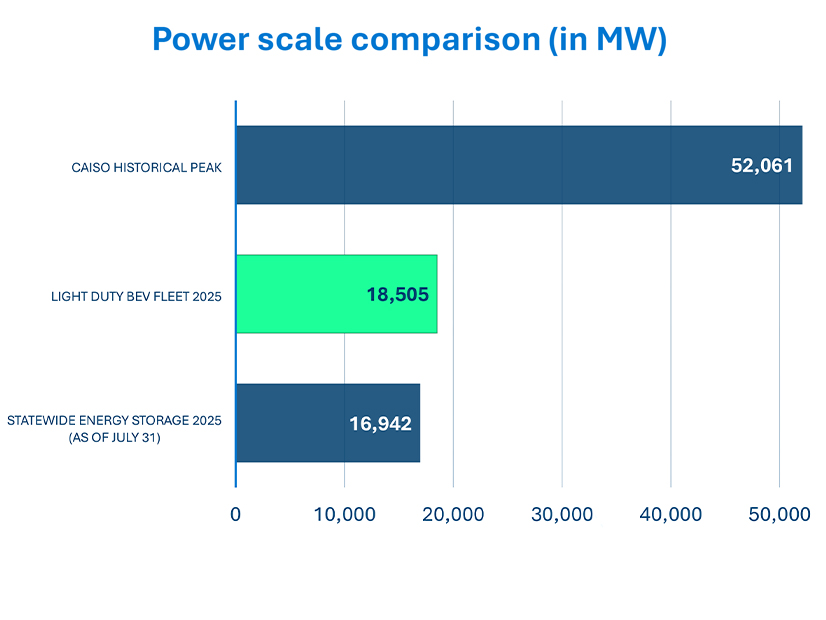
California’s historic battery storage boom over the past five years has not kept up with the state’s electric vehicle capacity growth — and now officials want to send idle EV electrons back to buildings, homes and the grid through new bidirectional chargers.
At the end of 2025, EV capacity in California reached 18.5 GW, which is more than a third of the historical peak load recorded in CAISO, Vincent Weyl, CEC principal of fuels and transportation, said at a March 12 CEC voting meeting. That figure also exceeds the state’s total stationary storage capacity of about 17 GW, including behind-the-meter storage and utility-scale storage, Weyl said.
“The opportunity and potential of bidirectional [charging] is massive and presents benefits to EV owners, grid operators and ratepayers,” Weyl said. “Of course, this resource can only be accessed when the vehicle is not driving and when the vehicle is located where bidirectional charging is possible.”
EVs could serve about 10% of California’s total residential load, he added.
To submit a commentary on this topic, email forum@rtoinsider.com.
The CEC has funded 200 bidirectional charging stations to date and is developing a program that could fund up to 18,000 new bidirectional chargers, Weyl said.
The CEC’s bidirectional charging research project is the first time a state agency has assessed the benefits of bidirectional charging for the grid, the driver and electricity consumers, CEC Commissioner Nancy Skinner said at the meeting. But much more work needs to happen for these chargers to proliferate, she said.
Many changes to rate structures and how equipment connects to the grid are needed to “compensate someone for using their EV to send power to the grid,” Skinner said.
More than half the EVs studied could participate at least weekly in a discharge event during peak hours, CEC staff found in their research. This charging frequency would reduce EV owners’ electricity bills an average of $260 to $320 from June to September.
“It is incredible how much power we have roaming around on our streets,” Commissioner Andrew McAllister said at the meeting. “If we can take advantage of even a small percentage of that at the margin, that is going to make a huge difference in our reliability profile.”
But the concept of connecting EVs to the grid has been around for more than 10 years at California’s energy agencies. In 2014, CAISO published a vehicle-to-grid road map report with support from the CEC and the California Public Utilities Commission. More recently, in February 2026, the CPUC in a resolution asked Pacific Gas and Electric to demonstrate how bidirectional EVs and electric vehicle supply equipment can provide community resiliency benefits during grid outages.
At the voting meeting, the CEC also approved Riverside Public Utilities’ (RPU) integrated resource plan. The city of Riverside plans to procure its electricity from only zero-carbon sources by 2040 and retire its gas-fired plants by the same year. Currently, about 30% of RPU’s electricity is generated by geothermal resources.
RPU’s annual demand is expected to increase from about 2,300 GWh in 2025 to more than 3,250 GWh in 2045.