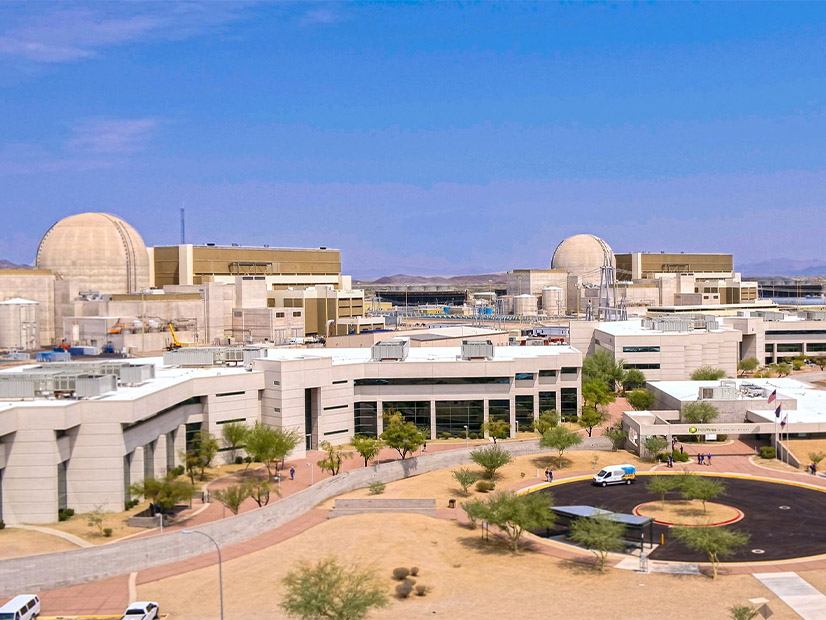
Arizona Public Service has notified the U.S. Nuclear Regulatory Commission that it plans to seek operating license renewals for all three units at Palo Verde Generating Station, potentially extending operations through the mid-2060s.
APS filed a notice of intent with the NRC on March 13, saying it will submit a Subsequent License Renewal application in late 2027. The renewal would allow Palo Verde units 1, 2 and 3 to run through 2065, 2066 and 2067 respectively.
NRC approval would extend the units’ life to a total of 80 years. APS noted that the NRC so far has renewed licenses for 80 years of operation to 10 nuclear plants across the U.S.
The three Palo Verde units, with a combined capacity of 4.2 GW, are a key piece of APS’s long-term energy strategy and central to Arizona’s grid reliability, the company said in a release.
To submit a commentary on this topic, email forum@rtoinsider.com.
“Our notice to the NRC is another step in ensuring Arizonans and the region continue to benefit from this critical resource for many more years to come.” APS CEO Ted Geisler said in a statement.
Units 1, 2 and 3 received their initial 40-year operating licenses from the NRC in 1985, 1986 and 1987, respectively. In 2011, the NRC approved APS’ request to extend the operating licenses for 20 years, through the mid-2040s.
Palo Verde is operated by APS and supplies electricity to Arizona, Texas, New Mexico and Southern California. It is owned by seven utilities: APS, El Paso Electric, Los Angeles Department of Water and Power, Public Service Company of New Mexico, Salt River Project, Southern California Edison and Southern California Public Power Authority.
Through its “subsequent license renewal” (SLR) process, the NRC conducts safety and environmental reviews for extending nuclear power plant operations for up to 80 years of operation. Public meetings are part of the process.
In addition to approved applications, the NRC is reviewing three SLR applications. Those include units 1 and 2 of Florida Power & Light’s St. Lucie plant; Unit 2 of Duke Energy’s H.B. Robinson power plant in South Carolina; and units 1 and 2 of the Edwin I. Hatch nuclear plant in Georgia. NRC also has a pipeline of notices of intent to file SLR applications.
Among the 10 nuclear plants that have been approved for 80 years of operation are Florida Power & Light’s Turkey Point units 3 and 4. The approval, received in 2024, allows the units to run through 2052 and 2053.
Units 2 and 3 of Peach Bottom Atomic Power Station, co-owned and operated by Constellation Energy Generation in York County, Pennsylvania, received approval to operate through 2033 and 2034.
Arizona’s Nuclear Future
Besides seeking license extensions for Palo Verde, APS has teamed up with two other Arizona utilities — Salt River Project and Tucson Electric Power — to explore additional nuclear generation in the state. In 2025, they applied for a U.S. Department of Energy grant to evaluate potential nuclear sites. (See Arizona Electric Utilities Team Up to Pursue Nuclear.)
The funding is available through the Generation III+ Small Modular Reactor program in the DOE’s Office of Clean Energy Demonstrations. The utilities are applying for funding in the “fast follower” category, which will provide up to $100 million to address hurdles the U.S. nuclear industry has faced in areas such as design, licensing, supply chain and site preparation. Awardees must match the DOE funding.
Tier 1 award recipients were announced in November 2025. (See DOE Awards Holtec, TVA $800M to Build Pioneering SMRs.)
Tier 2 applicants, including APS, are still waiting to hear if they’ll receive funding. But initial project planning has begun, including the hiring of a project manager, APS Senior Director Brad Berles told the Arizona Corporation Commission during a February workshop on nuclear power.
APS continues to evaluate nuclear technologies and hasn’t yet settled on a specific option.
“We know there’s a large demand growth that we need to meet,” Berles said.