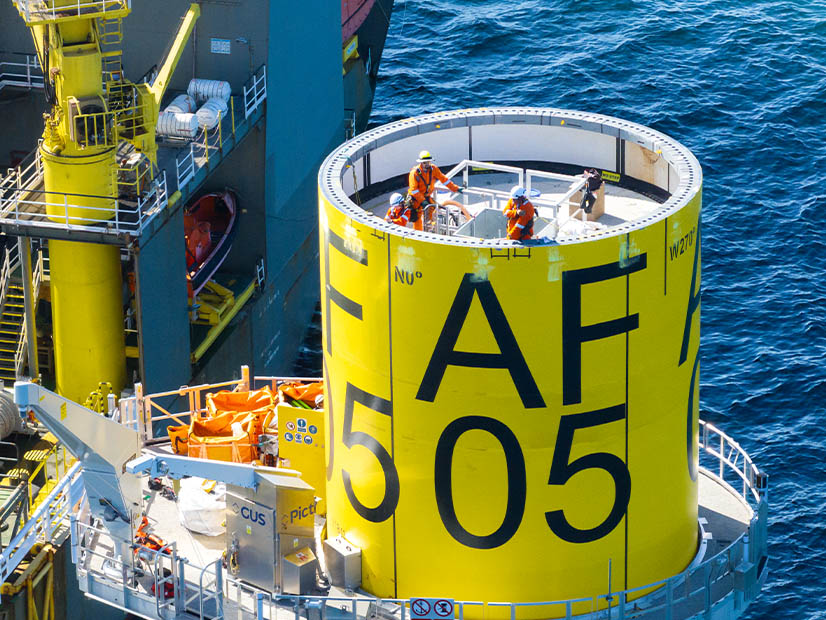
One New England offshore wind farm has completed construction, and another has begun sending electricity ashore as it finishes construction.
With a combined nameplate capacity of 1,510 MW, Vineyard Wind and Revolution Wind are expected to provide an important boost to the ISO-NE grid.
But both projects have faced delays and interference reaching their respective milestones, including two federal stop-work orders each — one from equipment problems, and three as part of the Trump administration’s ongoing campaign against offshore wind development. Whether the administration might take steps against completed wind farms remains to be seen.
Vineyard announced installation of the final turbine blades the evening of March 13, marking the completion of offshore construction.
Also on March 13, Revolution announced it had begun delivering electricity. Coincidentally, that date was the deadline for the Trump administration to appeal a federal judge’s Jan. 12 stay of a Bureau of Ocean Energy Management stop-work order against Revolution. BOEM did not appeal.
Vineyard put its first steel in the water in June 2023 and exported its first electricity to Massachusetts in January 2024. But the 806-MW project took a sharp turn for the worse later that year when a blade disintegrated, showering debris into the oceans and then onto beaches. An investigation revealed manufacturing flaws; work was slowed or halted while replacement blades were installed.
The 65-turbine, 704-MW Revolution Wind began construction in 2023 but ran into cascading delays even before President Donald Trump returned to office. Then late in 2025, as the project was nearing completion, BOEM shut it down along with the four other projects under active construction in U.S. waters.
One by one, judges lifted all of those stop-work orders. (See With Sunrise Wind Ruling, OSW Industry now 5-0 Against Trump Admin.)
Now that electrons have begun flowing to Connecticut and Rhode Island, Revolution will be scaling up generation in the days and weeks to come, an Ørsted spokesperson said March 16.
An ISO-NE spokesperson said March 16 that Revolution is one more asset for a region that needs new power resources: “Last week, Revolution Wind delivered power to New England’s regional grid, as part of the commissioning and testing process. Through the wholesale markets administered by the ISO, Revolution Wind has committed to helping meet New England’s demand for electricity, which is forecasted to grow approximately 11% over the next decade.”
Vineyard and Revolution would not say how much electricity they are sending ashore, and ISO-NE said it could not, citing confidentiality rules. An industry advocate previously said Vineyard sent as much as 600 MW to the strained New England grid during a major winter storm in January.
As of 5 p.m. March 16, the RTO’s ISO Express dashboard indicated wind turbines were producing a total of 1,066 MW, or 66% of the renewable resource mix. System load was 14,473 MW.
Natural gas (6,735 MW) and nuclear (3,358 MW) accounted for the bulk of resources. Net imports (1,623 MW) were a bit ahead of wind power, and hydro (982 MW) was a bit behind.
In 2025, wind provided 4,618 GWh of electricity to the ISO-NE grid, which was 4.1% of generation and 3.9% of net energy for load. Solar was slightly higher: 4,836 GWh, 4.3% and 4.1%, respectively.
U.S. Sen. Sheldon Whitehouse (D-R.I.) was among those cheering the news about Revolution powering up.
“When Rhode Island families pay their utility bills, they will be grateful to Ørsted and the resilient union workers who got this project over the finish line,” said Whitehouse, who brought a union apprentice electrician helping build Revolution to Trump’s 2026 State of the Union Address. “Power from Revolution Wind will make our grid more reliable in the winter and reduce Rhode Islanders’ energy costs for years to come.”