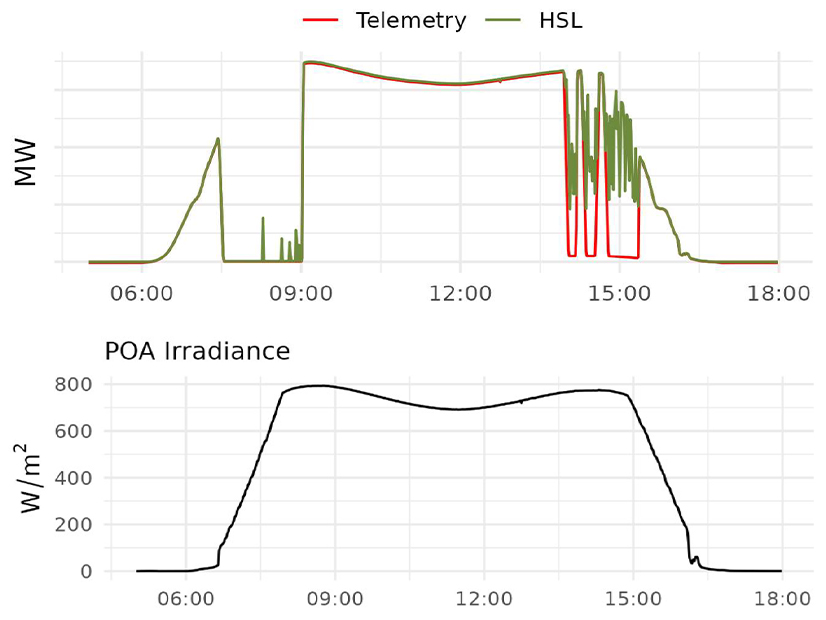
CAISO is proposing new methods to address “poor-quality data” from some variable energy resources in its markets to improve grid forecasting, the ISO said in a March 9 straw proposal.
California and the West each year rely increasingly on variable resources such as solar and wind, with 93% of California’s energy coming from these two resources on March 16, for example.
Grid forecasting requires accurate data from variable resources, but CAISO has observed significant differences between a resource’s high sustainable limit and its generation data. This discrepancy indicates that some resources are submitting poor-quality data, specifically high sustainable limit data, the ISO said in the proposal.
A resource’s “high sustainable limit” is the generation capacity of the resource after accounting for weather. For example, a 10-MW solar facility that generates 8 MW on a sunny day has a high sustainable limit of 8 MW. But on a cloudy day, the facility might generate 5 MW, so its new high sustainable limit is 5 MW.
To submit a commentary on this topic, email forum@rtoinsider.com.
High sustainable limit data is associated with co-located variable energy resources and renewable components of hybrid resources. Firm resources, such as gas and nuclear, are minimally affected by weather.
High sustainable limit data is useful for grid forecasting because it is unimpacted by economic and operational conditions, CAISO staff said in the proposal. In CAISO and the WEIM, all variable energy resources providing ancillary services and all hybrid variable energy components must submit high sustainable limit data, staff said.
CAISO uses a resource’s high sustainable limit data to calculate real-time dispatch and pre-dispatch forecasts. If this data is not accurate, the ISO’s real-time forecast accuracy decreases, leading to inefficient dispatch by overestimating or underestimating a resource’s true generation potential, staff said.
Because data quality is inconsistent across resources, the ISO cannot systematically correct for poor data quality, they said in the proposal.
In CAISO’s initiative on the subject, some stakeholders suggested the ISO — rather than the resource owner — calculate a resource’s high sustainable limit. But CAISO noted that shifting calculation responsibility would not address the overall concerns with data quality.
“An ISO-calculated high sustainable limit would still rely on the quality of data provided by the resource,” staff said. “In addition, the ISO does not have visibility to all operational factors that could impact high sustainable limit, such as the status of an inverter.”
To improve high sustainable limit data, CAISO proposed to provide a new, clearer definition of what good quality data looks like. The ISO also provided an example methodology for solar resource owners to calculate their high sustainable limit data more accurately. Though the example methodology serves as “guidance,” other ways of calculating high sustainable limit data could meet data quality requirements too, staff said.
Stakeholder feedback on CAISO’s straw proposal is due March 30.