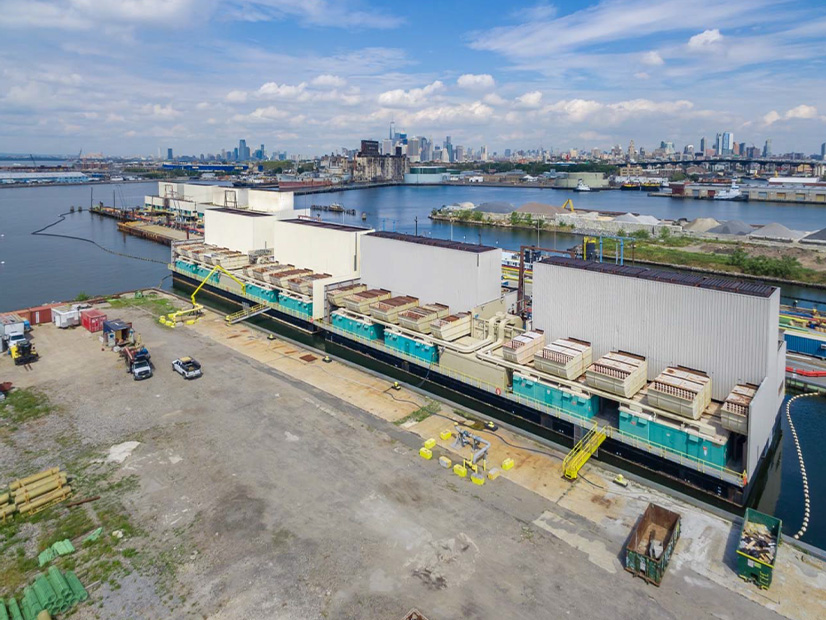
Alpha Generation, owner and operator of the Gowanus and Narrows floating power plants in New York City, has proposed replacing the six peaking units with three lower-emitting ones in response to Consolidated Edison’s solicitation for solutions to the city’s reliability need.
Con Ed had issued a request for information after the New York Public Service Commission directed it to address the NYISO-identified shortfall with non-emitting resources only. (See N.Y. PSC Directs Con Edison to Create Plan to Avert Energy Shortfall.)
The Gowanus and Narrows plants in Brooklyn have been slated for retirement since the state instituted an emissions standard for peaking plants, but the dates have been repeatedly pushed back, as NYISO has said they are needed for reliability. The plants are currently slated for retirement May 1, 2027, but AlphaGen said it expects the ISO to once again determine they are needed for reliability and extend their operation for an additional two years.
“Given tightening resource adequacy margins and uncertainty around the timing of replacement resources capable of delivering equivalent reliability services, AlphaGen anticipates these units will likely be needed even longer,” the company said in a news release. The proposed new units would each deliver 273 MW of fast-start, dispatchable power and produce 50% fewer emissions compared to the existing units.
“Repowering recognizes the realities of current power technology and the need to balance reliability with sustainability,” AlphaGen CEO Curt Morgan said in a statement. “It is not intended to be an affront to the [state’s emission-reductions goals] or the commission-initiated RFI process, which seeks non-emitting solutions, but to start a conversation about supporting cleaner technology as a bridge to a zero-emissions future.”
The proposal also includes the development of a 150-MW/600-MWh battery storage facility at Gowanus, as well as two batteries at the Astoria plant in Queens totaling 126 MW/504 MWh.
“Battery energy storage systems are a critical complement to the repowering projects,” the company said. “While the repowered barges provide fast-start, dual-fuel, dispatchable capacity for extended-duration events, batteries offer near-instantaneous response to short-term fluctuations in demand and frequency.”
But Elizabeth Yeampierre, executive director of Brooklyn-based environmental justice group UPROSE, told RTO Insider that AlphaGen’s proposal was to “justify the continued toxic exposure of Sunset Park under the language of reliability.”
“There is nothing ‘forward-looking’ about doubling down on false solutions,” Yeampierre said. “This is not a bridge — it is a misleading dilatory tactic that undermines the health of our children and elders.”
The case is a microcosm of the fight over energy priorities in New York. Gov. Kathy Hochul has signaled she is open to amending the state’s climate law but hasn’t explained what that would entail, according to New York Focus. In December 2025, the Hochul administration approved a new State Energy Plan embracing an “all of the above” approach to energy policy. (See N.Y. Embraces All of the Above in Energy Strategy Update.)
Hochul’s office declined to comment. Con Ed did not reply to requests for comment.