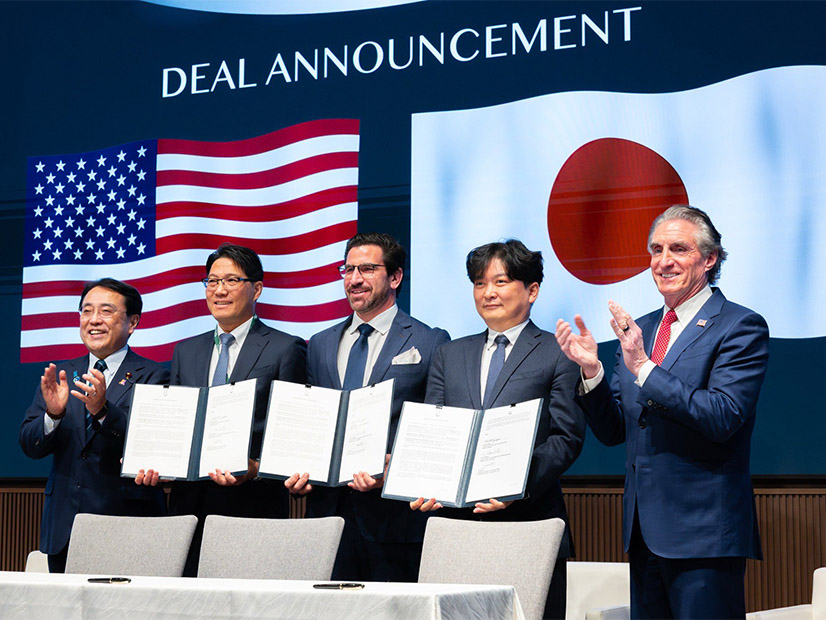
The Trump administration announced energy, technology and resource deals worth $56 billion stemming from an Asia-Pacific energy summit.
The announcements include expansion of the U.S. LNG sector, procurement of small modular reactors and a new U.S. coal-fired power plant.
The Indo-Pacific Energy Security Ministerial and Business Forum brought representatives from 17 countries to Tokyo March 14 and 15. U.S. officials framed the results as a boost for the American workforce and a step toward President Donald Trump’s vision of U.S. energy dominance.
The list of agreements announced by the U.S. Department of the Interior is lengthy due to the number of deals included rather than the level of detail provided.
Some of the parties involved elaborated in their own announcements. Others did not.
Details were minimal on the $1 billion agreement in principle between Terra Energy Center and Hyundai Heavy Industries Power Systems to provide boilers for a new 1.25-GW coal-fired power plant in Alaska. KOREIT committed a $500 million equity investment.
Interior said it was the first utility-scale announcement of its kind since approximately 2006. If it comes to pass, it will prove wrong many experts, observers and pundits who predicted no new coal plants would be built in the U.S. because of regulatory risks under future Democratic administrations and uncompetitive operating costs.
The department’s announcement framed it as part of America’s “Big Beautiful Coal” resurgence, one of Trump’s regular talking points. If a resurgence happens, it would mark the end of a steep and sustained decline: U.S. coal power generation dropped from 2,016 TWh in 2007 to 652 TWh in 2024 as plants were run less often or retired in the face of stricter emissions controls, cheaper natural gas generation and proliferating renewables.
The most recent new U.S. coal plant was the 900-MW Sandy Creek Energy Station in Texas, which began construction in 2008 and started commercial operation in 2012.
Other announcements ranged from letters of interest to binding commitments covering a wide range of technologies. LNG figured prominently in the Interior announcement and in the $56 billion tally:
-
- Venture Global closed an $8.6 billion final investment decision for the CP2 LNG facility in Louisiana, bringing total financing to $20.7 billion.
- Venture Global and Hanwha Aerospace executed a 20-year purchase agreement valued at about $10 billion for 1.5 million tons of U.S. LNG per year starting in 2030.
- The Export-Import Bank of the United States (EXIM) issued a term sheet for the $14 billion Delfin LNG project, a proposed 13-million-ton per year offshore facility that would be the first floating export terminal in the U.S.
Advanced nuclear deals announced included:
-
- X-Energy and Doosan Enerbility struck a binding agreement to manufacture 16 main power systems for X-Energy’s Xe-100 SMR and to build the world’s first dedicated fabrication facility for the reactors.
- Holtec International, Mitsubishi Electric and Hyundai Engineering & Construction entered a memorandum of understanding to jointly deliver the first two units of Holtec’s SMR-300 in Michigan and to deploy more SMR-300s across the Indo-Pacific region.
- GE Vernova and Hitachi agreed to advance market development and commercial opportunities for deployment of their BWRX-300 SMR in Southeast Asia.
Other announcements included:
-
- LG Energy Solution and Tesla reached a supply agreement to build a $4.3 billion lithium-iron-phosphate prismatic battery cell factory in Michigan that will supply Tesla’s Megapack 3 energy storage systems.
- The U.S. and South Korea are exploring a critical minerals memorandum of understanding.
- The U.S. Trade and Development Agency (USTDA) awarded an unspecified grant to PT Geo Dipa Energi supporting a pilot project to assess viability of U.S. ion-exchange technology from Lilac Solutions.
The USTDA organized the summit. The U.S. delegation was led by Interior Secretary Doug Burgum, who also is chair of the National Energy Dominance Council (NEDC); EPA Administrator Lee Zeldin; EXIM President John Jovanovic; NEDC Director Jarrod Agen; and USTDA Deputy Director Thomas Hardy.