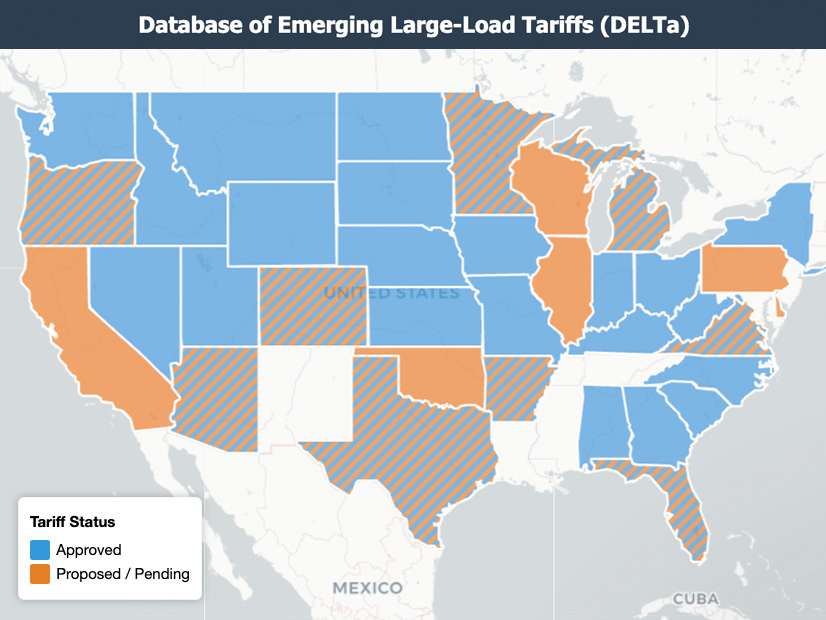
The Smart Electric Power Alliance’s update to its Database of Emerging Large-Load Tariffs (DELTa) shows how much the concept is spreading for utilities as state regulators grapple with a surge in load growth driven by new large customers.
SEPA created DELTa in partnership with the North Carolina Clean Energy Technology Center to track the proliferation of utility tariffs for large load customers after hearing interest from its members that include utilities, regulators and tech companies, SEPA’s Anne Collier said during a March 30 interview with RTO Insider.
“Everyone would like to know what are the solutions and strategies they have to meet load growth in a way that not only protects existing customers from some of the cost or reliability risks that we’ve seen come out in other papers, but also, to look proactively at this as a moment to do something good for the grid and to improve service to everyone,” Collier said.
The database, which anyone can download, shows 77 large load tariffs either in place or being considered at utilities around the country. Only 12 states neither have adopted nor are considering such a tariff.
Users can break down the data by whether the tariff has been approved and what kind of customers it applies to, by types like data centers or general commercial and industrial customers, and by how big a customer needs to be to qualify.
To submit a commentary on this topic, email forum@rtoinsider.com.
While hyperscalers have dominated headlines, just five states have large load tariffs that kick in at 100 MW or greater: Georgia, Kentucky, Michigan, Missouri and West Virginia. Florida, Minnesota, Virginia and Wisconsin are considering specific rules for customers at or above 100 MW.
Some states have found that the standard way of dealing with larger commercial and industrial customers with conventional tariffs and electric service agreements continues to work for them, Collier said.
“Of the states that are in DELTa, we see interest really accelerating,” Collier said. “It’s this hockey stick inflection point for the regulatory industry right now where we have 77 tariffs and service rules in DELTa right now with this quarterly update, and 29 of those were approved last year alone.”
The tariffs blend longtime principles used in traditional utility ratemaking with new contractual mechanisms that are seen as helpful for large customers participating in emerging industries, she added.
Before 2025, most tariffs SEPA was tracking were for smaller customers — applying to facilities with demand of 5-10 MW.
“Now we’re seeing that load threshold increase sort of in parallel with the emergence of hyperscale and frontier data centers,” Collier said. “So, thinking around what is large and what requires this new way of contracting for service is starting to change.”
Most of the tariffs characterize large loads by their size and load factor, but some get more specific and are aimed at specific types of customers, such as data centers or crypto miners. Other changes are designed to require data center projects to provide upfront interconnection deposits meant to weed out speculative projects shopping for the best, cheapest connections to the grid.
“We’re also seeing provisions that are meant to provide increased certainty to the utility over the long term,” Collier said. “So, contractual timelines and take-or-pay contracts terms where they’re used, they tend to settle in that 75-to-85% range.”
Other terms include different financial security provisions meant to limit the risks of stranded costs in the event of an economic downturn, or whatever causes a large customer to shut down before completion of the useful life of infrastructure built to serve it.
“The process of utility ratemaking is an art and a science,” Collier said. “And it’s not for me to really say how precise the science is going to be able to get here. But I know from broad conversations with utilities, with those in the regulatory community, and with those at data centers and large customers, that there is shared interest in figuring this out so that the degree of error is minimized. So, we’re looking for a risk-minimization approach here.”