

Despite a few large storms in January and February, snowpack levels in California are approaching record lows due to a heat dome that settled over the state in March.
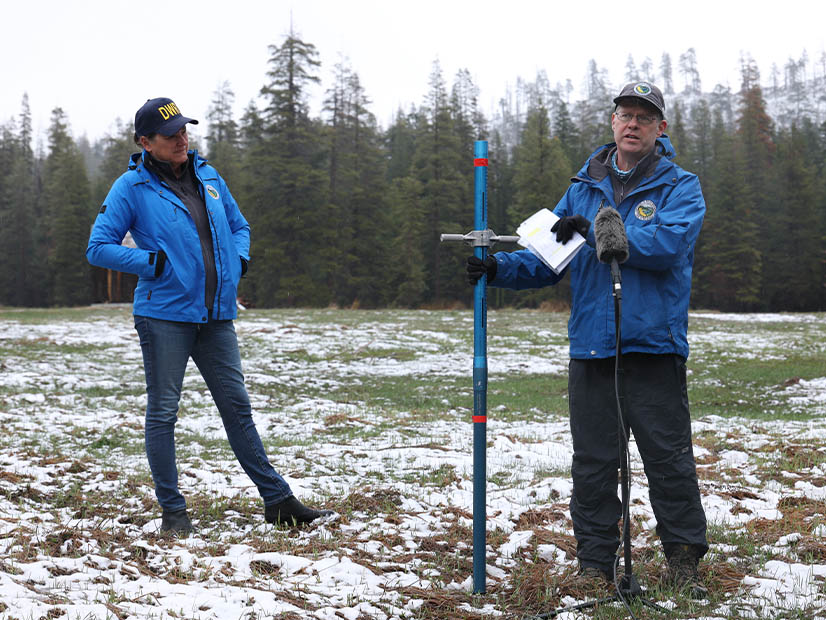
The California Department of Water Resources (DWR) on April 1 found nothing when it measured the snowpack at Phillips Station in El Dorado County.
“We measured today, but there was actually no measurable snow … so we are calling today’s measurement 0 [inches],” Andy Reising, manager of snow surveys and water supply forecasting at DWR, said during a press conference held from the station on April 1.
In an average year, the snowpack depth at Phillips Station measures about five feet, with about three feet of snow and two feet of water below the snow. The zero-inch measurement represents the second-lowest April 1 measurement at the station in DWR’s history, Reising said, given that there was a trace amount of snow on the ground.
Snowpack levels typically peak around April 1, but the heat dome in March caused large snowmelt to start about two months early.
DWR Director Karla Nemeth called the measurements “one of the quickest snow surveys we’ve had and maybe one where people could actually use an umbrella.”
“That’s just the reality that we’re living in,” she said.
Most of the state’s precipitation in 2026 has come as rain, Nemeth said. The combination of rain, limited snow and warmer weather in March is “setting us up for what will be a challenging year for water management in the state,” she said.
Snowpack across the state is just 18% of average for April 1, DWR said in a news release. The snowpack fulfills about 30% of California’s water usage and is sometimes called the state’s “frozen reservoir,” DWR said.
However, there is fortunate news: California’s reservoirs are nearly full, Nemeth said.
“But what we have in our reservoirs is what we have. We have to manage that really for the next six months or so until we hit October,” she added.
Rivers in California are currently running higher than average due to the early snowmelt. Much of the snow runoff cannot be stored, however, because reservoirs are full and must keep some room to protect communities from flooding in the event of late spring rains. The state lacks the right infrastructure to convey early-season runoff into underground aquifers, DWR said.
CAISO relies on hydropower supplied by DWR’s State Water Project (SWP). The SWP has five hydroelectric generating plants and four hybrid plants, which generate about 6 billion kWh/year.


